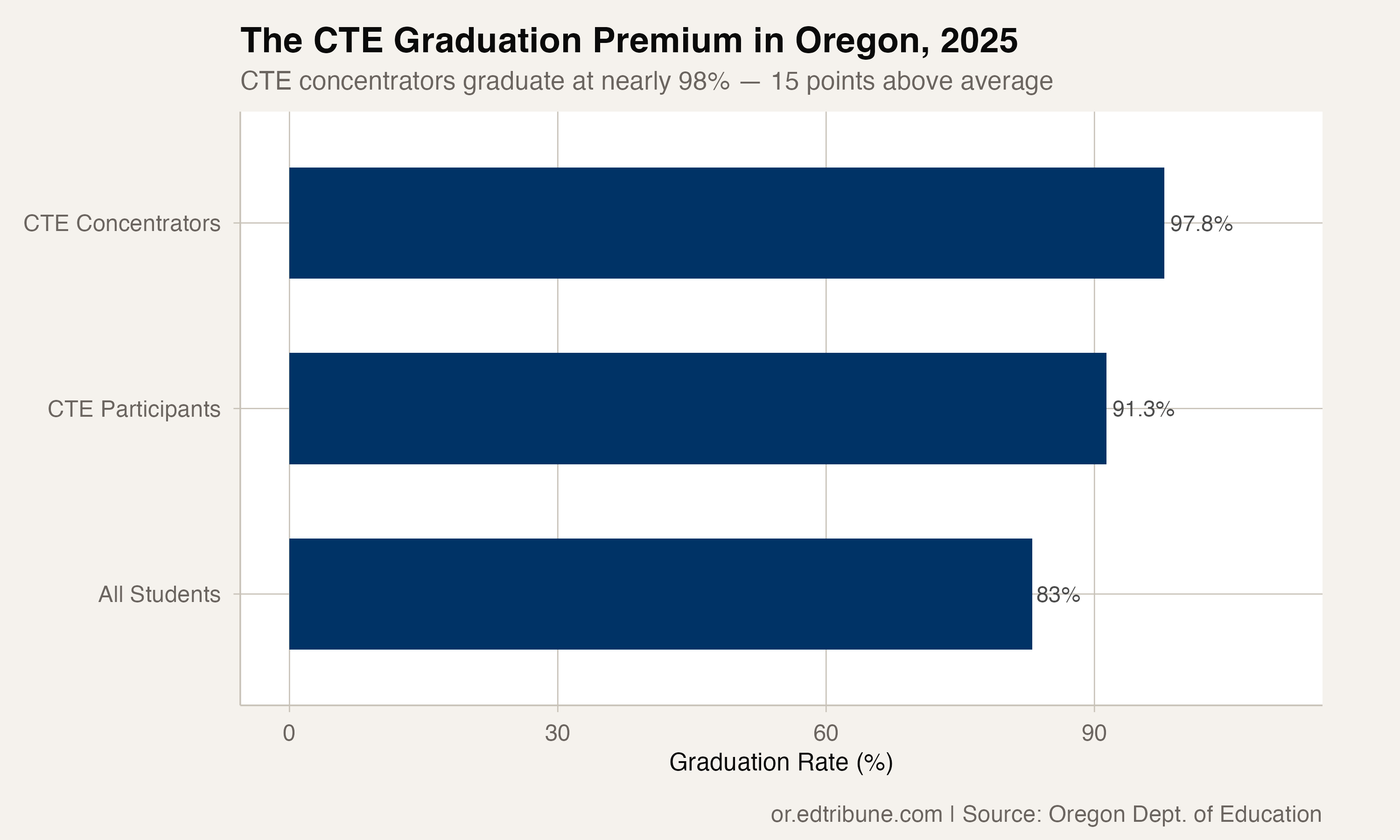
Oregon students who complete a Career and Technical Education concentration graduate at 97.8%. That rate, for the Class of 2025 across 13,904 students, is not a typo. It is nearly 15 percentage points above the statewide average of 83.0%.
Even students who participate in CTE courses without concentrating graduate at 91.3%, eight points above average. The "CTE premium" in Oregon is one of the clearest patterns in the state's graduation data.
The Numbers
Oregon began reporting CTE graduation rates in 2024. The data for both available years tells a consistent story:
| Year | CTE Concentrators | CTE Participants | All Students |
|---|---|---|---|
| 2024 | 97.7% (12,752) | 90.3% (36,075) | 81.8% (47,430) |
| 2025 | 97.8% (13,904) | 91.3% (37,041) | 83.0% (48,563) |
CTE concentrators, students who complete a defined sequence of courses in a specific career pathway, are the highest-graduating subgroup in Oregon's data. They outperform Asian students (92.3%), white students (84.5%), and even the "talented and gifted" subgroup (96.9%).
Selection Bias or Causal Effect?
The 97.8% rate invites a straightforward question: does CTE cause better graduation outcomes, or do students who are already likely to graduate self-select into CTE pathways?
The honest answer is both. Students who complete multi-year CTE concentrations are by definition engaged in school. They chose a pathway, stuck with it through multiple semesters, and accumulated credits. Those behaviors strongly predict graduation regardless of the specific coursework.
But the CTE effect is not purely selection. National research, including the Association for Career and Technical Education's review of longitudinal studies, consistently shows that CTE participation is associated with higher graduation rates even after controlling for baseline academic performance. The mechanism is straightforward: CTE provides a tangible connection between school and future employment, which sustains motivation through the years when dropout risk peaks.
The Scale
More than 37,000 Oregon students, 76% of the graduating class, participated in at least one CTE course. Nearly 14,000 concentrated. Oregon has more than 450 CTE certificate programs statewide, spanning healthcare, manufacturing, information technology, agriculture, and the trades.
The scale means this is not a boutique program serving a narrow population. Three in four Oregon graduates touch CTE in some form. The gap between participation (91.3%) and concentration (97.8%) suggests the programs work best when students commit to a full pathway, not just a single elective.
What 97.8% Means for Policy
When a student subgroup graduates at 97.8%, the policy implication is that the pathway is functioning as intended. Nearly every student who engages deeply with CTE finishes high school.
The corollary is also important: the 24% of students who do not participate in any CTE course graduate at rates well below the CTE population. Oregon's data does not break out non-CTE students separately, but the math implies a rate somewhere around 55-60% for students with no CTE participation.
For a state that has suspended its essential skills testing requirement and is debating what graduation should mean, CTE concentration offers a data-backed answer: students who complete structured career pathways almost universally finish high school.
Data Source
This analysis uses four-year adjusted cohort graduation rate data published by the Oregon Department of Education. CTE graduation data is available for the Classes of 2024 and 2025 only.
Detailed code that reproduces the analysis and figures in this article is available exclusively to EdTribune subscribers.
Discussion
Sign in to join the discussion.
Loading comments...