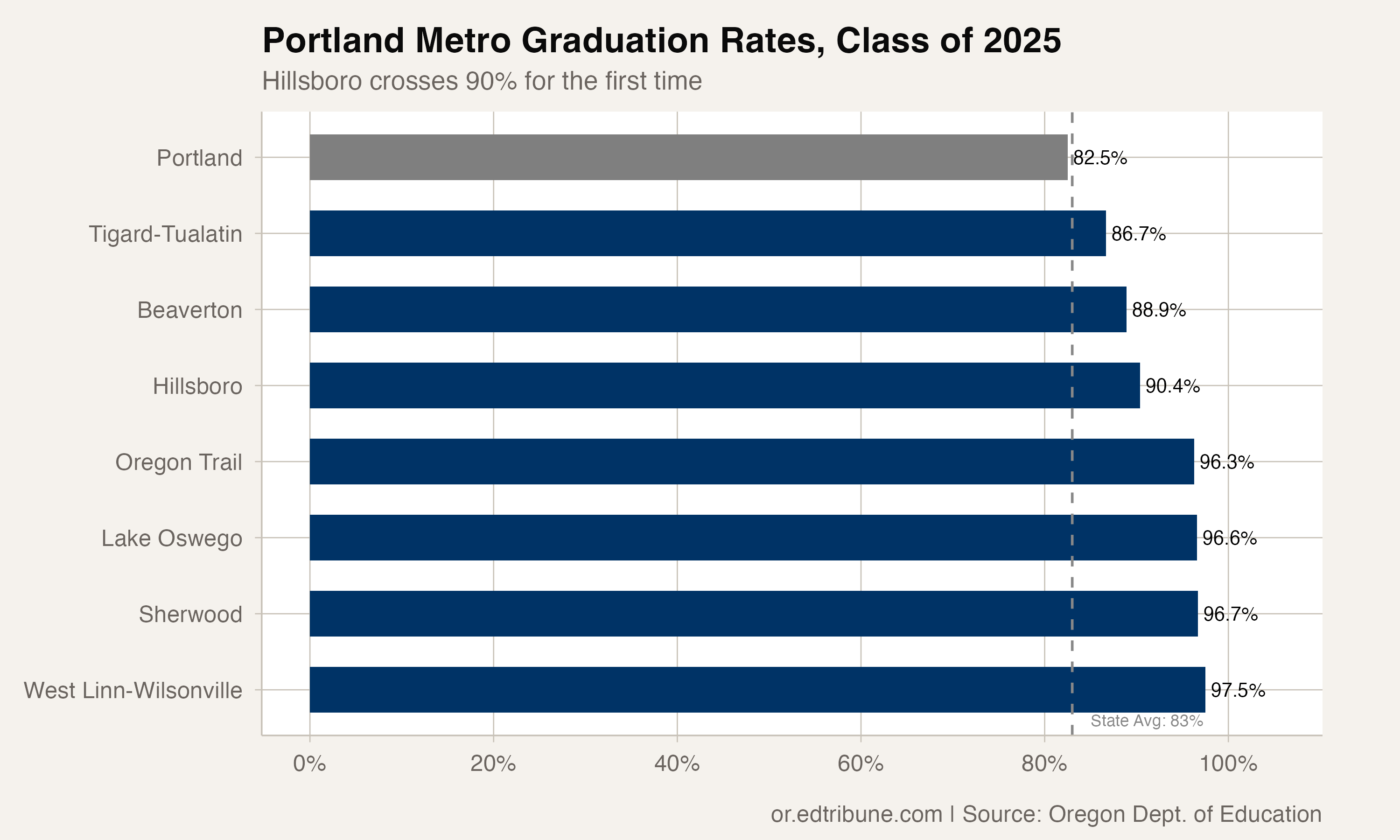
Hillsboro SD 1J↗ET graduated 90.4% of its students for the Class of 2025, crossing the 90% threshold for the first time in the district's recorded history. With 1,651 students in the cohort, it is the largest Oregon district to reach that mark.
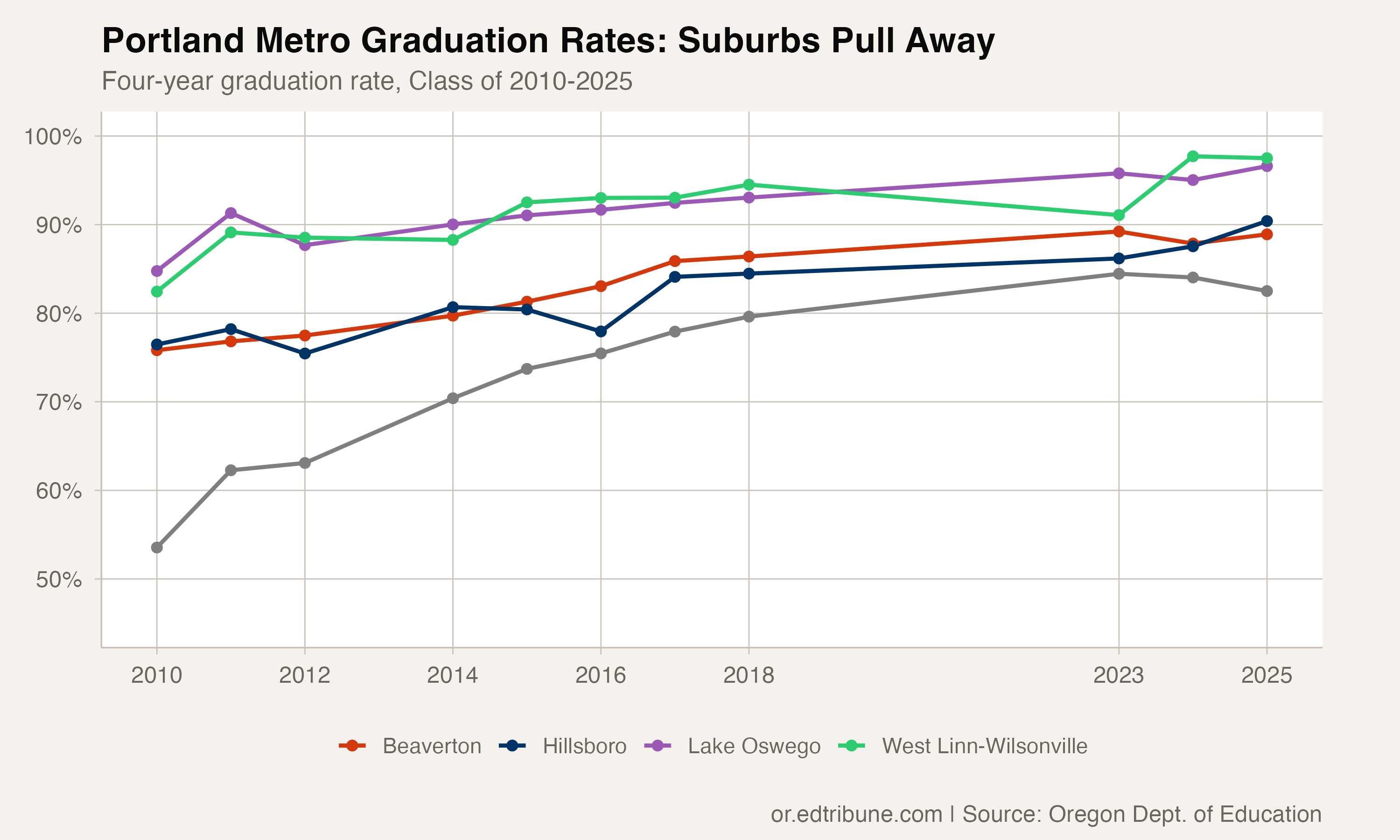
The milestone crystallizes a broader pattern in the Portland metro area: the suburbs are pulling away from the city on graduation.
The suburban ring
Five Portland-area suburban districts now graduate above 90%, four of them above 96%:
| District | Graduation Rate | Cohort |
|---|---|---|
| West Linn-Wilsonville | 97.5% | 831 |
| Sherwood | 96.7% | 397 |
| Lake Oswego | 96.6% | 593 |
| Oregon Trail | 96.3% | 354 |
| Hillsboro | 90.4% | 1,651 |
| Beaverton↗ET | 88.9% | 3,267 |
| Tigard-Tualatin | 86.7% | 999 |
| Portland↗ET | 82.5% | 3,797 |
The gap between West Linn-Wilsonville↗ET at the top and Portland at the bottom is 15 points. Even Beaverton, which like Hillsboro serves a diverse, mid-income suburban population, outpaces Portland by 6.4 points.
Portland's 82.5% rate is itself a 29-point improvement from 53.5% in 2010. But the city peaked at 84.4% for the Class of 2023 and has declined for two consecutive years. The suburbs, meanwhile, continued climbing.
Hillsboro's path
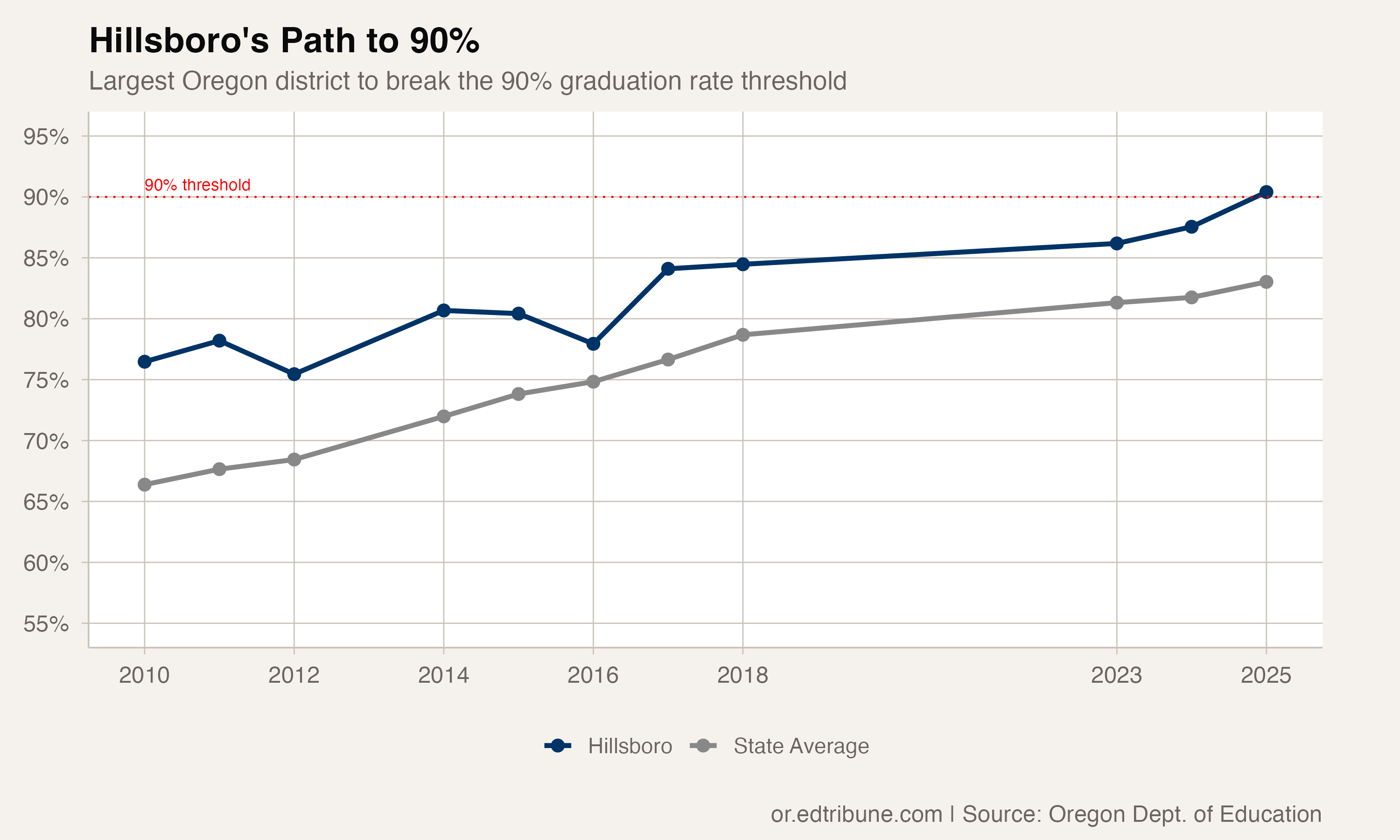
Hillsboro's ascent to 90% was not sudden. The district graduated 76.5% of its students in 2010 and has improved in nearly every reporting year since. The trajectory is steady: 76.5% to 80.7% (2014), to 84.5% (2018), to 86.2% (2023), to 90.4% (2025) -- a nearly 14-point gain over 15 years.
The district is not a wealthy enclave. Hillsboro is a working- and middle-class suburb anchored by Intel's semiconductor campus and a substantial agricultural sector. The student body is racially diverse -- the graduating class includes significant Hispanic and Asian populations alongside a white plurality.
That Hillsboro crossed 90% with this demographic profile matters. Lake Oswego↗ET at 96.6% is one of the wealthiest communities in Oregon. West Linn-Wilsonville is similarly affluent. Hillsboro's achievement comes without those economic advantages.
What Portland's dip suggests
Portland's two-year decline, from 84.4% to 82.5%, is small in absolute terms but directionally concerning. The state average rose from 81.3% to 83.0% over the same period. Portland was above the state average in 2023; it is now below it.
The district's challenge is one of internal gaps. Portland's white students graduate at 88.5%, its Asian students at 87.5%. But Black students graduate at 71.8%, Hispanic students at 70.4%, and Native American students at 47.6%. Those subgroup rates pull the overall average down in ways that the more homogeneous suburbs do not face.
The suburban districts are not gap-free. Hillsboro, Beaverton, and Tigard-Tualatin all serve diverse populations with their own internal disparities. But the overall rates suggest that suburban systems are either starting from a higher floor or doing something differently in how they support students across demographic lines.
The structural question
The Portland metro graduation landscape raises a familiar structural question: does the suburban advantage reflect what happens inside schools, or does it reflect who lives where?
Families with means choose communities with strong schools. Students whose families can provide stable housing, consistent transportation, and after-school support are more likely to graduate. When those families concentrate in certain districts, the graduation rates in those districts rise without the schools necessarily doing anything different.
But the suburban advantage is large enough, and growing enough, that it cannot be entirely structural. Hillsboro's steady climb from the mid-70s to 90% over 15 years reflects sustained institutional effort, not demographic sorting alone. Portland, meanwhile, has slipped below the state average for two consecutive years while its suburbs keep climbing.
Four-year adjusted cohort graduation rate data from the Oregon Department of Education. Data covers the Class of 2010 through the Class of 2025, excluding 2013 and 2019-2022. Duplicate rows in the source data averaged. Oregon's essential skills testing requirement has been suspended through 2027-28.
Detailed code that reproduces the analysis and figures in this article is available exclusively to EdTribune subscribers.
Discussion
Sign in to join the discussion.
Loading comments...