For 17 years, the ranking among Oregon's three largest school districts never changed. Portland↗ET first. Salem-Keizer↗ET second. Beaverton↗ET third.
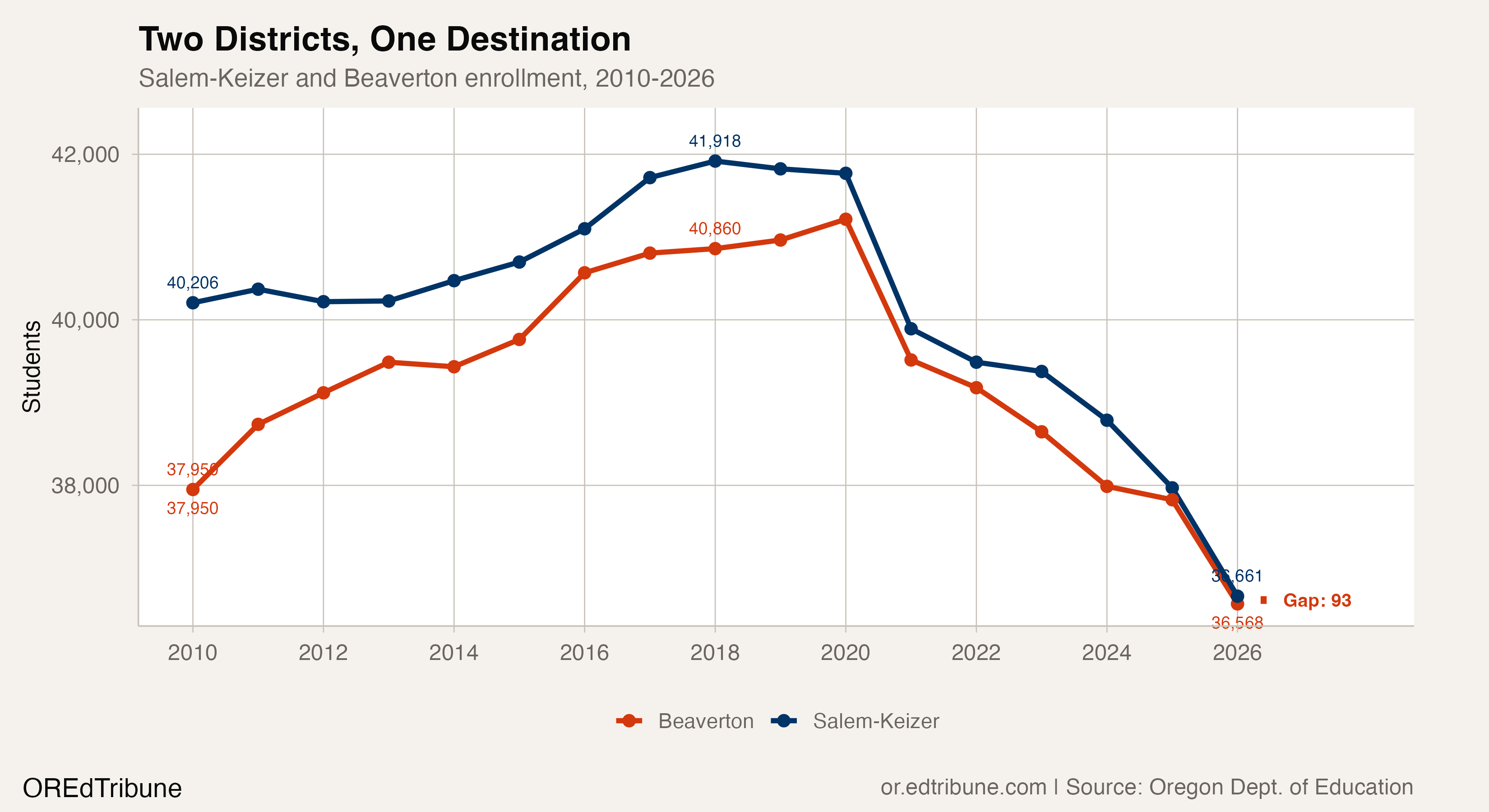
In 2010, Salem-Keizer held its position by 2,256 students. In 2025-26, the margin is 93. Salem-Keizer enrolled 36,661 students; Beaverton enrolled 36,568. If both districts continue losing students at their 2025-26 pace, Beaverton would overtake Salem-Keizer during the 2026-27 school year, the first reshuffling of Oregon's top three in the available data.
The convergence is not the result of one district thriving while the other struggles. Both are at all-time lows. Both lost more than 1,200 students in 2025-26. Both face budget deficits exceeding $20 million. The gap is closing because Salem-Keizer is falling slightly faster than Beaverton, and the districts that were once 2,256 students apart now serve nearly identical numbers of children in profoundly different communities.
A gap that flickered before it vanished
The path from 2,256 to 93 was not a straight line.
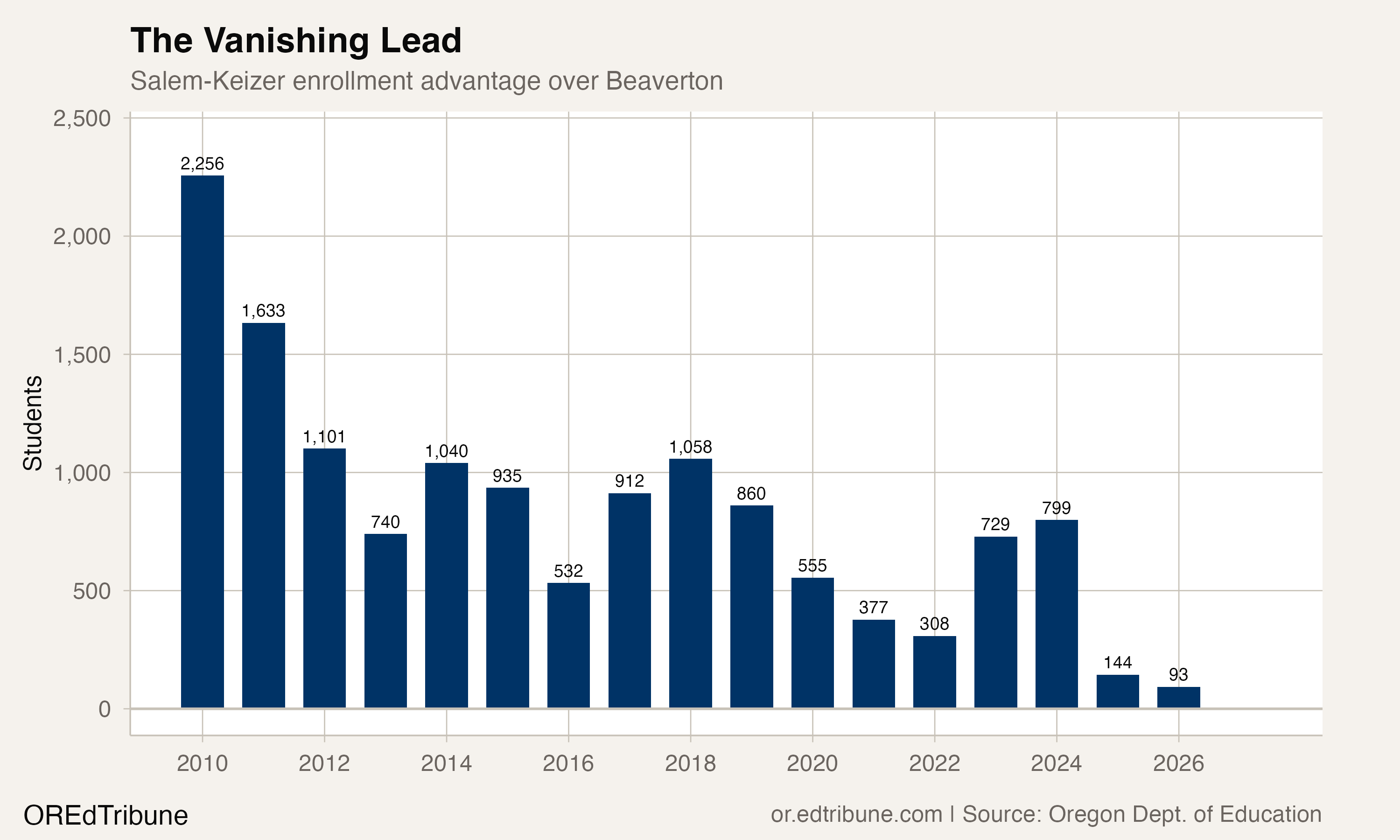
Beaverton closed the gap rapidly in the early 2010s, growing from 37,950 to 39,488 while Salem-Keizer held relatively flat. By 2013, the margin had narrowed to 740. Then Salem-Keizer surged during the mid-2010s, adding 1,690 students over five years and pushing the gap back above 1,000 by 2018.
COVID erased that recovery. Salem-Keizer lost 1,878 students in 2021 alone, a 4.5% single-year drop, compared to Beaverton's 1,700. Both districts have declined every year since. The gap shrank from 555 in 2020 to 308 in 2022, then widened back to 799 in 2024 as Beaverton fell faster in 2023 and 2024. The final collapse came in the last two years: 144 in 2025, 93 in 2026.
Both falling, one faster
In 2025-26, Salem-Keizer lost 1,309 students (-3.4%) and Beaverton lost 1,258 (-3.3%). The difference, 51 students and one-tenth of a percentage point, is the kind of gap that could flip in either direction based on a single apartment complex opening or a boundary adjustment.
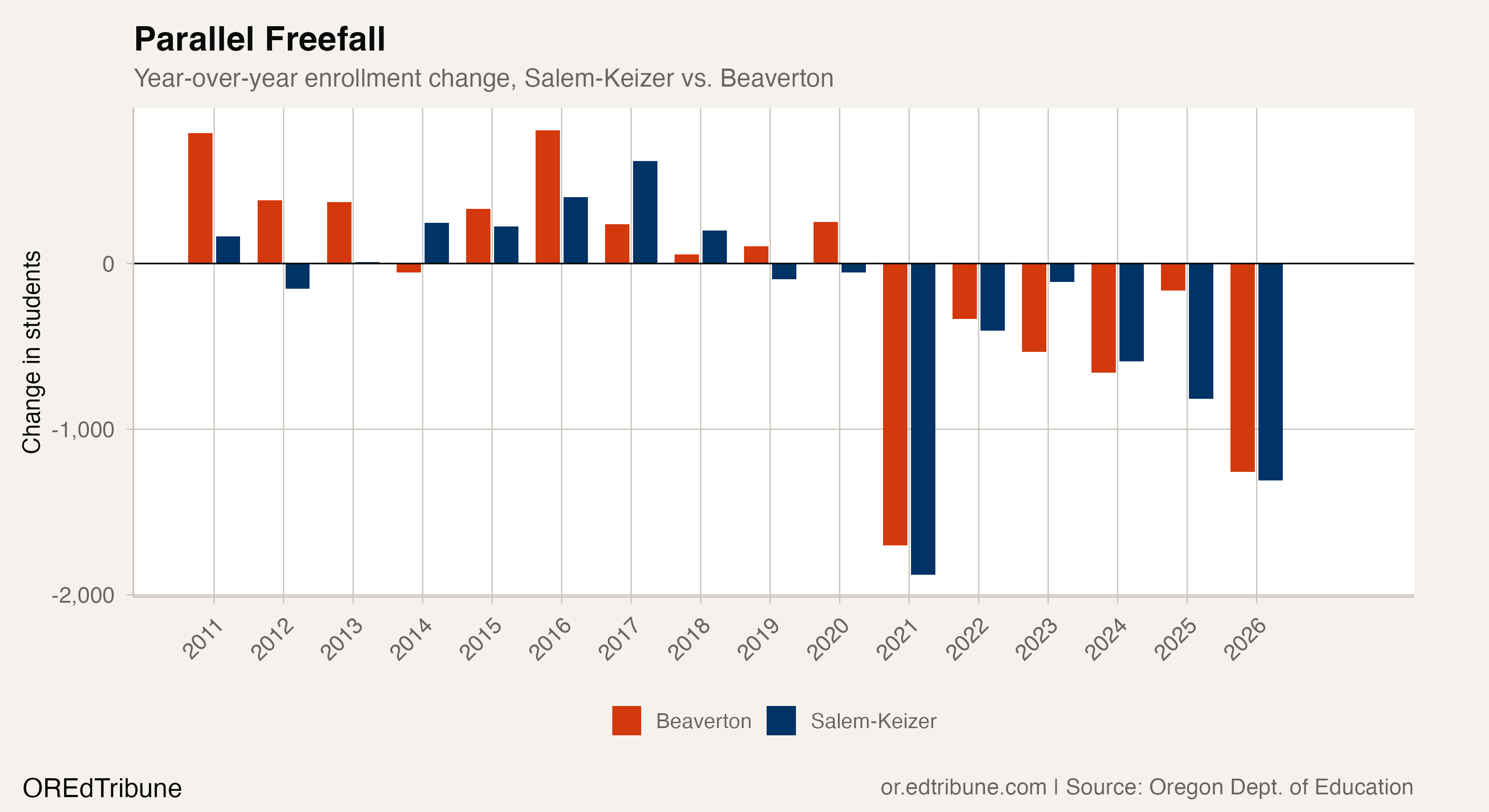
But the longer view reveals a structural difference. Salem-Keizer has now declined for eight consecutive years, starting in 2019 when it lost 94 students even before the pandemic. Beaverton was still growing in 2020, adding 251 students that year. Its decline streak is six years, starting with the COVID shock in 2021. Salem-Keizer peaked at 41,918 in 2018 and has lost 5,257 students since, a 12.5% decline. Beaverton peaked at 41,215 in 2020 and has lost 4,647, an 11.3% decline.
Together, the two districts account for 13.7% of Oregon's total enrollment and 20.8% of the statewide loss since 2020.
Two districts with different demographics
The near-identical enrollment figures mask two starkly different student bodies.
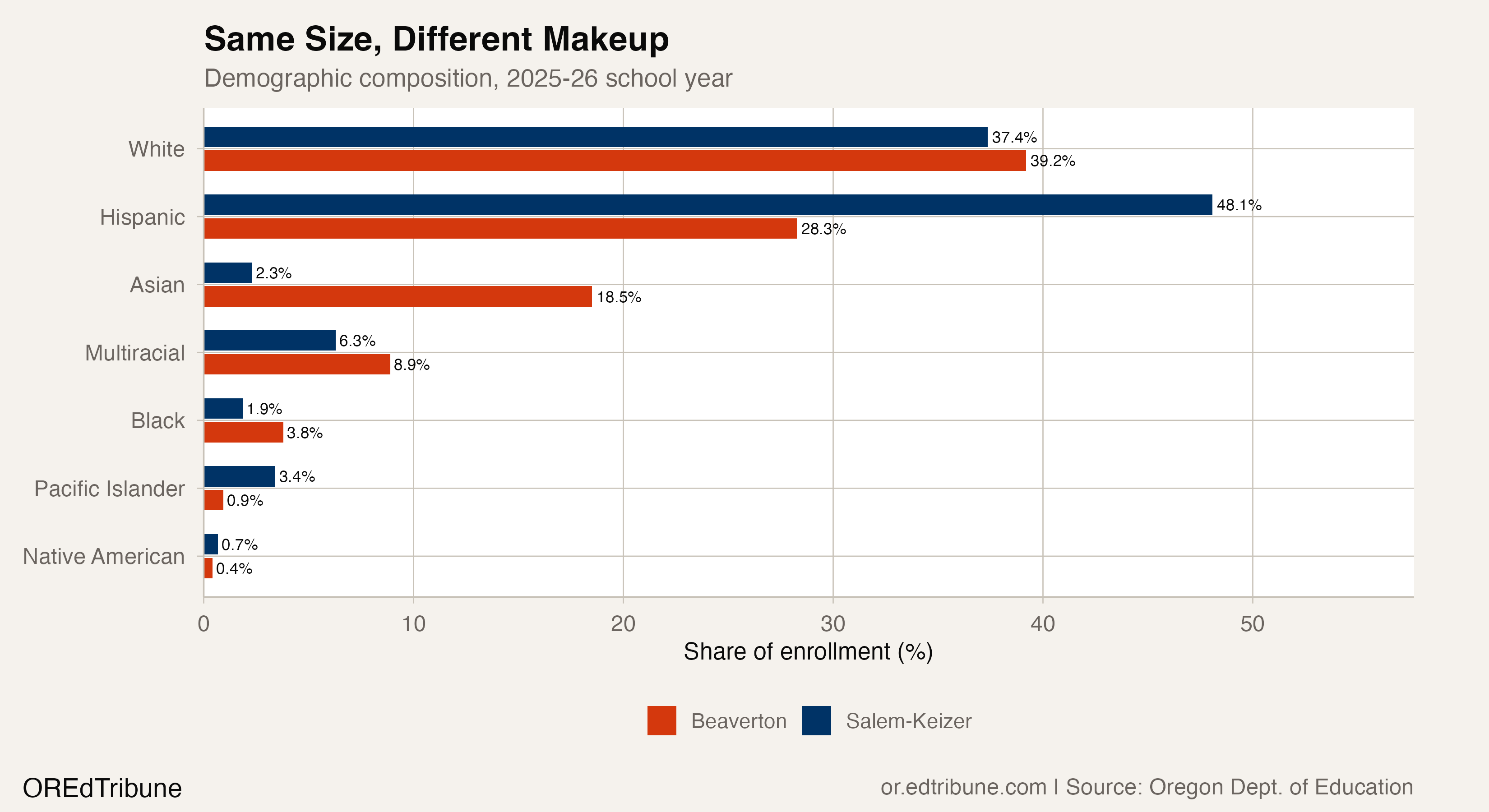
Salem-Keizer is 48.1% Hispanic and 37.4% white. Beaverton is 39.2% white with no single majority group; its Hispanic students (28.3%) are its second-largest group, followed by Asian students at 18.5%, a share eight times larger than Salem-Keizer's 2.3%.
The divergence has widened over the past decade. Since 2016, Salem-Keizer has lost 7,645 white students, a 35.8% drop, while its Hispanic enrollment grew by 2,351, or 15.4%. Hispanic students passed white students as the district's largest group in 2021 and now account for nearly half of all enrollment.
Beaverton's white enrollment has also fallen substantially, losing 5,764 students (-28.7%) since 2016. But its Asian enrollment has been more stable, rising from 6,026 to 6,767, an increase of 12.3%. Beaverton's Asian enrollment has held relatively steady even as other groups declined, partially offsetting white enrollment losses. Salem-Keizer's Hispanic growth, while larger in absolute terms at 2,351 students, has not been sufficient to prevent the district's overall total from falling.
These demographic profiles carry different resource implications. Salem-Keizer's higher share of economically disadvantaged students generates additional weighted funding under Oregon's formula, but also requires proportionally more investment in bilingual instruction, family services, and nutrition programs. The Keizertimes reported that in 2019, approximately 90% of kindergarten-age children within Salem-Keizer's boundaries attended public school; that figure has since fallen to about 75%, with families choosing homeschooling, micro schools, and other alternatives that expanded during the pandemic.
Beaverton has not reported a comparable shift in its capture rate, though its budget manager Jessica Jones told KOIN that the district is "graduating larger twelfth-grade classes" while "incoming kindergarten classes are much smaller than what we have experienced in the past."
The kindergarten signal
Both districts' kindergarten classes tell the same story about what comes next.
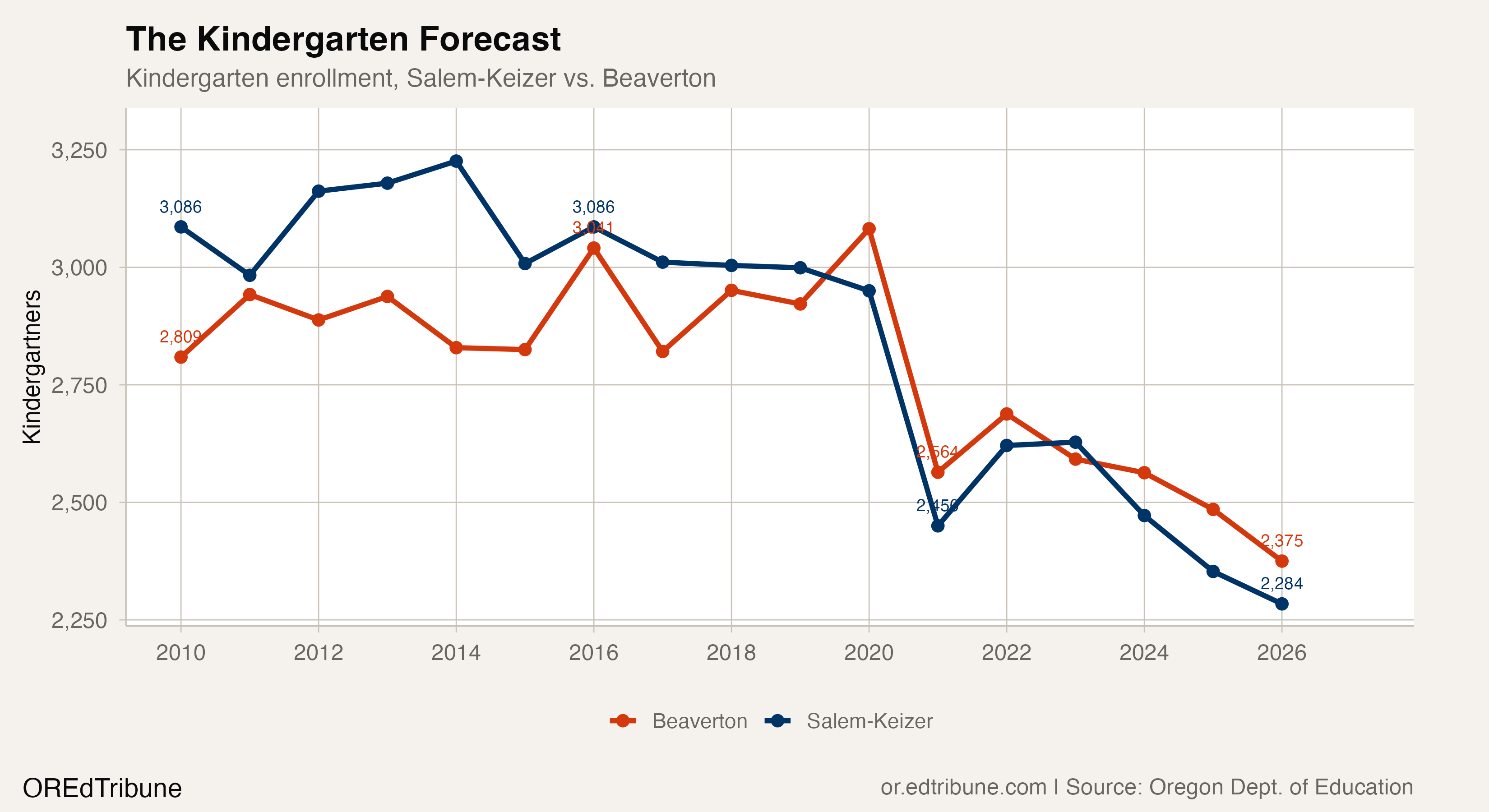
Salem-Keizer enrolled 3,086 kindergartners in 2010 and 2,284 in 2026, a 26.0% decline. Beaverton enrolled 2,809 in 2010 and 2,375 in 2026, a 15.4% drop. Salem-Keizer's chief operations officer Paul Odenthal told the Keizertimes the district is "graduating 3,500 kids and bringing in 2,500 kindergarteners." Beaverton faces the same arithmetic at a slightly smaller scale.
Oregon's fertility rate has remained well below the replacement rate of 2.1, and the state's Office of Economic Analysis projects an ongoing decline in the number of school-age children through 2030, driven by lower birth rates and slowing in-migration. The children who will enter kindergarten in fall 2027 were born in 2022, when the pandemic-era birth dip was near its trough. The pipeline is not going to widen.
$53 million in combined budget gaps
Salem-Keizer has proposed $23 million in cuts for 2026-27, including 60 teacher positions, 60 classified staff, and nine central office roles. Superintendent Andrea Castaneda framed the reductions as preemptive:
"Salem-Keizer is not in financial crisis. We're getting ahead of a predictable problem, so that we do not start burning our reserves too early." -- Salem Reporter, Feb. 2026
Beaverton faces a $30 million shortfall for 2025-26, driven by declining enrollment, a structural deficit, and rising retirement benefit costs. The district plans to absorb $20 million from reserves and cut $10 million. For 2026-27, it projects an additional $25 million deficit and has proposed $10.4 million in savings including proportional teacher staffing, counselor adjustments, and a regional social worker model.
Oregon school districts statewide are navigating the same squeeze. OPB reported that rising PERS (Public Employee Retirement System) costs are expected to more than offset the governor's proposed funding increases. A 1% reduction in state funding translates to roughly $4 million annually for a district the size of Salem-Keizer.
"There are forces outside of schools' control, from federal funding reductions to the loss of Medicaid and SNAP benefits." -- Krista Parent, executive director, Coalition of Oregon School Administrators, OPB, Nov. 2025
What the ranking shift means
Whether Beaverton overtakes Salem-Keizer in 2027 changes nothing about state funding formulas, which allocate dollars per student regardless of a district's size rank. It does not trigger any policy threshold or regulatory change.
What it signals is subtler. Salem-Keizer sits in the state capital and has historically carried political weight proportional to its enrollment. The district's school board has been a proving ground for education policy debates that affect the entire state. Losing the #2 designation to a Portland suburb does not erase that influence, but it recalibrates it at a moment when both districts are making visible, painful cuts.
Salem-Keizer's own enrollment forecast, prepared by Portland State University, projects 32,000 students by 2031, a further loss of roughly 4,500 from the 2025-26 figure. Beaverton has averaged a loss of roughly 770 students per year since 2021. If both projections hold, the crossover happens and then the two districts decline in tandem, within a few hundred students of each other, into the low 30,000s.
Salem-Keizer last closed schools between 2008 and 2014, shuttering five rural elementary buildings. Beaverton has not closed a school in decades. Both will face that conversation again soon. The 93-student gap between them matters less than the 9,904 students they have lost between them since their respective peaks — students whose per-pupil funding no longer arrives, in buildings that still need heating.
Detailed code that reproduces the analysis and figures in this article is available exclusively to EdTribune subscribers.
Discussion
Sign in to join the discussion.
Loading comments...