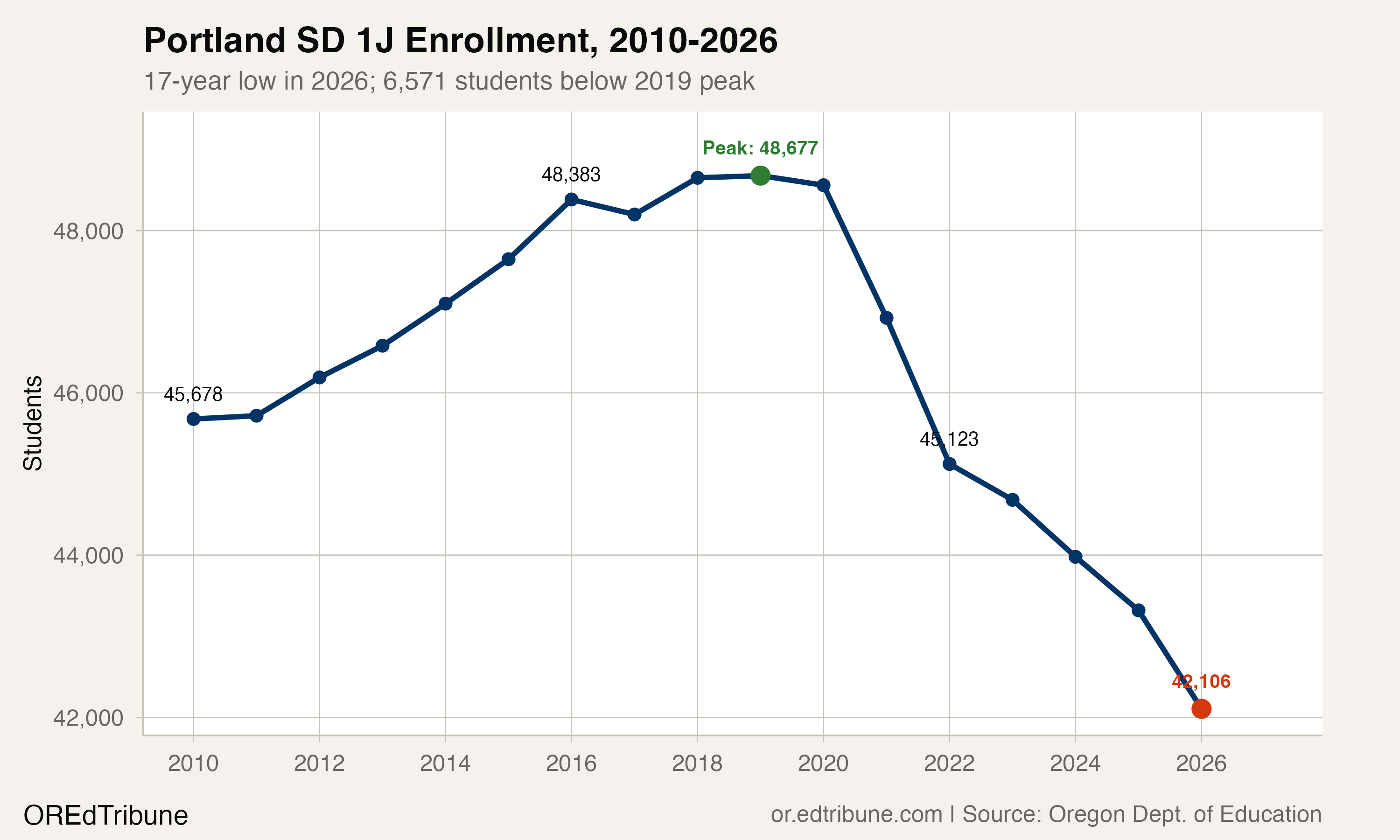
Portland SD 1J↗ET added students for nine consecutive years, peaking at 48,677 in 2019. Then it lost 6,571 of them. The 2025-26 school year brought the steepest single-year drop since the pandemic crash: 1,213 students gone, a 2.8% decline that nearly doubled the prior year's loss of 660. At 42,106, Portland's enrollment is lower than any year in the 17-year dataset, below where it stood in 2010.
The district is shrinking faster than Oregon as a whole. Portland lost 13.5% of its enrollment since 2019. The state lost 7.9%. In the latest year alone, Portland's 2.8% decline ran well ahead of the statewide 1.7% drop. Oregon's largest school district, once home to 8.4% of the state's students, now accounts for 7.9%.
The acceleration
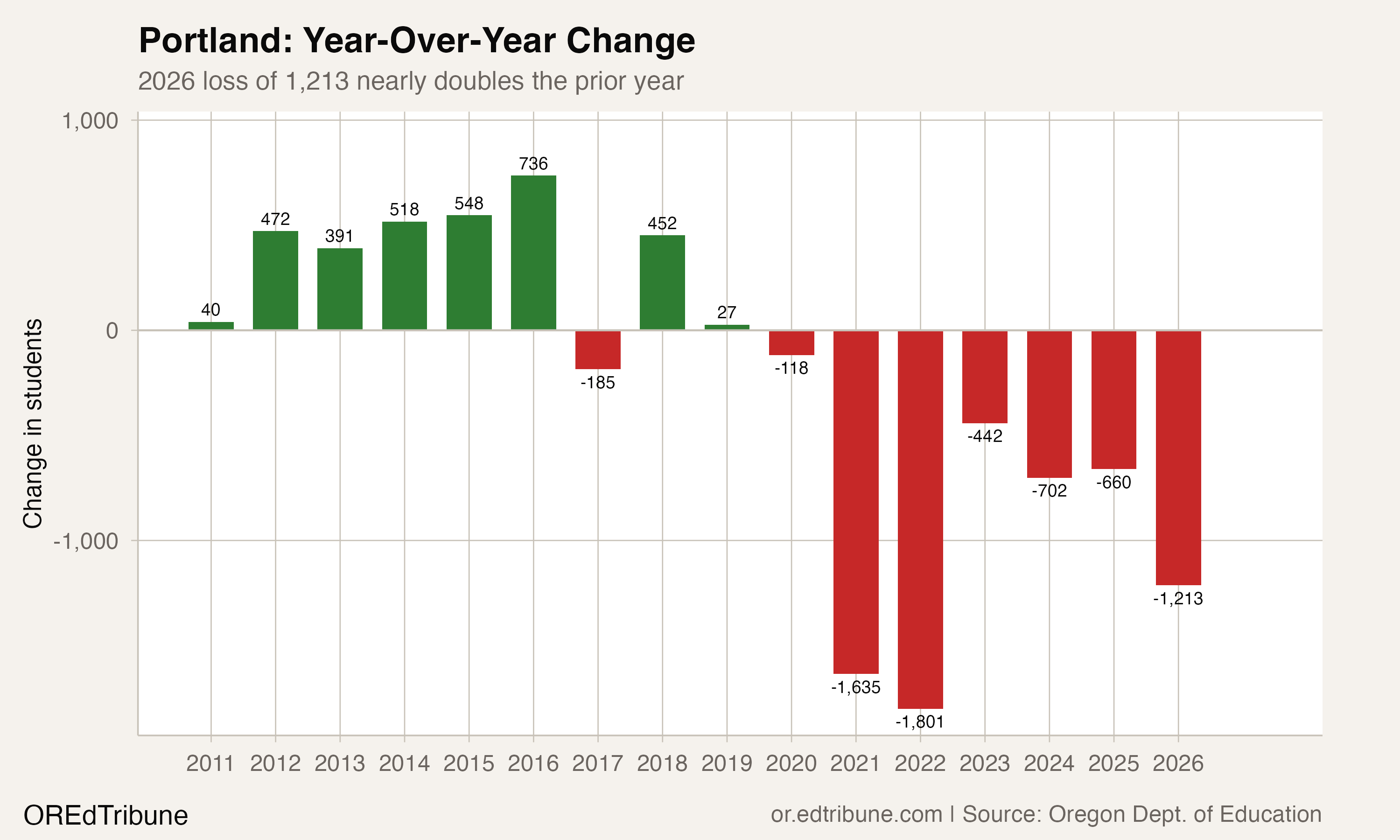
Portland's enrollment fell every year from 2020 through 2026, a seven-year streak with no sign of flattening. But the pace has shifted. The COVID-era freefall of 2021 and 2022, when the district shed 3,436 students in two years, gave way to a period of slower losses: 442 in 2023, 702 in 2024, 660 in 2025. That apparent stabilization ended in 2026, when the loss nearly doubled to 1,213.
The 2026 drop stands out because it arrived after what looked like a recovery trajectory. Three years of progressively smaller losses suggested the district might be approaching a floor. Instead, the decline re-accelerated.
Who is leaving
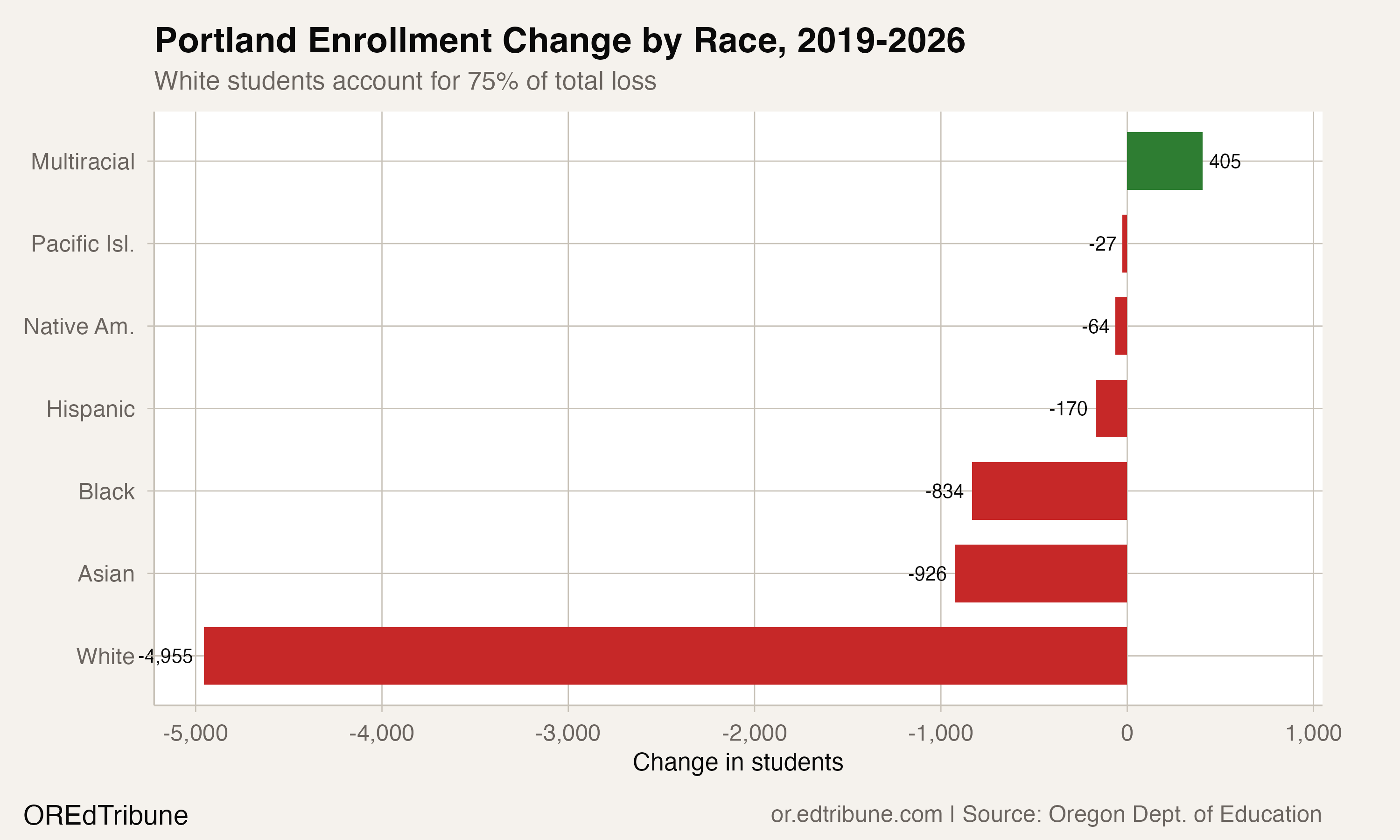
White students account for three-quarters of Portland's total enrollment loss since 2019. The district lost 4,955 white students over that span, a 17.9% decline within the group. In 2026 alone, 870 of the 1,213 departures were white students, 71.7% of the year's loss.
Black enrollment fell by 834 students (19.4%) and Asian enrollment by 926 (28.4%) over the same seven-year period. Hispanic enrollment held relatively steady through 2025, reaching 7,899, before dropping 271 students in 2026 to 7,628, a net loss of 170 from 2019. Multiracial students were the only group to grow, adding 405 since 2019.
The composition of Portland's student body is shifting as a result. White students made up 56.8% of enrollment in 2019 and 53.9% in 2026. Hispanic students rose from 16.0% to 18.1% of the district. Multiracial students grew from 10.3% to 12.9%.
A pipeline problem written in kindergarten
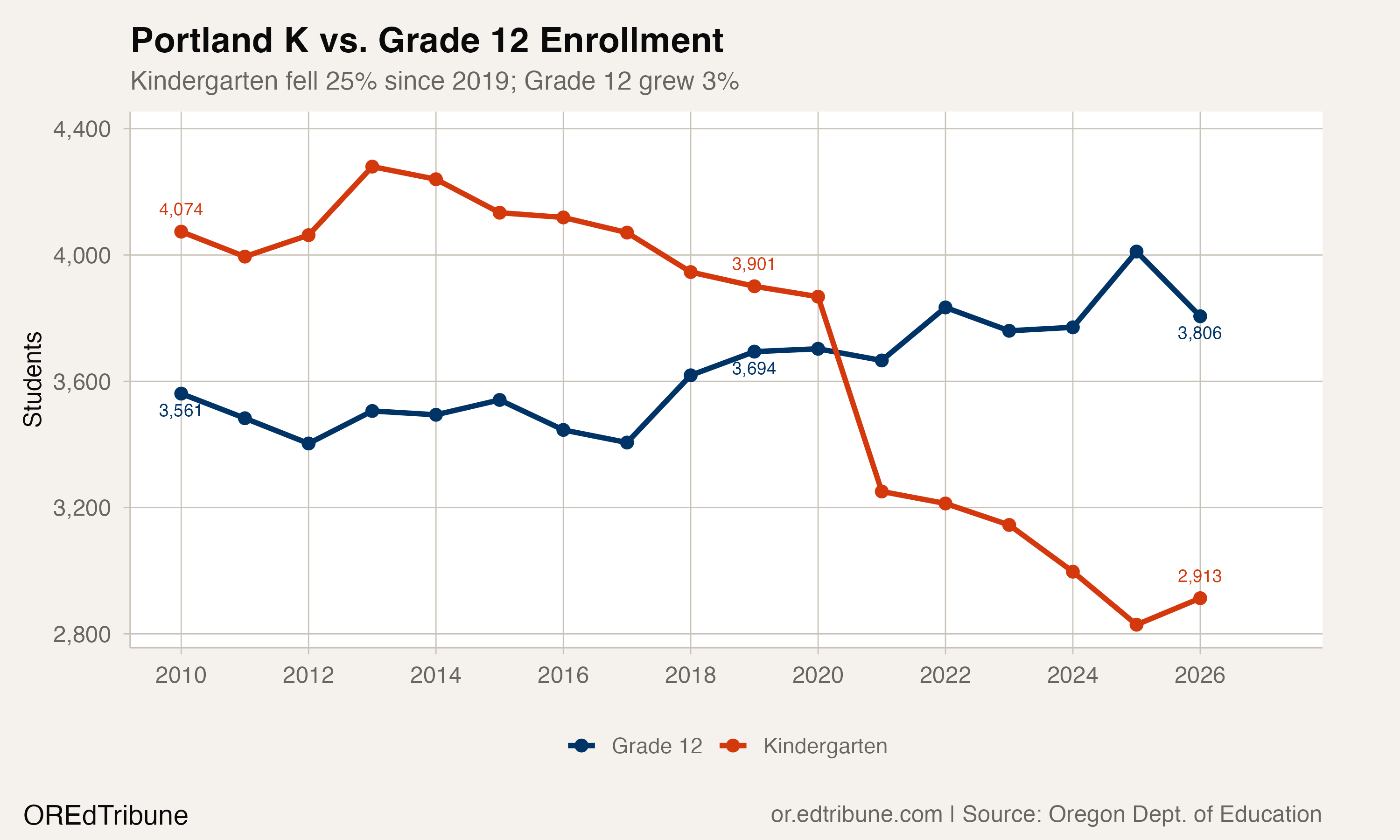
The district's incoming classes are much smaller than its outgoing ones. Portland enrolled 2,913 kindergartners in 2026 and graduated 3,806 twelfth-graders, a gap of 893 students. That imbalance did not exist seven years ago: in 2019, kindergarten (3,901) and twelfth grade (3,694) were roughly the same size.
Kindergarten enrollment has fallen 25.3% since 2019, from 3,901 to 2,913. The 2026 figure actually represents a modest rebound from 2025's 2,829, the first kindergarten increase in over a decade. Portland State University had projected even fewer kindergartners (2,782), so the uptick exceeded expectations. But the structural picture remains: every new kindergarten class is far smaller than the twelfth-grade class it will eventually replace, locking in years of further total enrollment decline even if no additional students leave mid-career.
Not just Portland
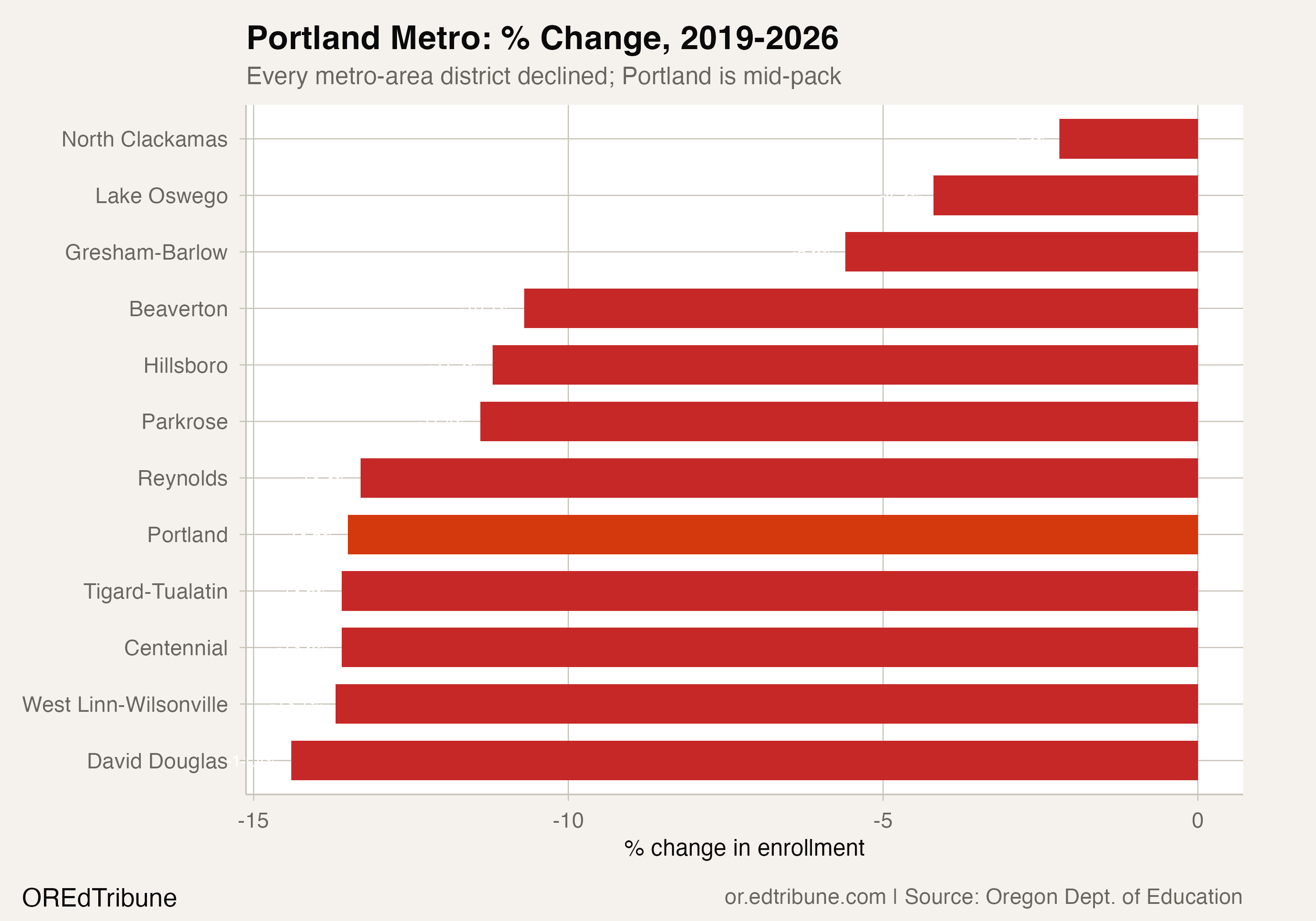
Portland's 13.5% loss since 2019 looks severe in isolation. In context, it is unremarkable. Of 12 Portland-metro districts, four lost a larger share of their students over the same period. David Douglas, a neighboring district that serves many of the same East Portland neighborhoods, lost 14.4%. Tigard-Tualatin and West Linn-Wilsonville, affluent suburban districts south and southwest of the city, each lost more than 13.5%. Every single metro-area district declined.
North Clackamas, which lost just 2.2%, and Gresham-Barlow at 5.6% were the relative outperformers. The fact that losses are spread across the entire metro area, from Portland's urban core to Tigard's suburban subdivisions, suggests the primary drivers extend beyond any single district's policies.
Housing, birth rates, and the fiscal spiral
The most likely driver of Portland's enrollment loss is families leaving Multnomah County, pushed out by housing costs. A LendingTree study ranked the Portland metro area as having the worst housing crisis outlook of any major U.S. metro. Only 656 multifamily housing permits were issued in 2025, the lowest since 2011 and down from over 2,000 in 2023. The region lost nearly 9,000 jobs in the past year, ranking it fourth-worst among all U.S. metro areas.
Declining birth rates compound the outmigration. Multnomah County had the largest population decrease of any Oregon county between 2020 and 2024, losing 13,900 residents, a 1.7% drop. Oregon's fertility rate sits near 1.4 children per woman, well below the 2.1 replacement level. Fewer children born in 2019 and 2020 are now entering kindergarten.
A lower "capture rate," the share of local families who choose PPS over private, charter, or homeschool options, is a competing explanation. District spokesperson Sydney Kelly told Willamette Week that "great things are happening at PPS, and we hope that these data show and continue to show that parents are identifying PPS as a district of choice." But CFO Michelle Morrison acknowledged the underlying reality: "Although enrollment is slightly higher than projected, especially in kindergarten, we're celebrating that. It's still an overall decline."
The $50 million question
Oregon funds schools through the State School Fund, a $11.36 billion pot for the 2025-27 biennium that distributes money primarily on a per-pupil basis. Every student who leaves takes their funding allocation with them. Portland has already cut 240 positions and $43 million from its current-year budget. Superintendent Kimberlee Armstrong described the situation as "a sobering fiscal cliff."
The next fiscal year looks worse. The district projects a $50 million shortfall for 2026-27, and has signaled that school closures and consolidations are on the table. The district operates 81 schools. With 42,106 students, that averages roughly 520 per building. As enrollment continues to fall, maintaining that many facilities becomes structurally unsustainable.
"These challenges existed before I stepped into this role, and now, with rising education costs, limited funding, and enrollment decline, we face a sobering fiscal cliff." — Superintendent Kimberlee Armstrong, OPB, April 2025
Portland enrolled 893 fewer kindergartners than twelfth-graders in 2026. Those smaller incoming classes will advance through the system for the next 12 years, pulling the total lower regardless of what happens to housing prices or school budgets. Portland State University's revised forecast projects the district below 40,000 by 2028-29. At that point, the 81-building footprint will carry roughly 490 students per school. Some of those buildings will close. The only open question is which ones.
Detailed code that reproduces the analysis and figures in this article is available exclusively to EdTribune subscribers.
Discussion
Sign in to join the discussion.
Loading comments...