In this series: Oregon Chronic Absenteeism.
Correction: An earlier version of this article cited a homeless-to-overall chronic absenteeism gap for a school year that predates Oregon's homeless chronic absenteeism data. The data begins several years later, and the article now cites the earliest year available. The article has been updated.
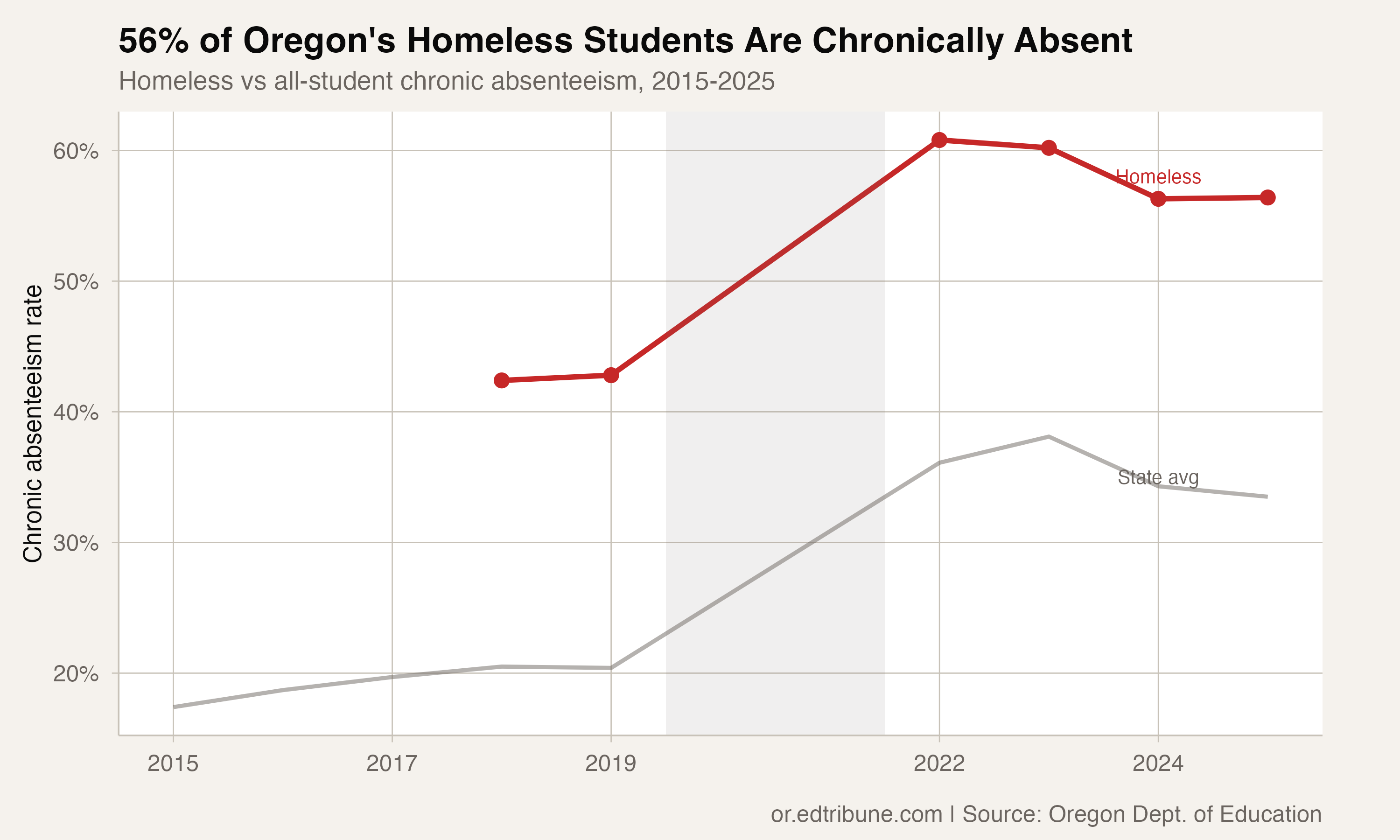
Before the pandemic, 42.8% of Oregon's students who are currently homeless were chronically absent. That was already catastrophic — more than two in five missing at least 10% of the school year. COVID pushed it to 60.8%. And while the rate has come down to 56.4% in 2024-25, it remains a number that should stop any conversation about attendance in its tracks.
More than half of Oregon's 15,920 students who are currently homeless miss too much school. That is roughly 8,979 children whose housing instability is translating directly into educational instability.
The gap that doesn't close
The gap between homeless and overall chronic absenteeism has been remarkably stable across every year of the dataset. In 2018: 21.9 points. In 2019: 22.4. At the pandemic peak: 24.7. In 2025: 22.9.
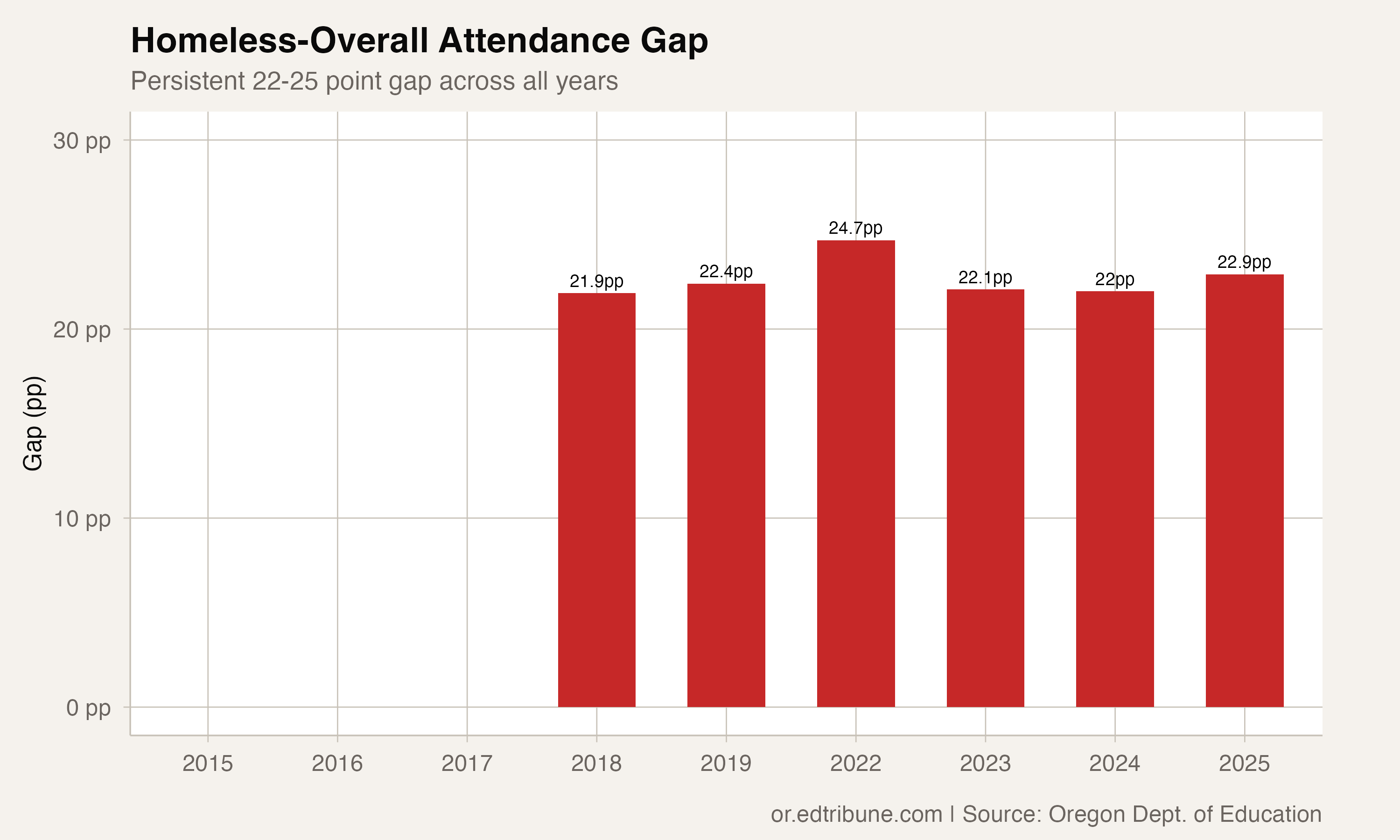
This stability is both informative and discouraging. The factors that drive the gap — doubling up with relatives, moving between shelters, sleeping in cars, the chaos of housing insecurity — are not pandemic-sensitive. They existed before COVID and persist through it. The pandemic made everyone's attendance worse, including students who are currently homeless, but the distance between homeless and housed students barely changed.
Near the top of Oregon's attendance crisis
Students who are currently homeless have one of the highest chronic absenteeism rates tracked by the Oregon Department of Education. In the 2024-25 data, only incarcerated students have a higher state-level subgroup rate in the package. The homeless rate is higher than foster care students, special education students, migrant students, English learners, and every racial group.
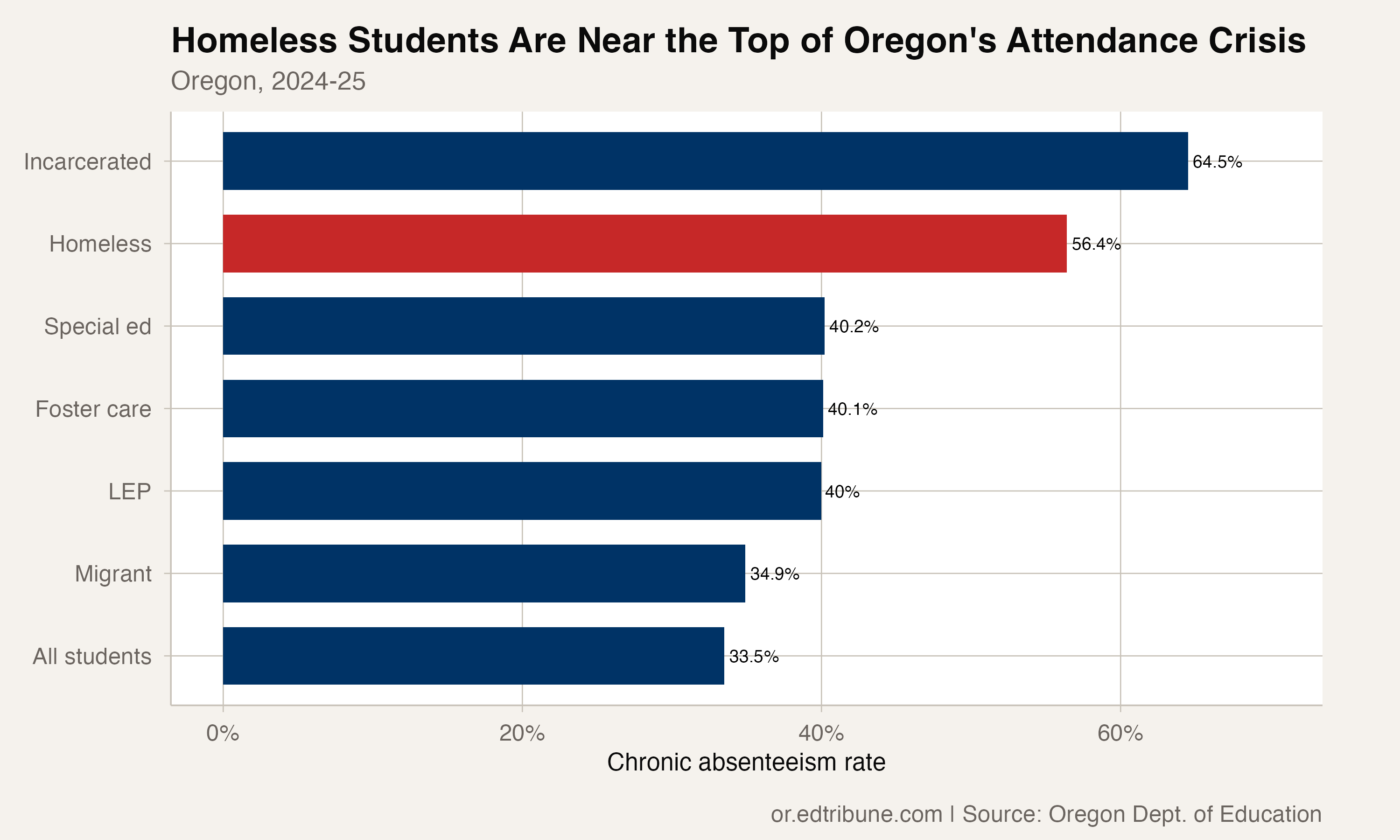
The comparison with foster care students is instructive, but not because foster care is easy. Oregon's foster care students have a chronic rate of 40.1% — also severe, but 16.3 points lower than the rate for students who are currently homeless. The gap shows how sharply housing instability stands out in Oregon's attendance data.
15,920 students
The McKinney-Vento Act defines homelessness broadly: students living in shelters, motels, doubled up with other families, or lacking a fixed nighttime residence. Oregon's student who is currently homeless count of 15,920 — roughly 3.1% of total enrollment — likely undercounts the real population. Districts vary widely in how aggressively they identify qualifying students.
Oregon has among the lowest per-capita psychiatric hospital-bed capacity in the nation and has lost more than 200 youth mental health residential beds since 2003, according to OHSU. The intersection of homelessness, untreated mental health conditions, and chronic absenteeism creates a compounding crisis that school-level interventions alone cannot resolve.
A pre-pandemic problem
The pre-COVID rate of 42.8% matters for calibrating expectations. Even if Oregon manages a full recovery from the pandemic's effect on attendance, students who are currently homeless would still have a chronic rate above 40%. The pandemic added roughly 14 points to an already unacceptable baseline. Full COVID recovery would still leave a population where two in five students are chronically absent.
The 4.4-point improvement from the peak (60.8% to 56.4%) is progress, but it took three years to achieve. At that pace, returning to the pre-COVID 42.8% would take another decade. And 42.8% was itself the worst rate of any subgroup before the pandemic.
For Oregon's 15,920 students who are currently homeless, the attendance crisis is not recovering. It is barely receding from its worst-ever levels, with a floor that was already catastrophic.
Detailed code that reproduces the analysis and figures in this article is available exclusively to EdTribune subscribers.
Discussion
Sign in to join the discussion.
Loading comments...