In this series: Oregon Chronic Absenteeism.
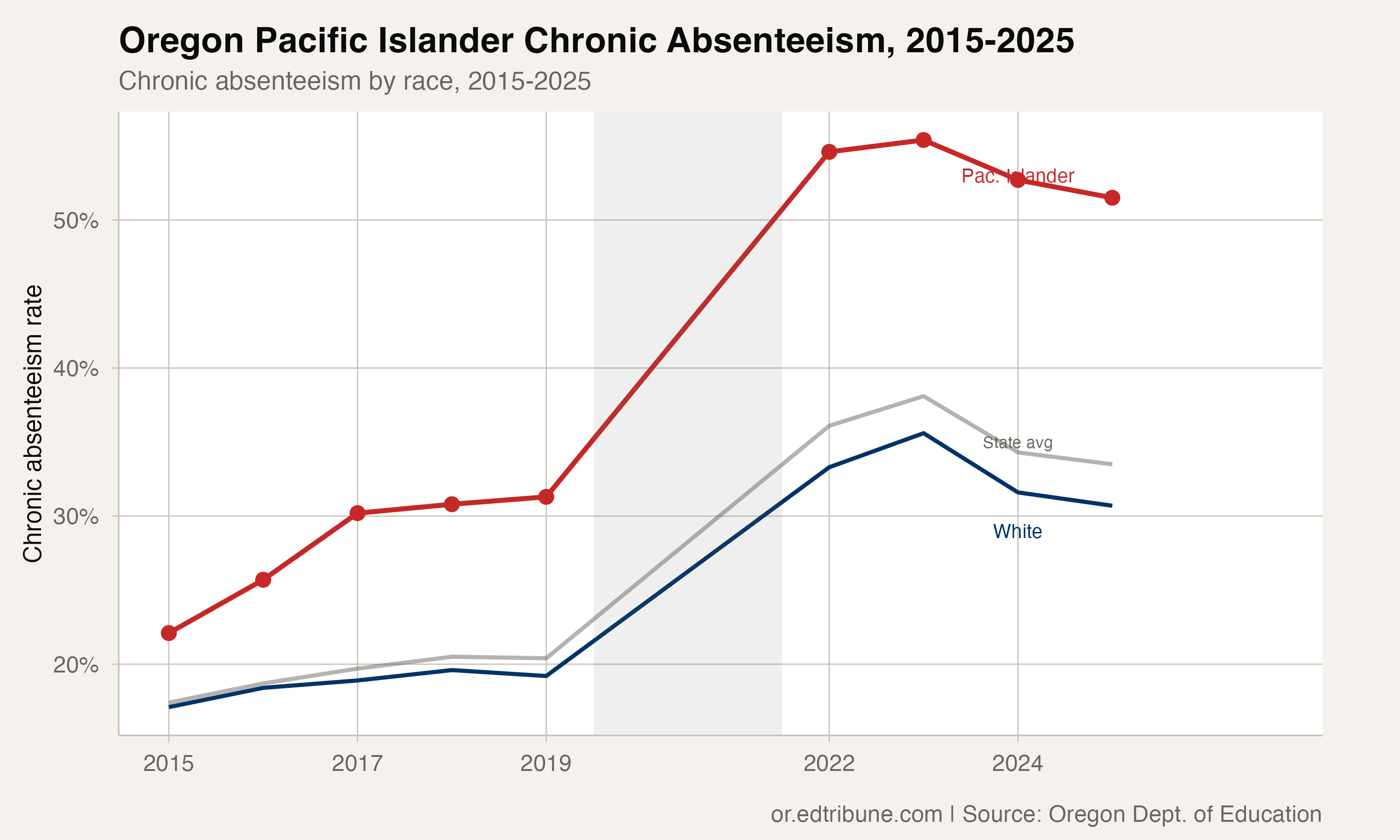
Oregon's 4,458 Pacific Islander students have the highest chronic absenteeism rate of any racial group in the state: 51.5%. More than half miss at least 10% of the school year. The rate was 22.1% in 2014-15. In a decade, it has more than doubled.
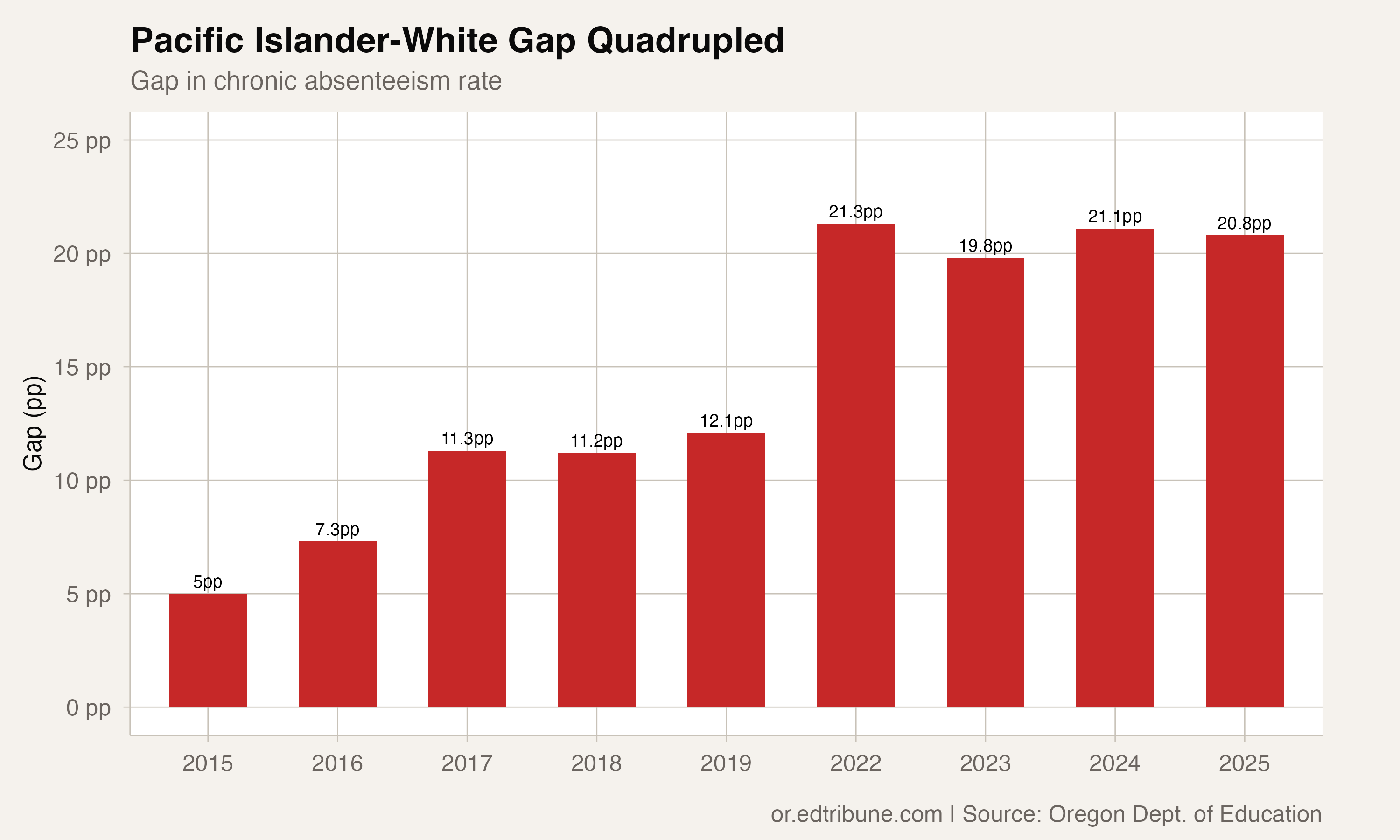
The Pacific Islander-white gap has quadrupled — from 5.0 percentage points in 2015 to 20.8 points in 2025. No other racial equity gap in Oregon's attendance data has widened as dramatically.
A small community, a large crisis
Oregon's Pacific Islander population is small — 4,458 students, less than 1% of total enrollment. Many families are from Compact of Free Association (COFA) nations — the Marshall Islands, Federated States of Micronesia, and Palau — whose citizens in Oregon may qualify for medical, food, cash, and child care benefits if they meet income rules, according to Oregon DHS. This is suggestive context for service access, not direct evidence explaining the attendance rate.
Federal Medicaid eligibility for COFA migrants was restored in December 2020 after coverage had been limited in many cases to emergency services, according to federal Medicaid guidance. The article's data does not measure whether health coverage changes caused attendance differences.
The racial hierarchy of absence
Pacific Islander students sit at the top of Oregon's chronic absenteeism ranking by race, followed by Native American students at 45.9%, Hispanic students at 40.5%, Black students at 40.0%, multiracial students at 33.5%, white students at 30.7%, and Asian students at 17.2%.
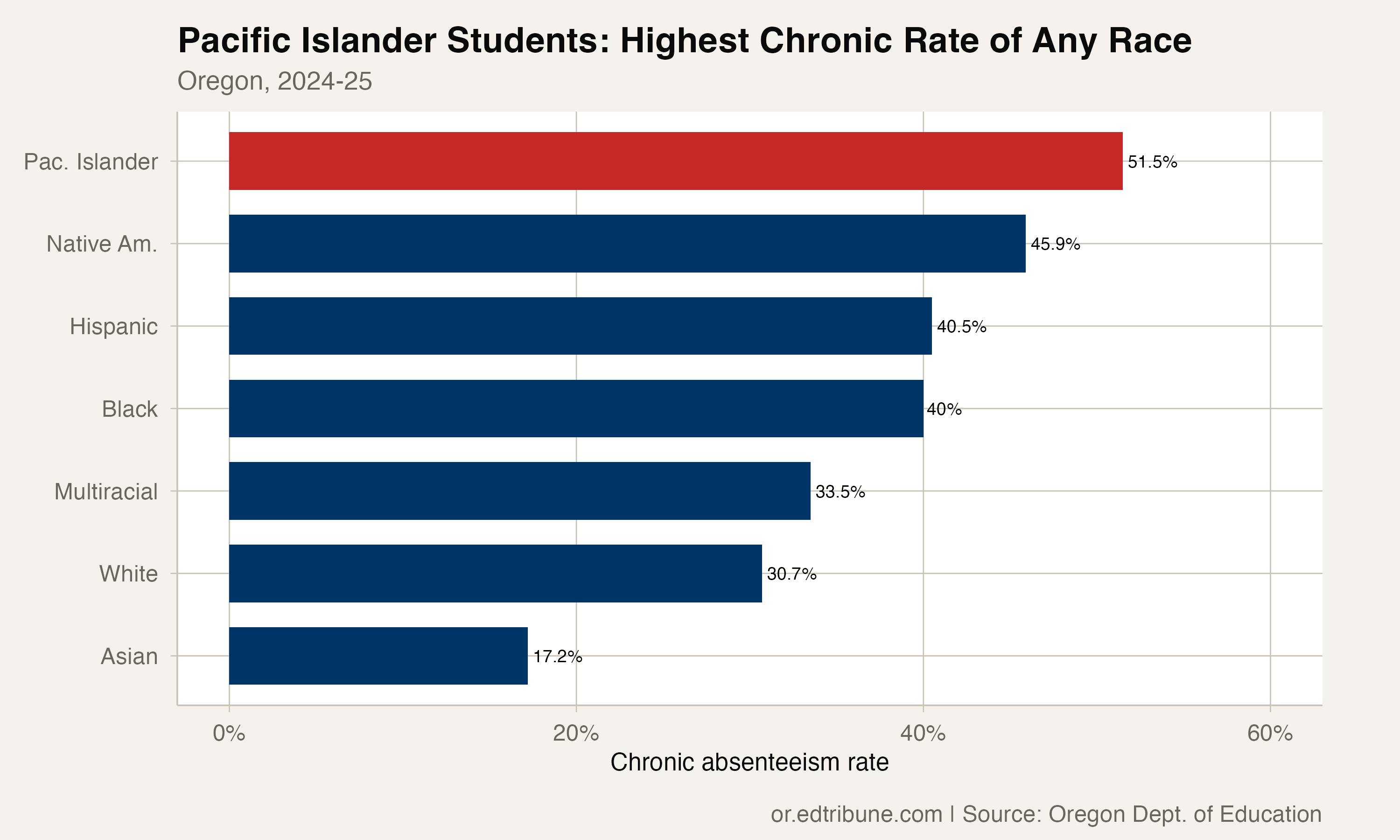
The 34.3-point spread between Pacific Islander and Asian students — both broadly categorized as "Asian/Pacific Islander" in some federal datasets — illustrates why aggregated racial categories obscure more than they reveal. These are communities with radically different immigration histories, economic resources, and access to institutional support.
What 51.5% means
At 51.5%, the typical Pacific Islander student in Oregon misses roughly 18 or more days per year. Among the chronically absent, many miss far more. For a community of 4,458 students, that means approximately 2,296 students missing 18+ days — students who are falling behind academically in ways that compound year over year.
The rate peaked at 55.4% in 2022-23, and the recovery to 51.5% — a 3.9-point improvement — means the community is participating in the broader statewide recovery. But the pace would need to accelerate dramatically to close the 20.8-point gap with white students, which has shown no sign of narrowing since 2023.
Oregon's statewide data does not explain the gap. Commonly cited barriers for Pacific Islander families include housing instability, transportation, language access, and the economic pressure older students may face in multi-generational households, but those are suggestive context rather than direct evidence for this article's findings.
The smallness of the population makes the crisis simultaneously easier and harder to address. Easier because the numbers are manageable — 2,296 chronically absent students could theoretically be reached individually. Harder because the community's size means it lacks the political visibility and institutional support that larger populations command.
Detailed code that reproduces the analysis and figures in this article is available exclusively to EdTribune subscribers.
Discussion
Sign in to join the discussion.
Loading comments...