Correction (2026-05-21): Third-grade rate corrected to 25.5% (was 27.0%); sixth-grade rate corrected to 27.9% (was 31.6%); first-grade recovery corrected to 9.8 points (was 10.0); second-grade recovery corrected to 9.6 points (was 9.2). Headline revised to factual/asset-first framing.
In this series: Oregon Chronic Absenteeism.
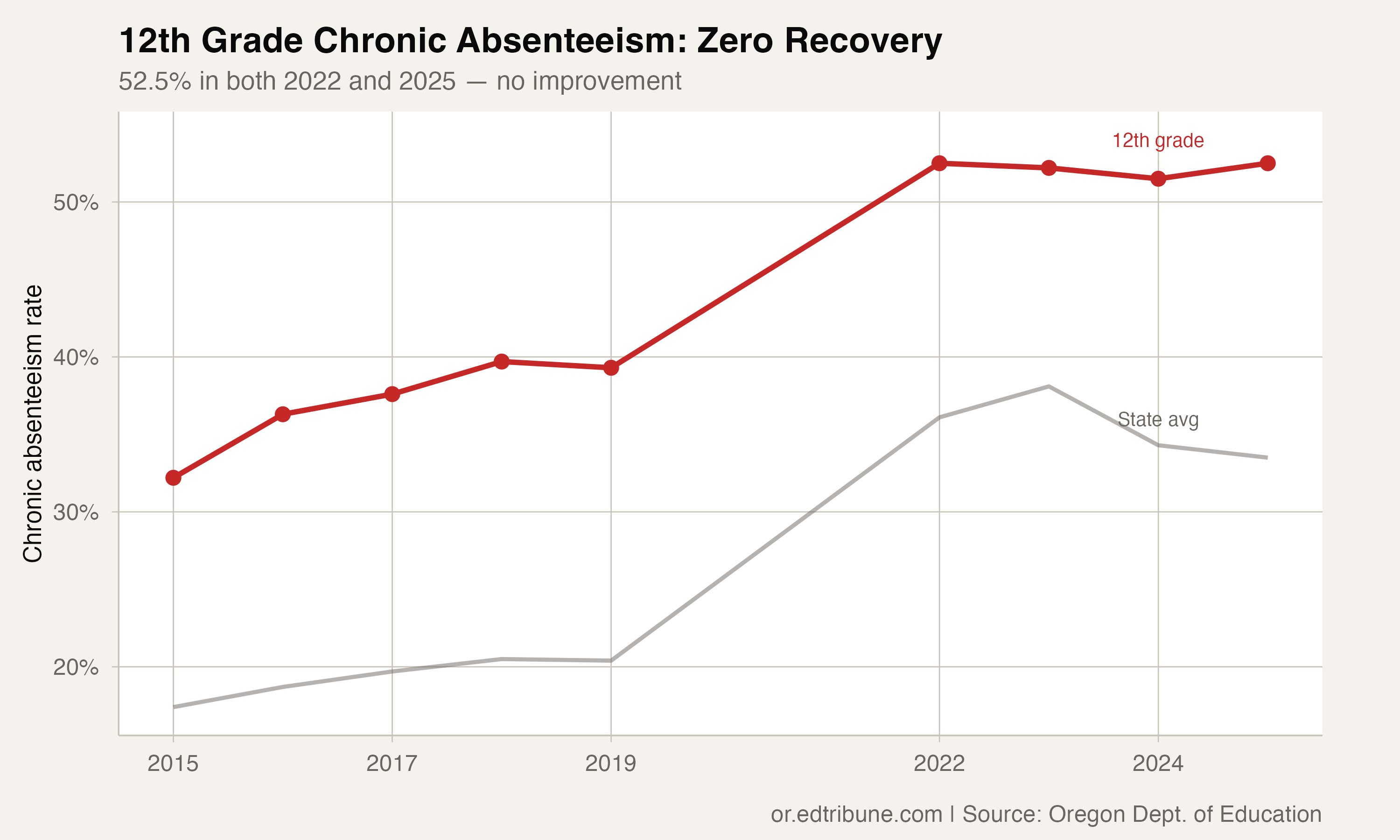
Oregon's 12th-grade chronic absenteeism rate in 2021-22 was 52.5%. In 2024-25, it was 52.5%. Three years of statewide recovery, interventions, campaigns, and policy changes produced exactly zero improvement for the class closest to graduation.
More than half of Oregon's roughly 41,000 seniors missed at least 10% of the school year. Over 21,000 students in their final year of K-12 education were chronically absent.
The grade ladder
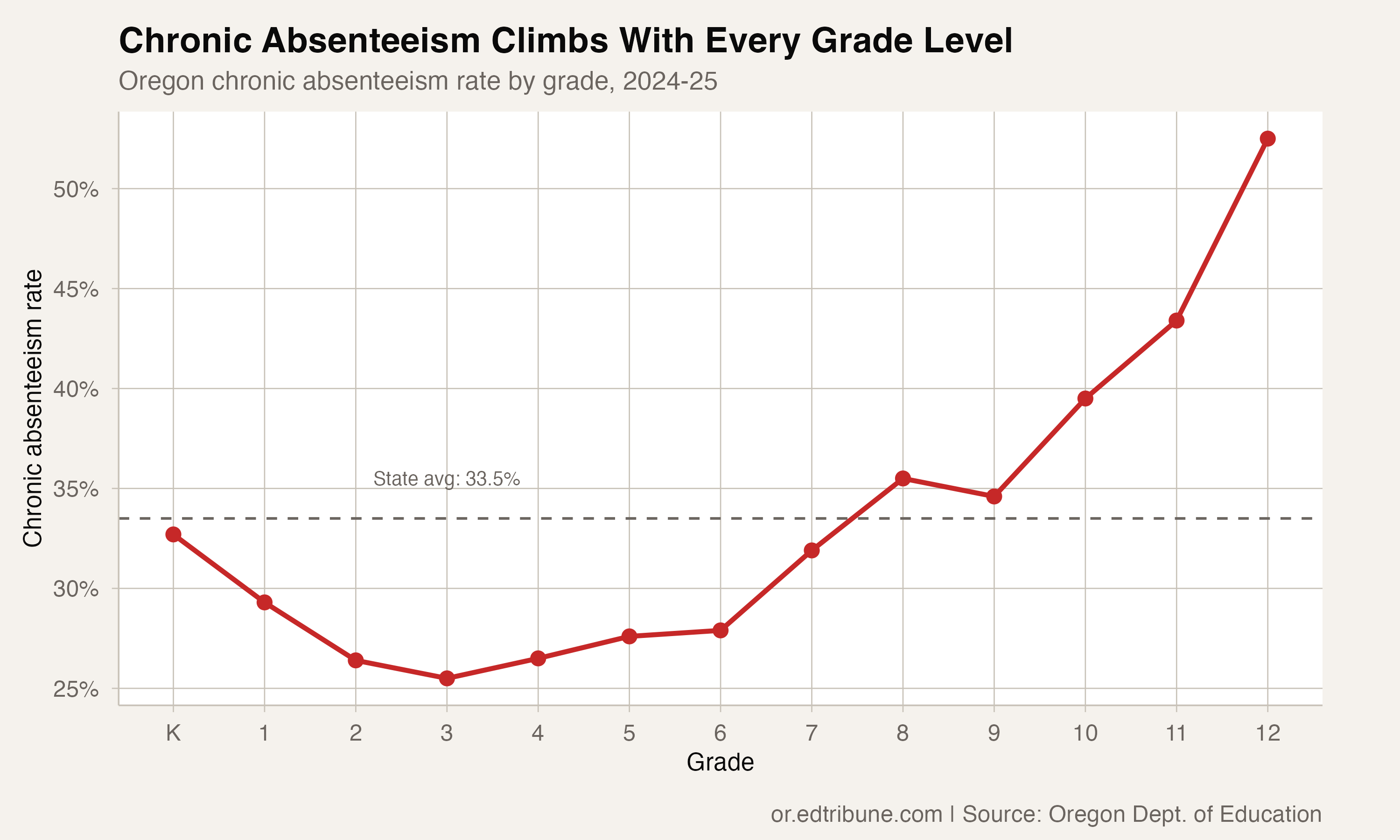
Chronic absenteeism in Oregon climbs with every year of schooling. In 2024-25, kindergarten was at 32.7%. Third grade: 25.5%. Sixth grade: 27.9%. Ninth grade: 34.6%. Twelfth grade: 52.5%.
The climb is not linear. It accelerates at the top. The jump from 11th grade (43.4%) to 12th grade (52.5%) is 9.1 percentage points, the largest single-grade transition in the data. This "senioritis gap" has been remarkably consistent: 7 to 10 points every year, before and after the pandemic. It is a structural feature of Oregon's high school system, not a COVID artifact.
The recovery divergence
The starkest finding is not the level. It is the trajectory. Kindergarten's chronic rate peaked at 45.0% in 2022-23, then fell 12.3 points to 32.7%. First grade recovered 9.8 points. Second grade recovered 9.6. Each successive grade shows less improvement, tapering to near-zero in high school.
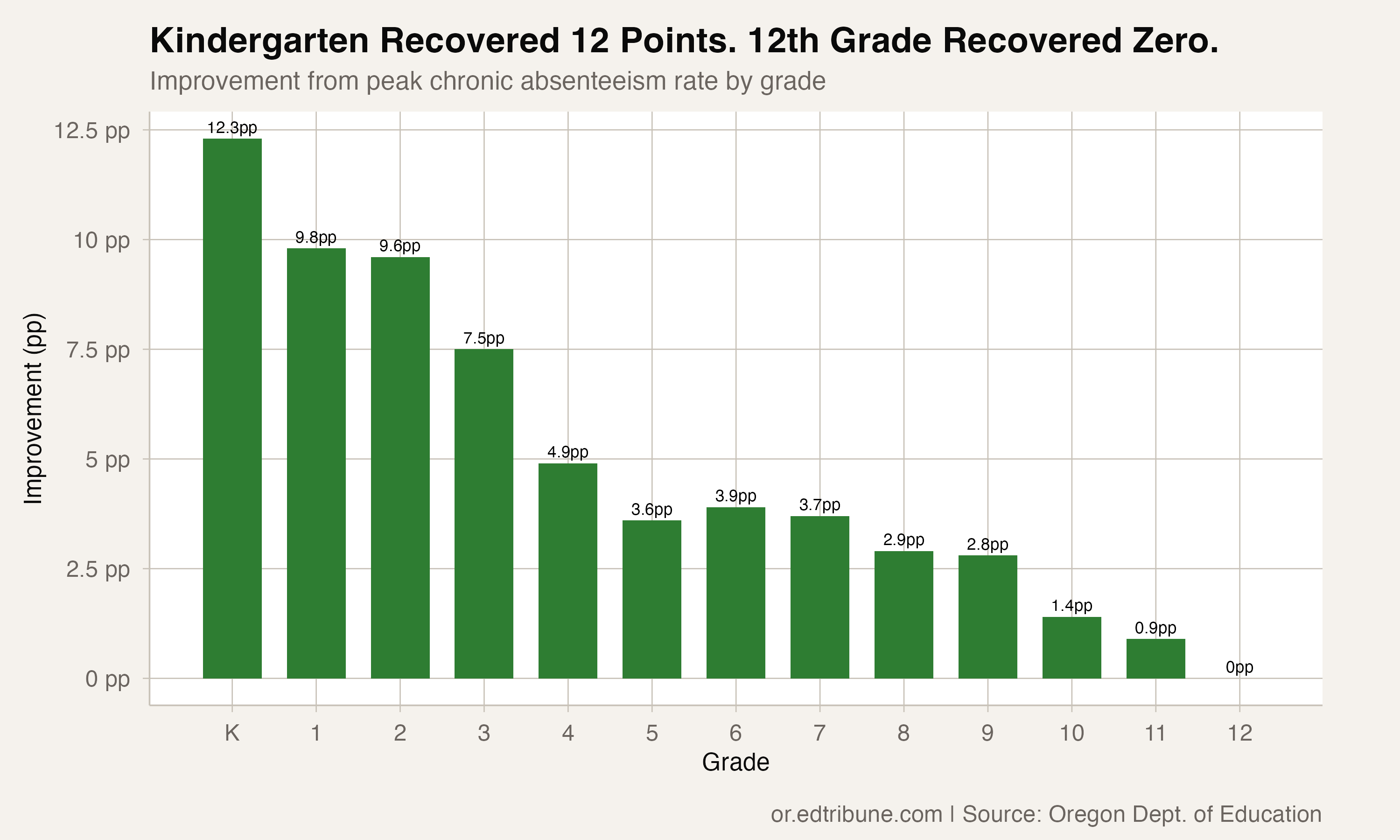
Twelfth grade's zero-point improvement is the extreme case of a broader pattern: whatever is bringing younger students back to school is not reaching older ones. Elementary schools may benefit from parents who can enforce attendance, from the social pull of childhood friendships, from the structure of a single classroom. By senior year, students are driving themselves, working part-time jobs, and making daily calculations about whether school is worth showing up for.
This was a crisis before COVID
The 12th-grade rate was already 39.3% in 2018-19, almost two in five seniors chronically absent before any pandemic disruption. COVID added 13 points. None of those 13 points have been recovered.
A pre-COVID rate of 39.3% suggests that the forces driving senior absenteeism (employment, early college enrollment, senioritis, credit accumulation that allows students to coast, disengagement) were already powerful. The pandemic may have normalized what was previously stigmatized: missing school became unremarkable when everyone was doing it. For seniors with enough credits to graduate, the stigma may never have returned.
What 52.5% costs
At 52.5% chronic absenteeism, the median Oregon senior misses roughly 18 days per year. But the chronic rate is a threshold measure. It counts students who miss 10% or more. Among the chronically absent, many miss far more than the minimum. A district where 52.5% of seniors are chronically absent is a district where a substantial number of seniors are functionally part-time students.
Oregon's graduation rate was 82.0% in 2023-24, according to the Oregon Department of Education. The relationship between chronic absenteeism and non-graduation is well-documented nationally. With more than half of seniors chronically absent, the state's graduation rate may be more fragile than it appears, sustained by credit recovery, alternative pathways, and systems designed to push students across the finish line despite their absence.
The elementary recovery is good news. But a system where kindergartners are returning to school while seniors are not creates a pipeline problem that will take a generation to resolve.
Detailed code that reproduces the analysis and figures in this article is available exclusively to EdTribune subscribers.
Discussion
Sign in to join the discussion.
Loading comments...