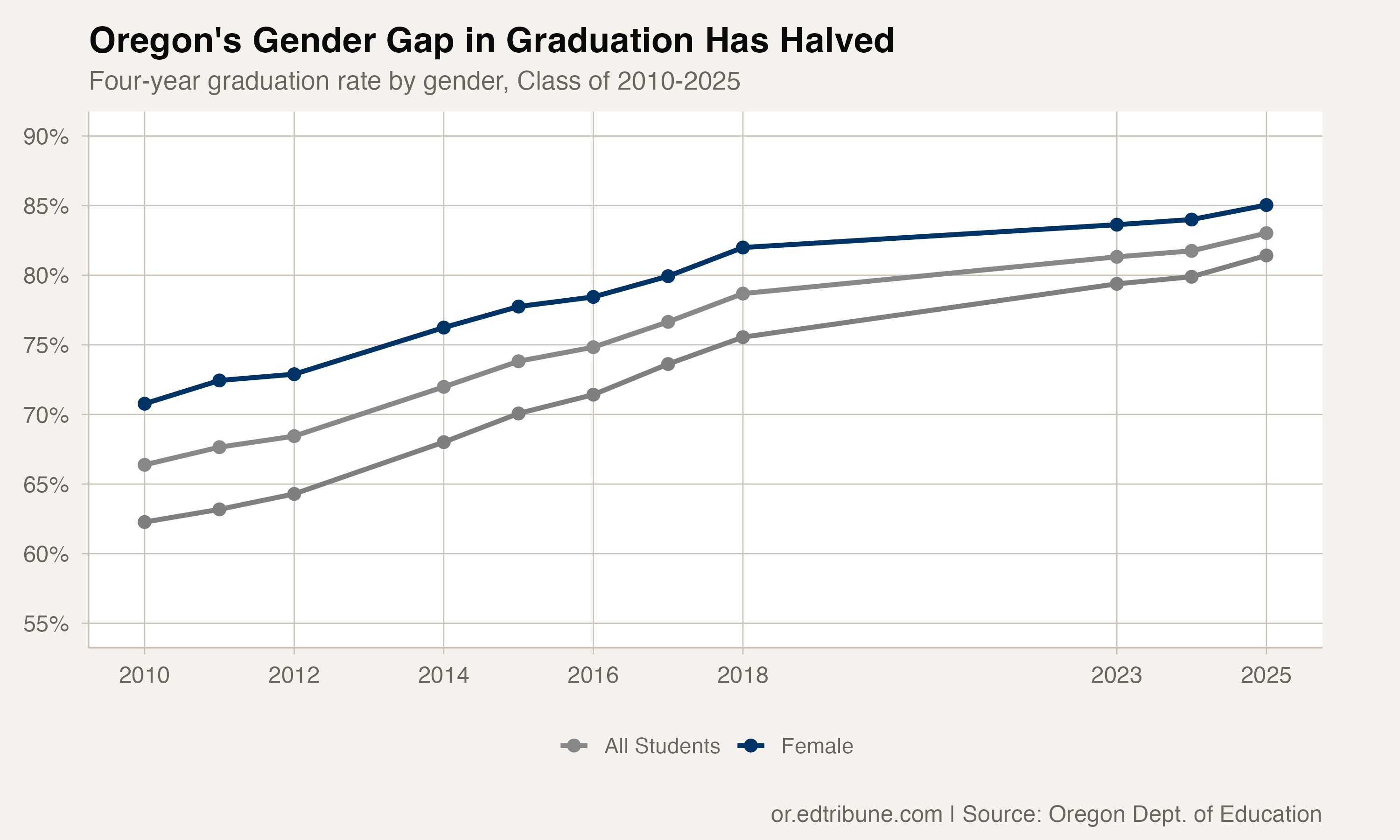
Male students gained 19.1 percentage points on Oregon's graduation rate since 2010. Female students gained 14.2. The result: a gender gap that was 8.5 points wide has shrunk to 3.6.
For the Class of 2025, young women graduated at 85.0% and young men at 81.4%. The gap has been halved not because female improvement stalled, but because male improvement outpaced it in nearly every reporting year.
The gap year by year
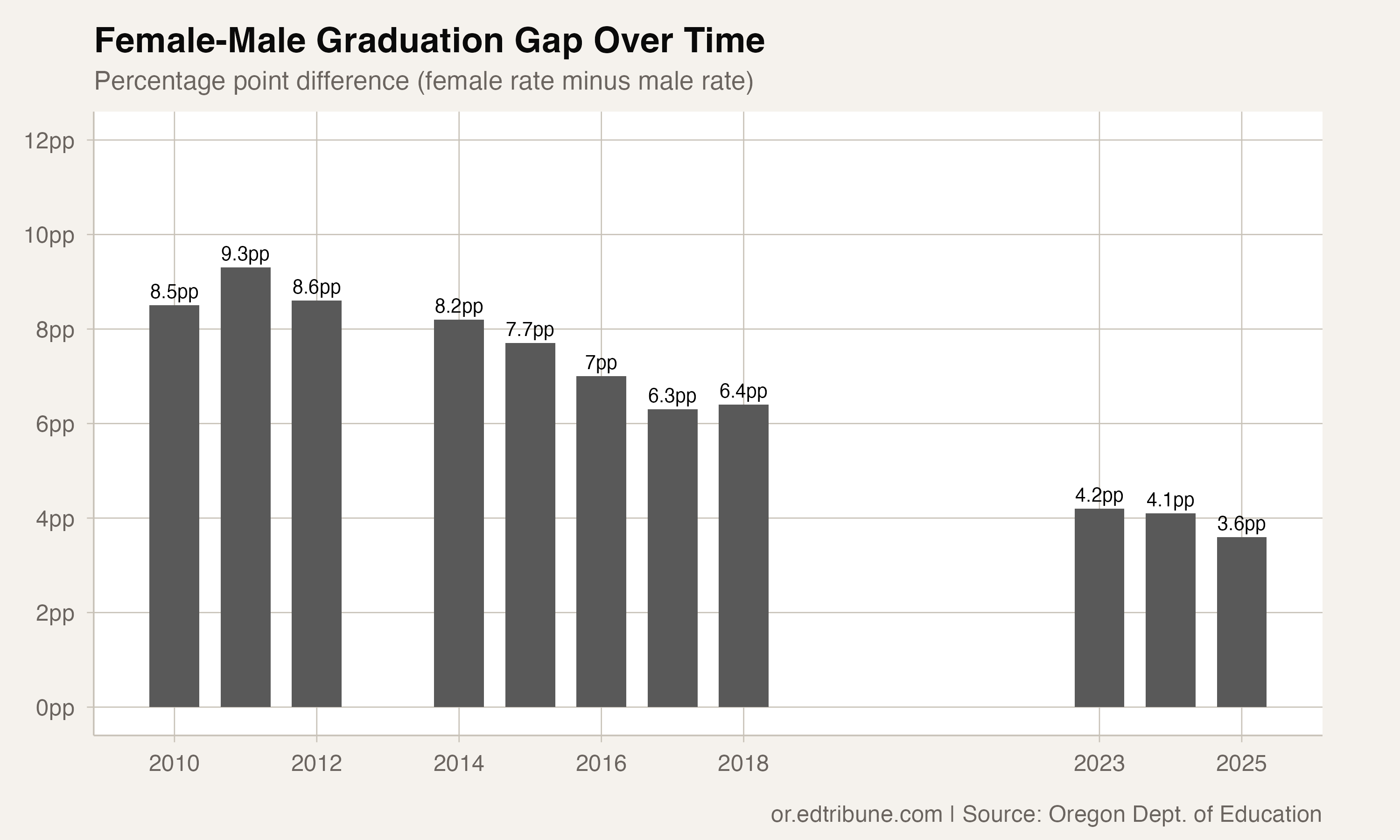
The decline was not smooth. Between 2010 and 2012, the gap held between 8.5 and 9.3 points. After a data gap (the 2013 graduation data is unavailable), it began narrowing in 2014, reaching 8.2 points when female students graduated at 76.2% and male students at 68.0%.
By 2018, the gap had compressed to 6.4 points. Oregon then stopped publishing comparable graduation data from 2019 through 2022 due to COVID-era testing and standard modifications. When reporting resumed with the Class of 2023, the gap had dropped to 4.2 points.
The most recent two years show the gap continuing to close: 4.2 points in 2024, then 3.6 points for the Class of 2025.
Oregon reports what most states do not
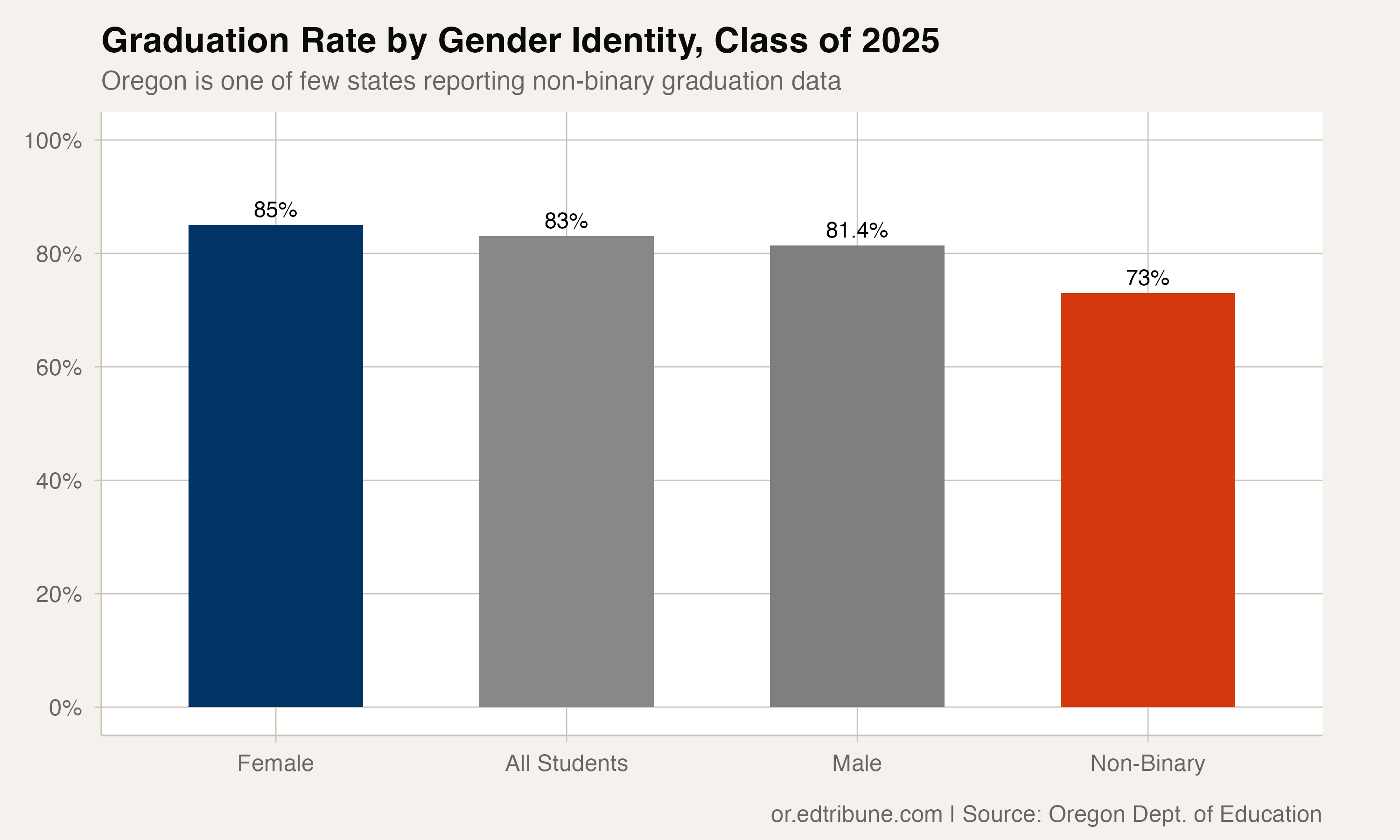
Oregon is one of a handful of states reporting graduation rates for students who identify as non-binary. The data, available for the first time with the Class of 2024, opens a window into an underexamined population.
For the Class of 2025, 581 non-binary students were in the graduating cohort. Their four-year graduation rate was 73.0%, about 10 points below the statewide average and 8.4 points below male students. In the first year of reporting (Class of 2024), the rate was 71.2% with 534 students.
The numbers are small enough that year-to-year fluctuations will be large, and two years of data are far too few to establish a trend. But the existence of the data itself matters. Most states do not track this population at all.
The testing question
Oregon suspended its essential skills testing requirement through the 2027-28 school year, which means the headline graduation rate reflects course credit completion alone, not a standardized proficiency bar. Whether the gender gap would be wider or narrower under the old testing regime is unknown.
The 3.6-point gap that remains is still meaningful. Applied to the Class of 2025, it represents roughly 900 more young men who did not earn a diploma in four years compared to what the rate would be if male students graduated at the female rate.
Detailed code that reproduces the analysis and figures in this article is available exclusively to EdTribune subscribers.
Discussion
Sign in to join the discussion.
Loading comments...