Every other racial group in Portland Public Schools has seen its graduation rate improve substantially since 2010. Asian students gained 27 points. White students gained 27. Hispanic students gained 36. Black students gained 26.
Native American students gained 11. And they have not gained anything in three years.
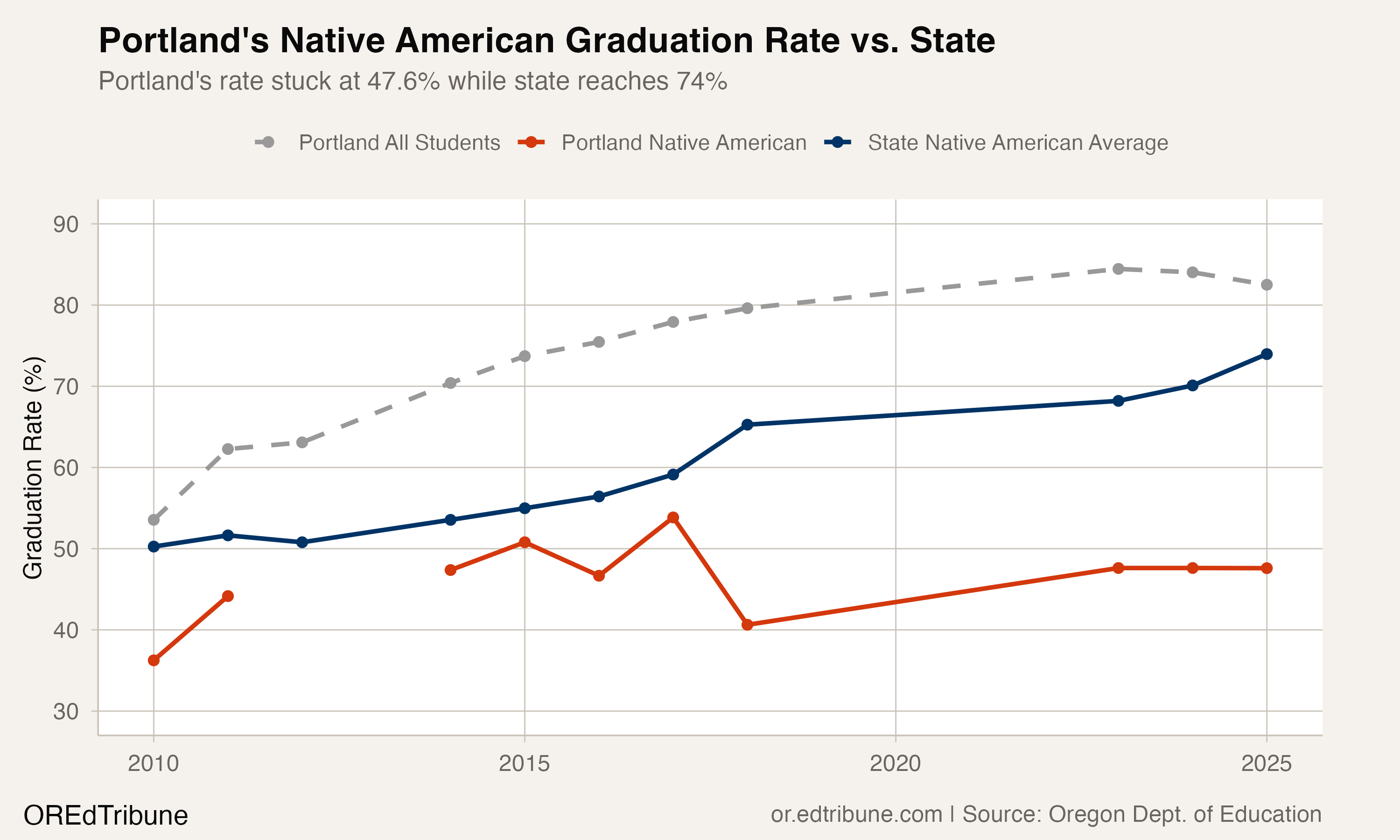
Portland's Native American graduation rate has been stuck at 47.6% for the Classes of 2023, 2024, and 2025. Fewer than half of the city's Native American students earn a diploma in four years. The rate is 35 points below Portland's overall average and 26 points below the statewide Native American rate of 74.0%.
Three Years of Stagnation
The 47.6% rate is not a floor that Portland is bouncing off. It appears to be a ceiling the district cannot break through. After improving from 36.2% in 2010 to the high 40s and low 50s in the mid-2010s, the rate crashed to 40.6% in 2018, recovered to 47.6% by 2023, and has not budged since.
| Year | Portland Native Am. | Portland All | Gap | State Native Am. |
|---|---|---|---|---|
| 2010 | 36.2% | 53.6% | 17.3 | 50.3% |
| 2014 | 47.4% | 70.4% | 23.0 | 53.6% |
| 2018 | 40.6% | 79.6% | 39.0 | 65.3% |
| 2023 | 47.6% | 84.4% | 36.8 | 68.2% |
| 2025 | 47.6% | 82.5% | 34.9 | 74.0% |
The most alarming column is the gap. As Portland improved for everyone else, the gap between Native American students and the district average widened from 17.3 points in 2010 to 34.9 points in 2025. The district got better. Native American students stayed in place.
The Urban-Rural Divide
The contrast with the statewide picture makes the failure more pointed. Oregon's overall Native American graduation rate climbed from 50.3% in 2010 to 74.0% in 2025, a 23.7-point gain. In Jefferson County, home to the Warm Springs Reservation, the rate is 86.8%.
Portland's rate of 47.6% means its Native American students graduate far below the statewide Native American average. The state's largest city, with the most resources and the most support organizations, produces worse outcomes for this population than rural tribal communities.
The 2025 cohort of 21 students is small, which means individual circumstances can swing the rate. But the three-year stagnation across similarly sized cohorts suggests this is not a statistical fluke.
Every Other Group Improved
Portland's overall graduation trajectory since 2010 is a genuine success story, from 53.6% to 82.5%, with large gains for every racial group. But placing those gains side by side reveals who was left behind:
| Group | 2010 | 2025 | Gain |
|---|---|---|---|
| Hispanic | 34.4% | 70.4% | +36.0 |
| Asian | 61.8% | 89.0% | +27.2 |
| White | 61.5% | 88.5% | +27.0 |
| Black | 45.8% | 71.8% | +26.0 |
| Native American | 36.2% | 47.6% | +11.4 |
Native American students gained less than a third of what Hispanic students gained, despite starting from similar baselines. The interventions that reached other historically underserved groups (bilingual services, culturally responsive teaching, dropout prevention programs) appear not to have reached Portland's Native American students with the same force.
What Portland Faces
Portland sits inside a region that the Native American Youth and Family Center describes as home to 90,000 Native people, and NAYA says it provides culture, education, support, and resources through more than 40 programs. Yet the graduation data suggests that the pipeline between community support and diploma completion has a significant break.
The district faces a question it has not answered in fifteen years of statewide improvement: why does every group improve except this one? The small cohort size means that targeted intervention with a few dozen students could move the rate meaningfully. The three-year stagnation suggests that whatever Portland is doing now is not enough.
Detailed code that reproduces the analysis and figures in this article is available exclusively to EdTribune subscribers.
Discussion
Sign in to join the discussion.
Loading comments...