Oregon's graduation rate for students classified as English learners stands at 69.8% for the Class of 2025, about 13 points below the state average. It is, on its face, a sobering number.
It is also incomplete.
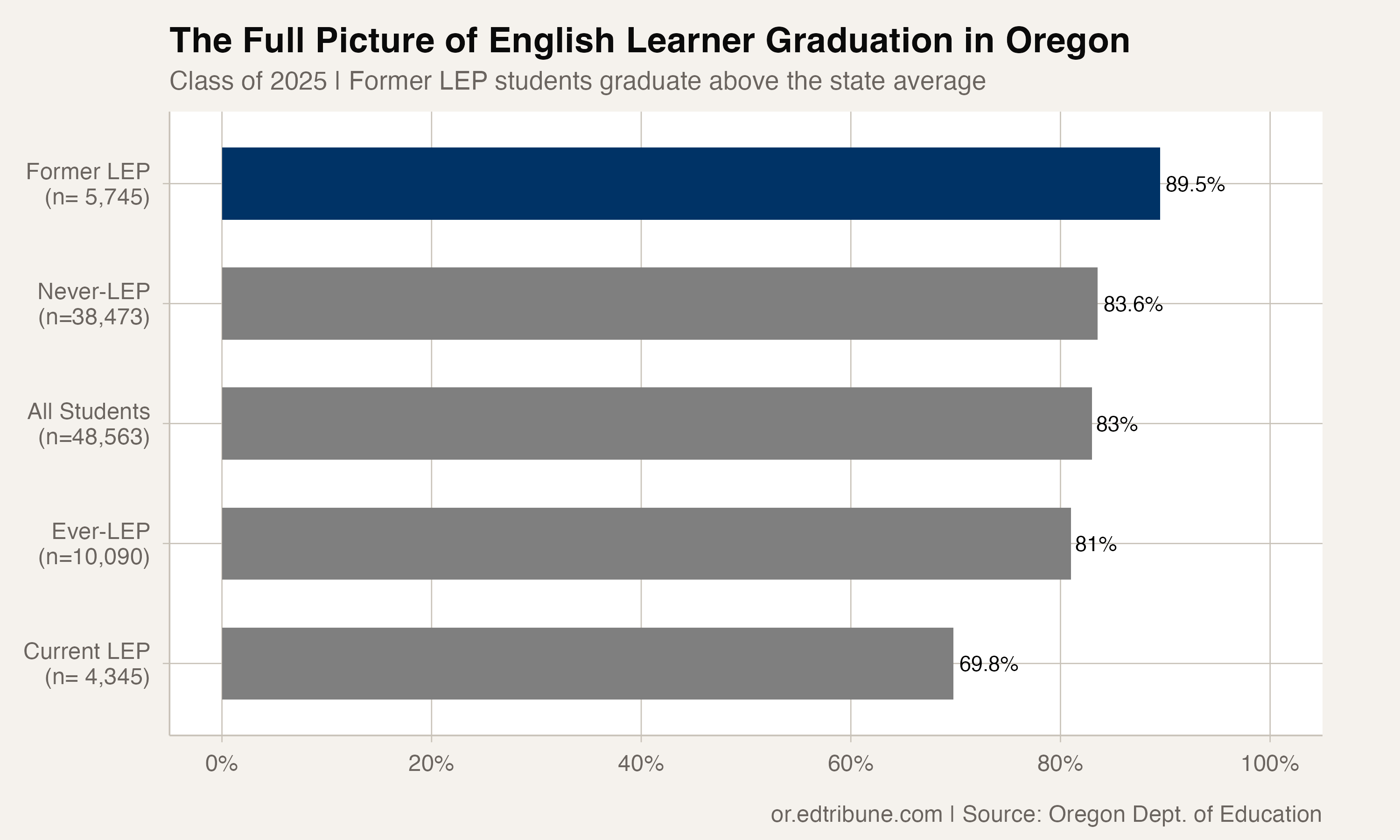
Oregon reports graduation rates not just for current English learners, but for students who were ever classified as English learners and for those who have exited EL services. That additional data tells a different story: students who were once English learners but gained enough proficiency to exit the program graduate at 89.5%, more than six points above the state average of 83.0%.
The gap is not about capacity. It is about timing.
Four categories, four outcomes
Oregon breaks English learner graduation data into categories that reveal the progression:
- Current LEP (still receiving services): 69.8%, 4,345 students
- Ever-LEP (ever classified, regardless of current status): 81.0%
- Former LEP (exited EL services): 89.5%
- Never-LEP (never classified): 83.6%
The pattern is striking. Students who were never English learners graduate at 83.6%, essentially the state average. Students who were once English learners but successfully transitioned graduate at 89.5%, the highest of the four English learner categories and well above the rate for students who never needed services. The lowest rate belongs to students who are still receiving services when they reach their expected graduation year.
The logical interpretation is that students who entered school speaking another language and then mastered English are, on average, among the most persistent and academically capable students in the system. The four-year graduation clock simply does not account for the years spent acquiring English.
A growing population
The number of current English learners reaching their graduation year has climbed back to 4,345 in 2025, up from a low of 1,884 in 2017. The cohort fell through the early 2010s, bottomed out late in the decade, and has more than doubled off that trough, returning to roughly where it stood in 2010. The recent rebound tracks broader demographic shifts in Oregon, where immigration from Latin America and elsewhere has reshaped school enrollment in the Portland metro area, the Willamette Valley, and agricultural communities across the state.
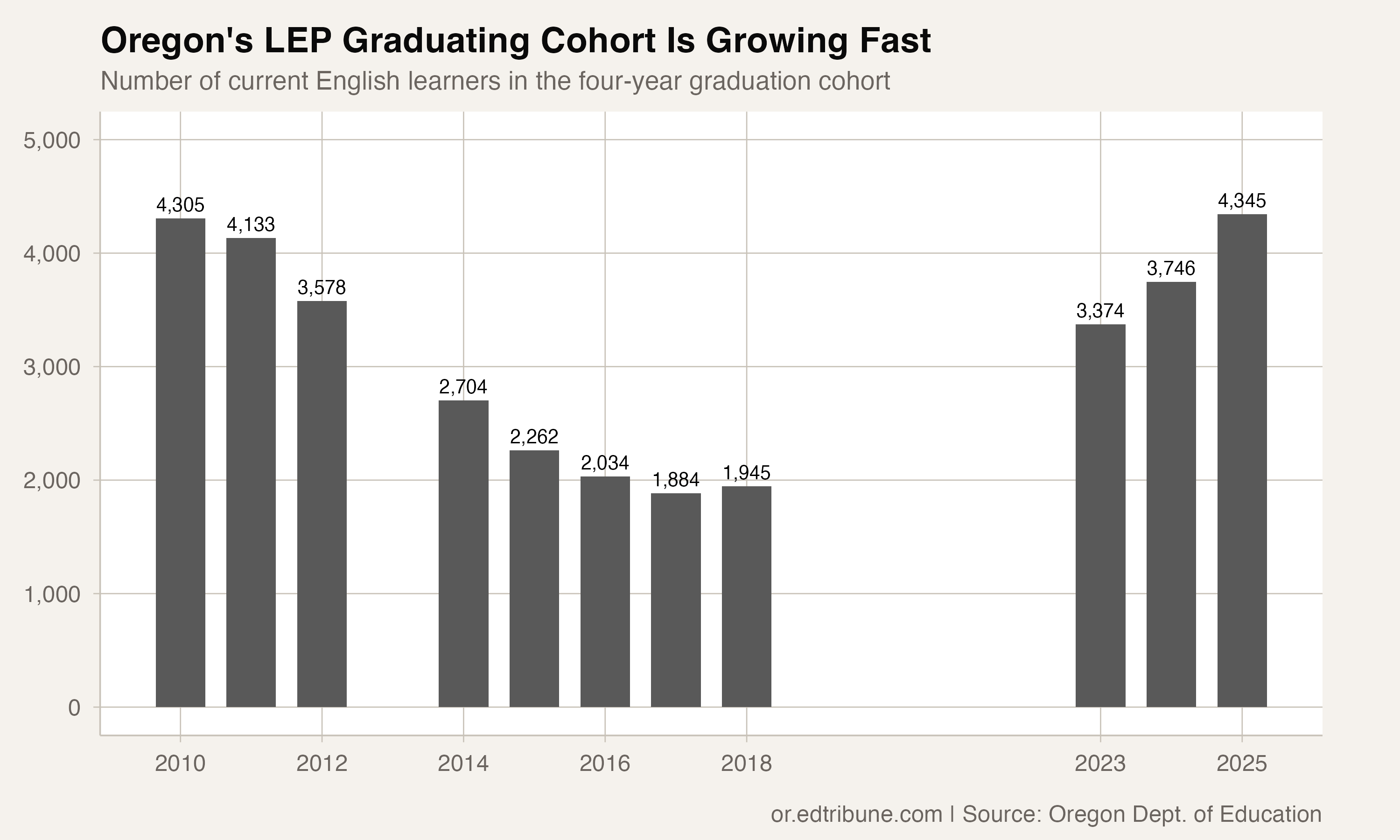
A larger cohort means the headline LEP graduation rate carries more weight in statewide accountability metrics than it did a few years ago. A 69.8% rate for 4,345 students represents roughly 1,312 English learners who did not graduate in four years. Many of them will graduate in a fifth or sixth year, but the four-year rate does not capture that.
The gap over time
The gap between current LEP students and all students has fluctuated but not meaningfully closed. In 2010, current LEP students graduated at 49.7%, some 16.7 points below the state average of 66.4%. By 2025, the gap has narrowed to 13.2 points, reflecting the broader rise in graduation rates that lifted all subgroups. The current LEP rate itself improved by 20.1 points over that span, though the gap narrowed by only 3.5 points because all groups were rising.
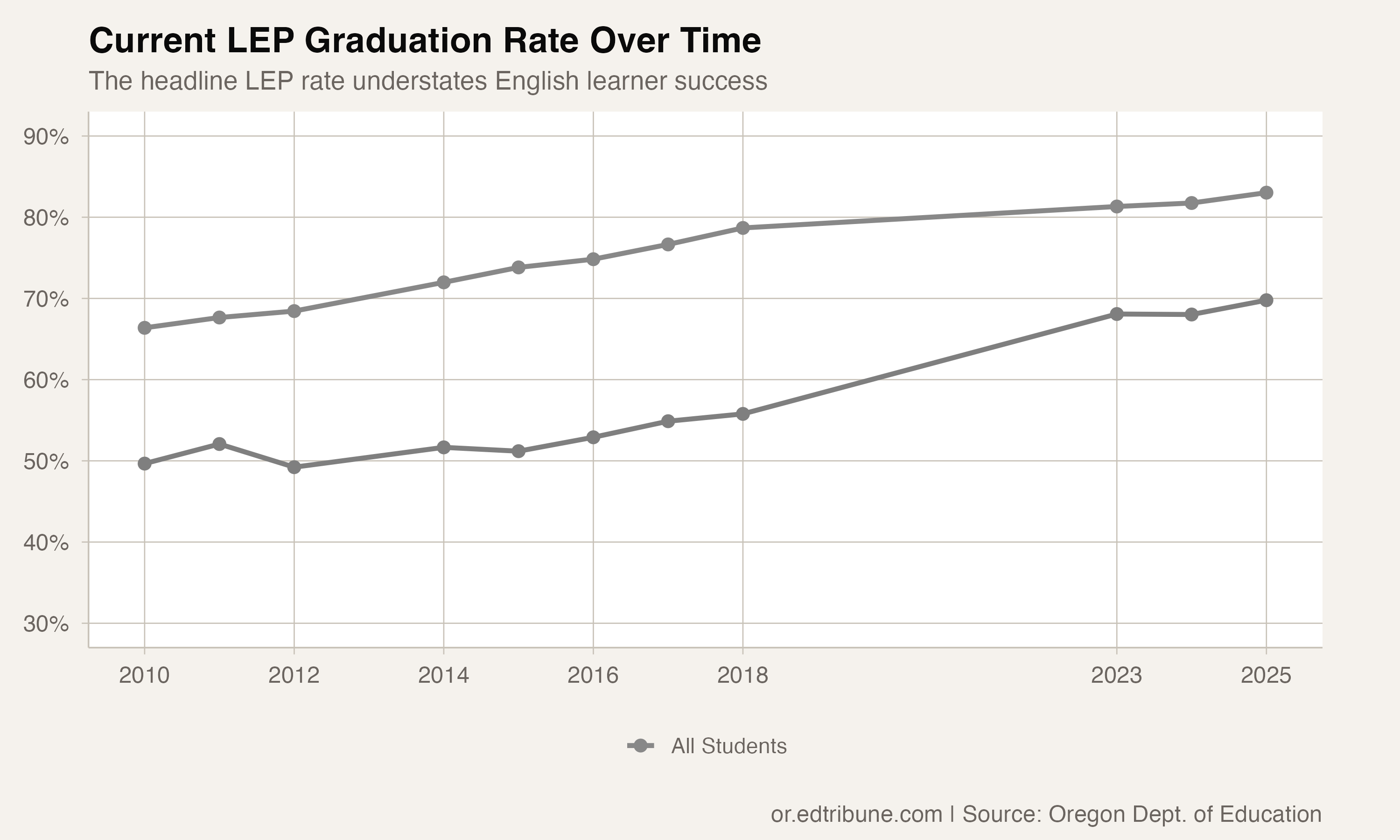
The more relevant comparison may be between current LEP and former LEP students. That 19.7-point gap (69.8% versus 89.5%) measures something closer to the effect of still being in language acquisition versus having completed it. It suggests that the primary intervention for improving English learner graduation rates may be accelerating the language acquisition timeline so that more students exit EL services before their cohort's four-year clock runs out.
What the data leaves open
The four-year graduation rate was designed for a population that enters ninth grade speaking English and advances through a standard course sequence. It was not designed for a student who arrives at age 15 from Guatemala and must simultaneously learn English and earn credits.
Oregon's decision to report ever-LEP and former-LEP rates is more transparent than most states, which report only the headline current-LEP rate. The fuller picture shows that English learners are not failing. Many are succeeding on a different timeline.
Four-year adjusted cohort graduation rate data from the Oregon Department of Education. Data covers the Class of 2010 through the Class of 2025, excluding years the state does not report at this level of detail (2013 and 2019 through 2022). Oregon reports graduation rates for current English learners, ever-English-learner, former English learner, and never-English-learner cohorts.
Detailed code that reproduces the analysis and figures in this article is available exclusively to EdTribune subscribers.
Discussion
Sign in to join the discussion.
Loading comments...