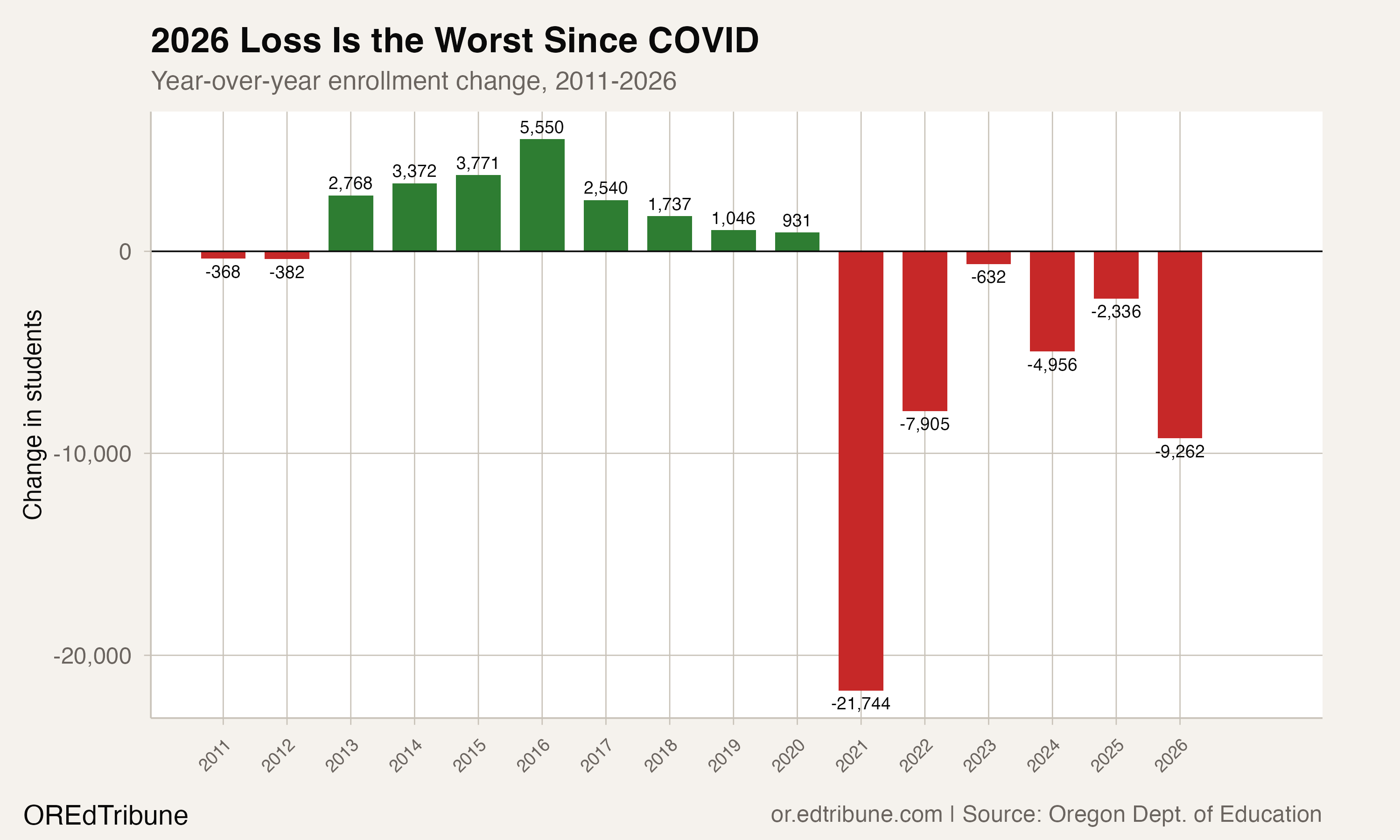
For five years after the pandemic emptied Oregon classrooms, the state's enrollment losses followed a recognizable pattern: a catastrophic COVID-year drop, then a slow bleed of a few thousand students per year as the system settled into a lower baseline. In 2023, the decline nearly stopped altogether, with just 632 fewer students than the year before. It looked like a floor.
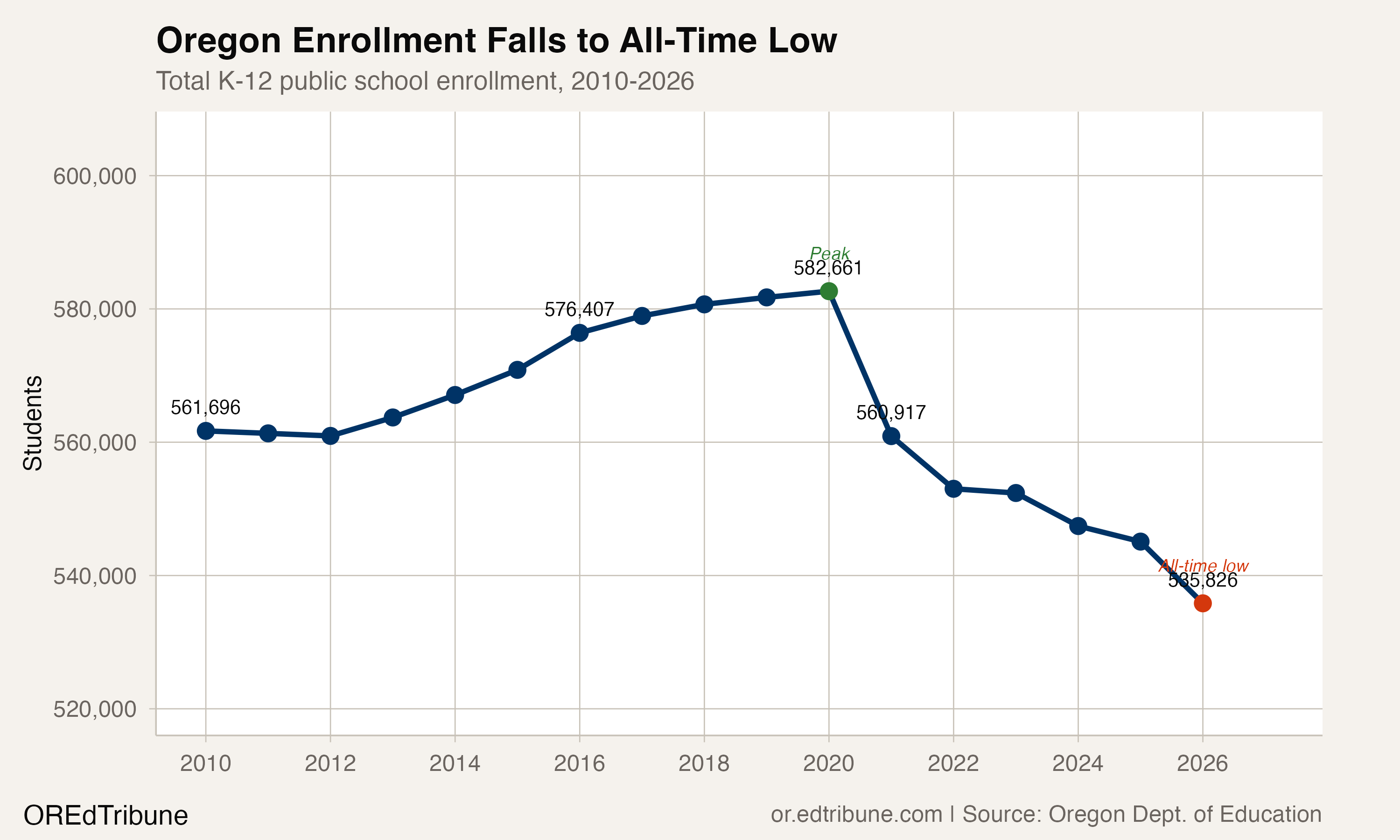
It was not. Oregon lost 9,262 students in 2026, nearly four times the 2025 loss of 2,336 and the second-largest single-year drop in the 17 years of data tracked here. Only the COVID crash of 2021, which erased 21,744 students overnight, was worse. At 535,826 total K-12 enrollment, Oregon has reached an all-time low, 46,835 students below its 2020 peak of 582,661, an 8.0% decline.
Not a slow bleed anymore
The acceleration is the headline, not the decline itself. Oregon has been losing students since 2021, but the three-year period from 2024 through 2026 erased 11,598 students, 1.4 times the 8,537 lost from 2021 through 2023. The 2023 near-stabilization now looks like a pause, not a turning point.
Had enrollment continued growing at its pre-pandemic rate (an average of 2,707 students per year from 2014 to 2020), Oregon would have had roughly 599,000 students in 2025-26. The actual figure is 63,000 below that projection, a gap equivalent to the entire enrollment of the state's three largest districts combined.
The high school cliff arrives
For years, the enrollment decline was concentrated in the elementary grades, where smaller birth cohorts and pandemic-era departures hit first. High schools were largely insulated because the students filling 9th through 12th grade in 2021-2024 were born before the birth rate decline steepened.
That buffer is gone. High school enrollment dropped by 4,768 students in 2026, the largest single-year HS loss in the dataset and nearly as large as the K-8 loss of 4,494. The high school sector peaked at 183,221 in 2023 and has now fallen to 177,524, a decline of 3.1% in three years.
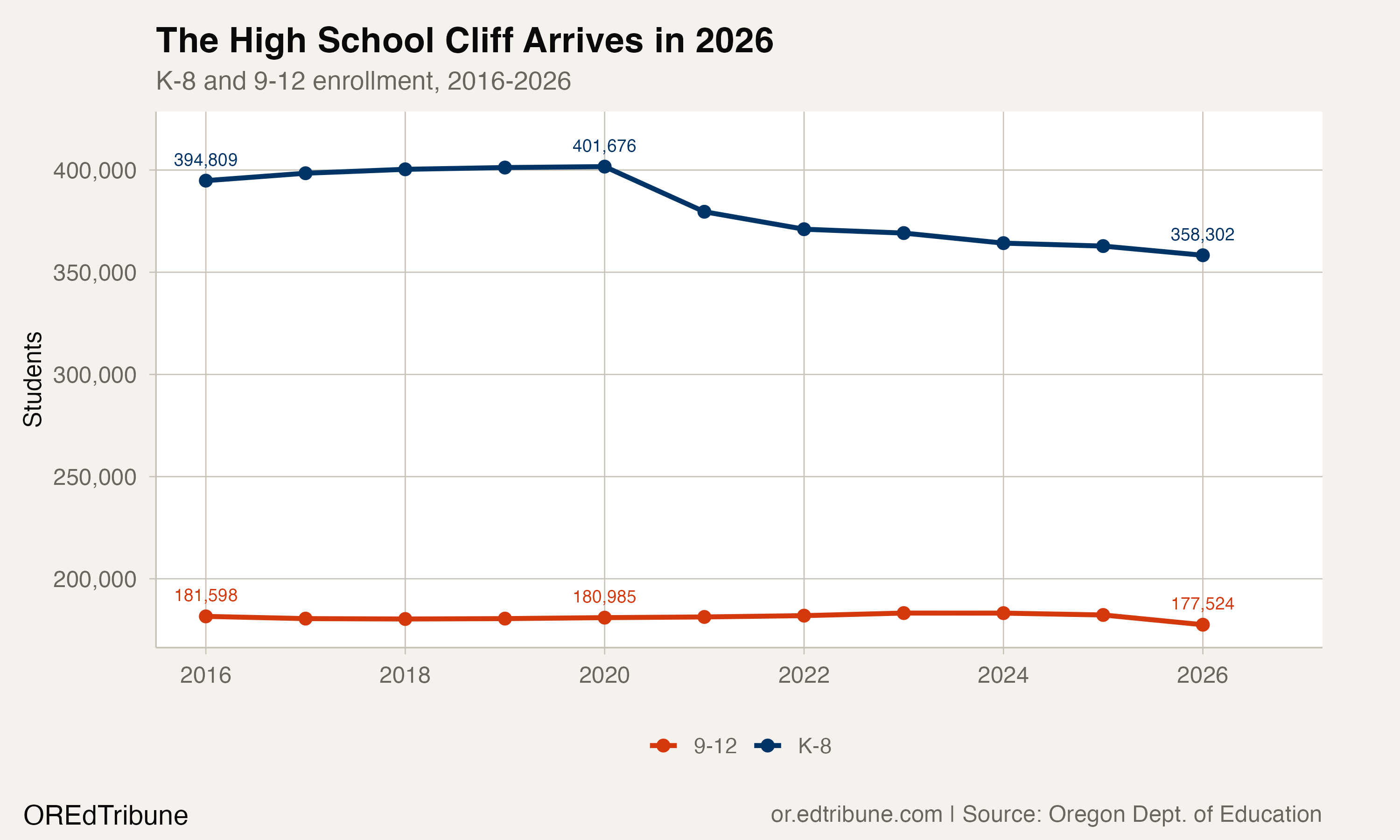
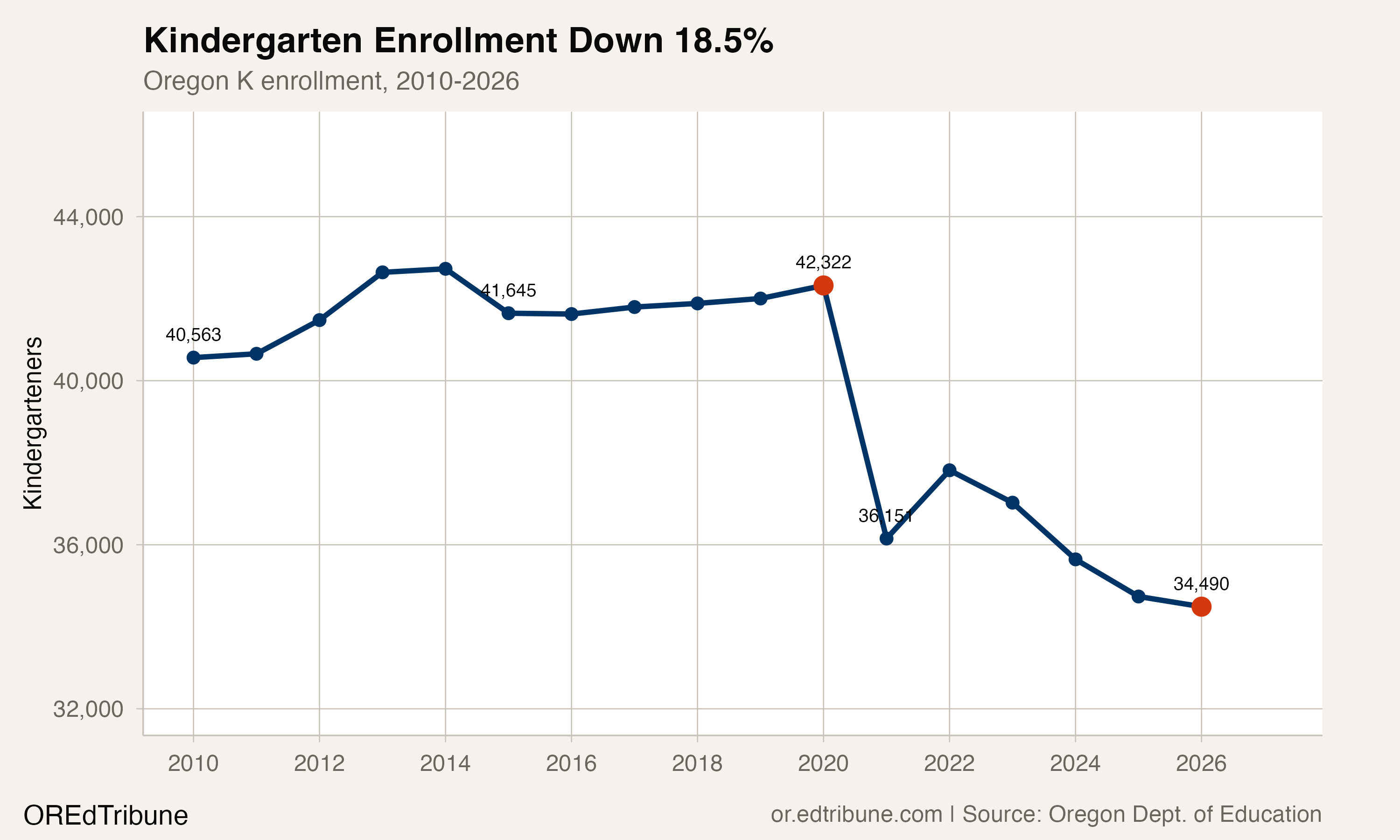
The K-8 decline is not slowing either. Elementary and middle school enrollment stands at 358,302, down 43,374 from its 2020 peak of 401,676, a 10.8% drop. Oregon's kindergarten class tells the starkest version of this story: 34,490 kindergarteners entered in 2026, down 18.5% from the 42,322 who enrolled in 2020. Every kindergarten cohort that falls short ripples through the system for 13 years.
Where the losses are concentrated
The decline is not evenly distributed. Of 208 districts with comparable year-over-year data, 148 lost students in 2026. Seventy districts hit their all-time enrollment low. The top three losses alone, Salem-Keizer (-1,309), Beaverton (-1,258), and Portland (-1,213), account for 3,780 students, 41% of the statewide loss.
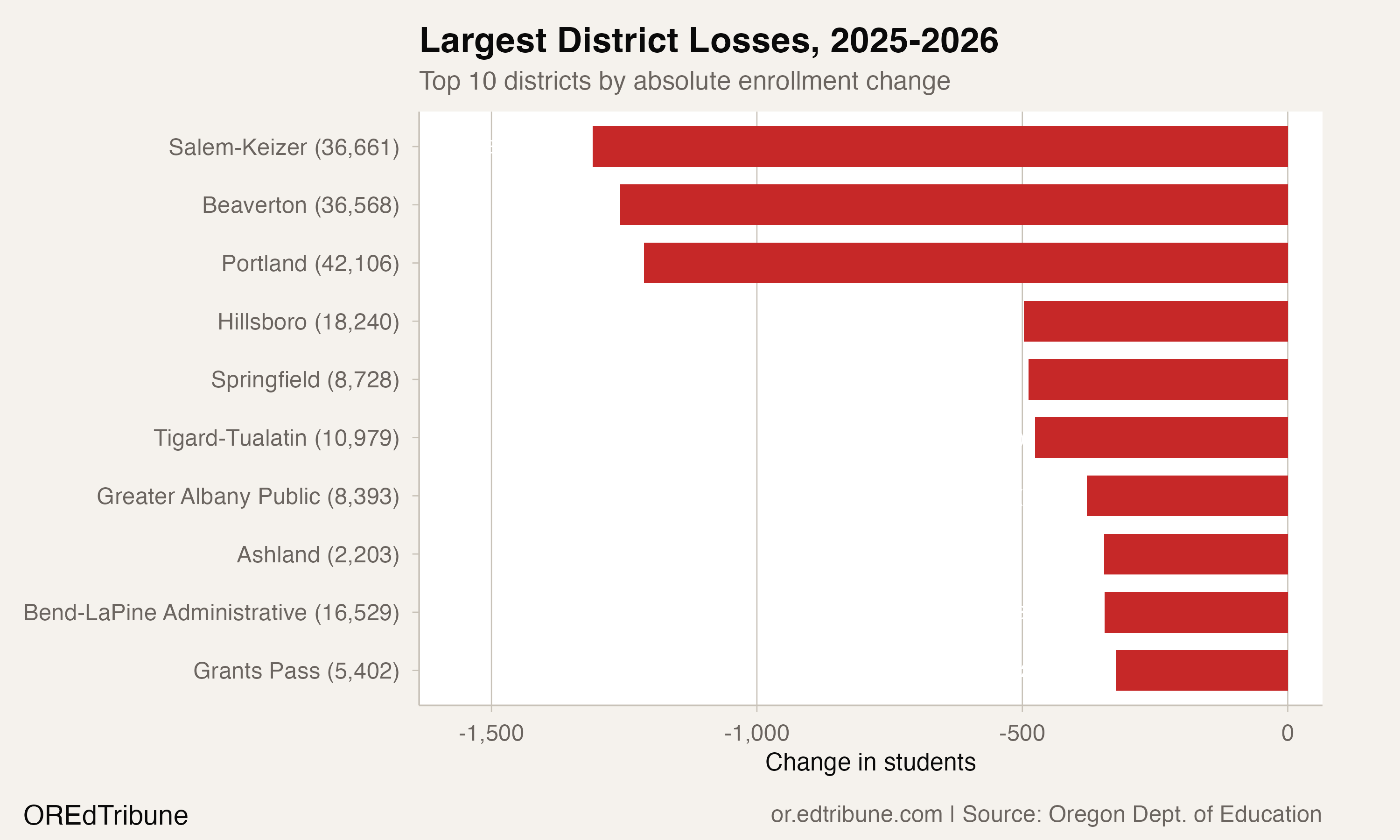
Salem-Keizer and Beaverton, once separated by thousands of students, now sit 93 students apart (36,661 and 36,568 respectively). Both have been in sustained decline: Salem-Keizer has lost 5,257 students (-12.5%) since peaking at 41,918 in 2018, Beaverton 4,647 (-11.3%) since its 2020 peak of 41,215. Portland, the state's largest district at 42,106, shed 1,213 students in 2026 alone, continuing a slide that has erased 6,571 students (-13.5%) since its 2019 peak of 48,677.
The 55 districts that gained students in 2026 are disproportionately home to statewide virtual charter schools. Baker SD 5J gained 666 students, but Baker Web Academy, a virtual charter hosted by the district, enrolls 3,752 of the district's 5,867 total students. Fossil SD 21J gained 818, but its Fossil Charter School is a statewide virtual program accounting for all 3,312 students. Scappoose SD 1J's gain of 1,358 students is almost entirely attributable to Scappoose Online Academy (1,412 students). When virtual charter hosts are excluded, the list of genuinely growing districts is thin.
Fewer babies, fewer families, fewer answers
The root mechanism is demographic. Oregon's birth rate has been declining for over a decade, producing progressively smaller kindergarten cohorts that compress enrollment from the bottom up. Salem-Keizer Superintendent Andrea Castañeda described the dynamic plainly to the Salem Reporter: "What it comes down to is mostly that people are having fewer babies than they once did and as those smaller number of babies hit kindergarten, it just starts squeezing our enrollment down and down and moves to the grades."
But birth rates alone do not explain why 2026 accelerated so sharply, or why 81% of districts that lost students during COVID have still not recovered six years later. A Brookings Institution analysis found that 12% of Oregon's school-aged children were "unaccounted for" as of 2021-22: living in the state but not enrolled in any public or private school. Oregon had the highest rate of unaccounted children among Western states studied. Sofoklis Goulas of Yale and Brookings told OPB that the gap cannot be fully explained by private school enrollment:
"We do not see the increase in the share of school-aged children not attending public schools to be fully explained by a corresponding bump in private school enrollment."
Housing costs are a plausible accelerant for the urban districts driving the statewide total. Portland Public Schools' own enrollment forecasts, revised downward in January 2025, now project the district will fall below 40,000 students by 2028-29, a 27% decline from where 2015 projections expected the district to be. A FutureEd analysis cited by Willamette Week attributed part of urban enrollment loss to domestic migration, with families relocating out of high-cost metro areas. John Horvick of DHM Research told the paper: "It just seems really fast, the shift in population demographic changes."
A competing explanation is that families who left during the pandemic never returned and have settled into homeschooling, private schooling, or non-enrollment. Oregon reported a 72% increase in homeschooling in the first two years of the pandemic. Ethan Sharygin of Portland State University's Population Research Center noted that data on these alternatives remains poor: "The picture on what's going on at homeschool is pretty murky, and the same thing goes for private."
The budget math
Enrollment decline translates directly into revenue loss under Oregon's State School Fund, which distributes money on a per-student basis. Salem-Keizer, losing roughly 1,000 students annually, is preparing $23 million in cuts for the coming year, including 60 teaching positions and 60 classified staff roles. Superintendent Castañeda framed it as preemptive:
"Salem-Keizer is not in financial crisis. We're getting ahead of a predictable problem, so that we do not start burning our reserves too early."
Portland Public Schools faces a $40 million shortfall with 228 positions at risk. The fixed-cost problem is structural: buildings, bus routes, and administrative functions do not shrink proportionally when a classroom loses three students. Districts must absorb the per-pupil funding loss while maintaining the infrastructure designed for a larger student body.
A first for Hispanic enrollment
One signal buried in the statewide data: Hispanic enrollment fell by 1,486 students in 2026, from 144,114 to 142,628. Outside the COVID year of 2021, this is the first decline in Hispanic enrollment in the dataset, which begins in 2016. From 2016 to 2025, Hispanic enrollment grew every non-COVID year, adding 14,704 students. The 2026 reversal, a 1.0% drop, is modest in isolation but breaks a sustained growth trend. Whether this reflects the same birth-rate compression hitting all demographic groups, or a distinct phenomenon such as changes in immigration patterns, cannot be determined from enrollment data alone.
What the next five years look like
A WICHE report published in late 2024 projected that Oregon's high school graduating class will shrink by 19%, roughly 8,000 students, by 2041. Ben Cannon, executive director of Oregon's Higher Education Coordinating Commission, said: "We know that we're already not producing enough well-trained workers for a number of critical industries, and declining high school and college completion numbers will stretch an already-tight labor force even further."
The kindergarten pipeline makes the near-term trajectory legible. Oregon enrolled 34,490 kindergarteners in 2026, 7,832 fewer than the 42,322 who entered in 2020. Those missing kindergarteners will not appear in first grade next year. They were never born, or they live in Oregon but attend a private school or are homeschooled, or their families moved to a state where housing costs less. The enrollment decline is not a temporary disruption to be waited out. It is the new baseline, and the 2026 acceleration suggests the system has not yet found its floor.
Detailed code that reproduces the analysis and figures in this article is available exclusively to EdTribune subscribers.
Discussion
Sign in to join the discussion.
Loading comments...