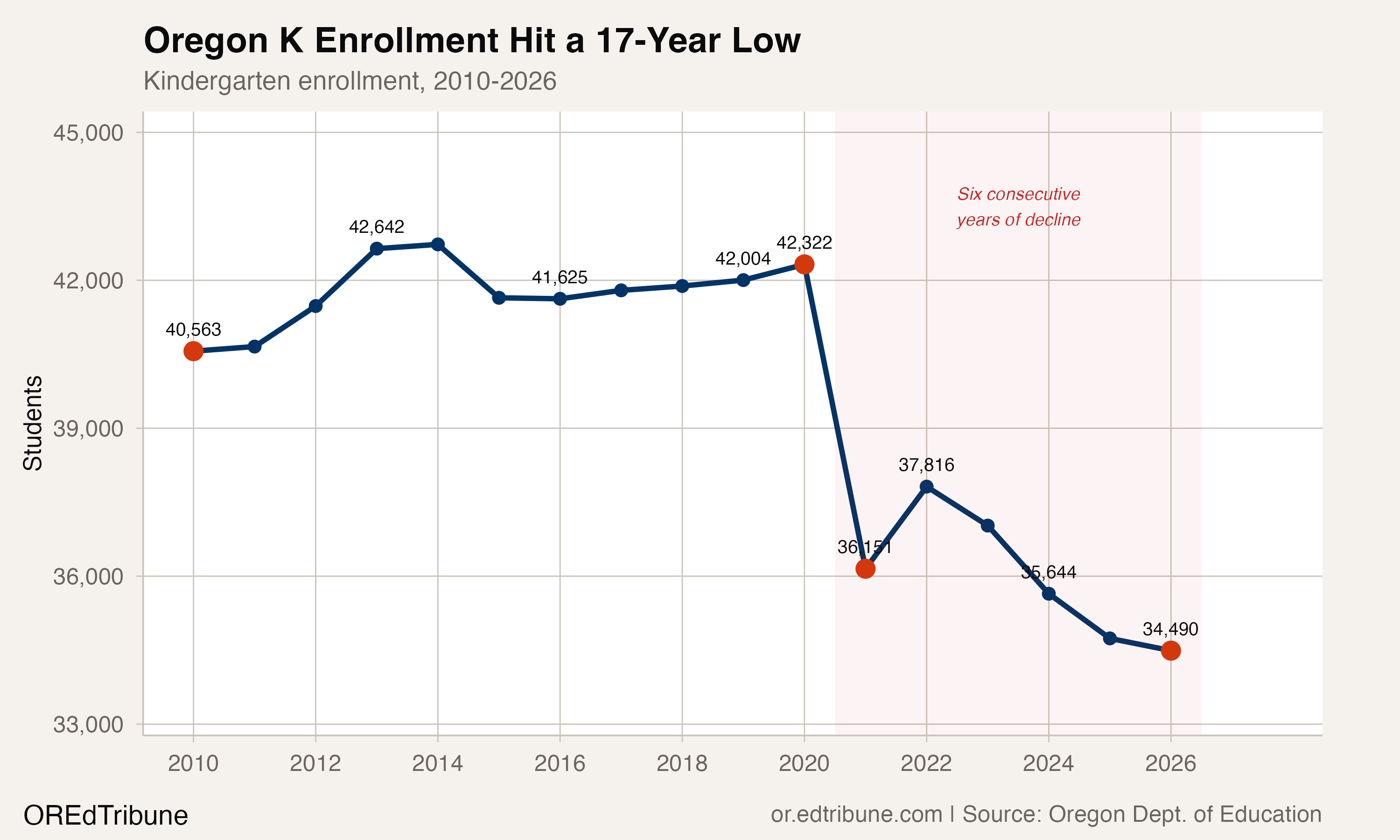
Oregon enrolled 34,490 kindergartners in 2025-26. That is the smallest K class in at least 17 years of state data, and it is 7,832 students fewer than the 42,322 who started kindergarten in 2019-20. The decline, 18.5% in six years, is not a blip caused by a single bad year. Kindergarten enrollment has fallen every year since the pandemic, and the 2026 class is smaller than even the COVID-disrupted 2021 class that shocked districts into emergency planning.
The number matters because kindergarten is the mouth of the pipeline. Every student who does not enter K in 2025-26 is a student who will not reach 5th grade in 2031, 8th grade in 2034, or 12th grade in 2039. Oregon's overall enrollment has already fallen 8.0% from its 2020 peak of 582,661 to 535,826. The kindergarten data shows that decline will not stabilize for at least another decade.
Six years of shrinking classes
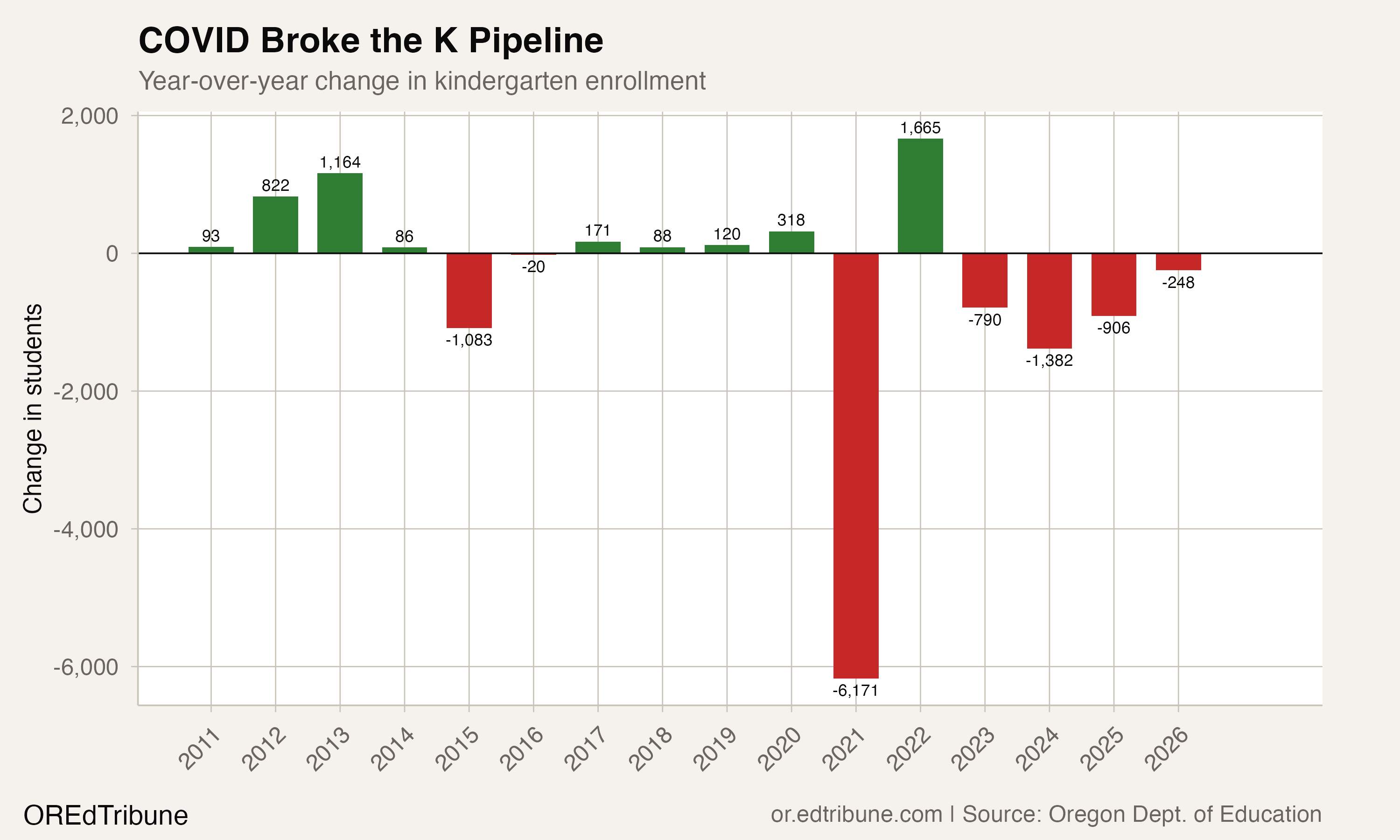
Before COVID, Oregon's K enrollment was remarkably stable. From 2010 to 2020, it fluctuated in a narrow band between 40,563 and 42,728, never moving more than 2.8% in a single year. The pandemic broke that pattern. In 2020-21, K enrollment plunged by 6,171 students, a 14.6% single-year drop.
A partial recovery followed: 1,665 kindergartners returned in 2021-22. But since then, K enrollment has declined in four consecutive years. The drops have been significant: -790 in 2023, -1,382 in 2024, -906 in 2025, and -248 in 2026. The pandemic did not merely cause a one-time dip. It broke the floor.
First grade confirms this is a true pipeline contraction, not merely families delaying K entry. First grade enrollment fell from 42,439 in 2010 to 35,950 in 2026, a 15.3% decline that closely mirrors the K trajectory. If families were simply holding children back a year, first-grade classes would be larger than the preceding year's K class. They are not. The K-to-1st-grade transition ratio has remained between 102% and 107% since 2022, consistent with pre-pandemic patterns.
The arithmetic of guaranteed decline
The starkest way to see where Oregon is headed is to compare kindergartners entering the system with seniors leaving it. In 2020, the gap between K enrollment (42,322) and 12th-grade enrollment (45,959) was 3,637 students. By 2026, that gap has tripled to 11,358: there are 34,490 kindergartners but 45,848 seniors.
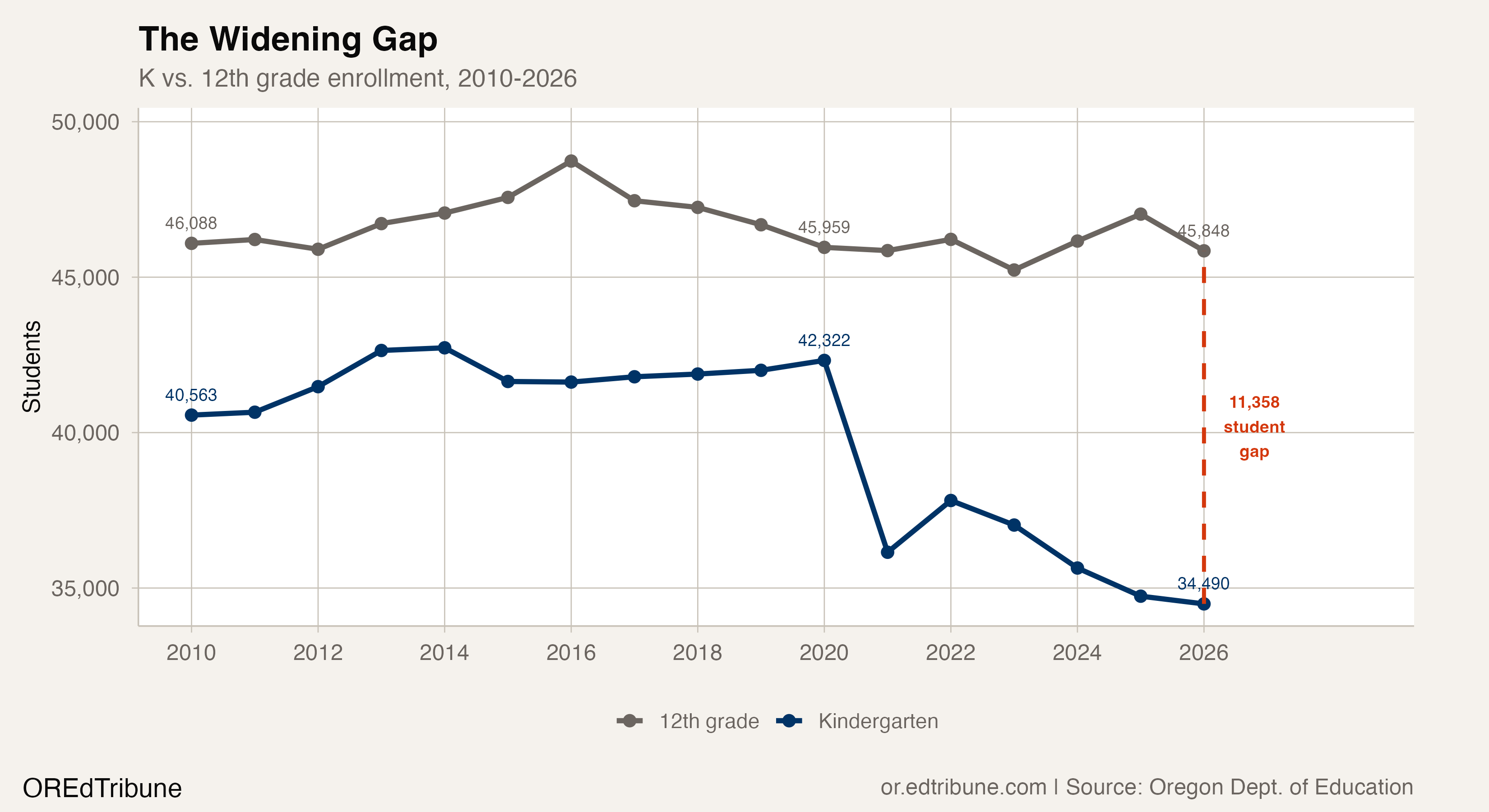
Each year, Oregon graduates a 12th-grade class roughly 11,000 students larger than the K class entering behind it. Until that gap closes, total enrollment will continue to fall by roughly that margin annually, independent of any policy intervention. The Western Interstate Commission for Higher Education (WICHE) projects Oregon will produce 19% fewer high school graduates by 2041, or about 8,000 fewer graduates per year. The K enrollment data suggests that projection is already baked in.
Ben Cannon, executive director of Oregon's Higher Education Coordinating Commission, put it bluntly:
"We know that we're already not producing enough well-trained workers for a number of critical industries, and declining high school and college completion numbers will stretch an already-tight labor force even further." -- OPB, Dec. 2024
A gradient from K to 12th
The enrollment losses are not evenly distributed across grades. Since 2020, every grade has lost students, but the pattern forms a steep gradient: K is down 18.5%, 1st grade is down 16.4%, and the losses taper steadily upward to 12th grade, which is essentially flat at -0.2%.
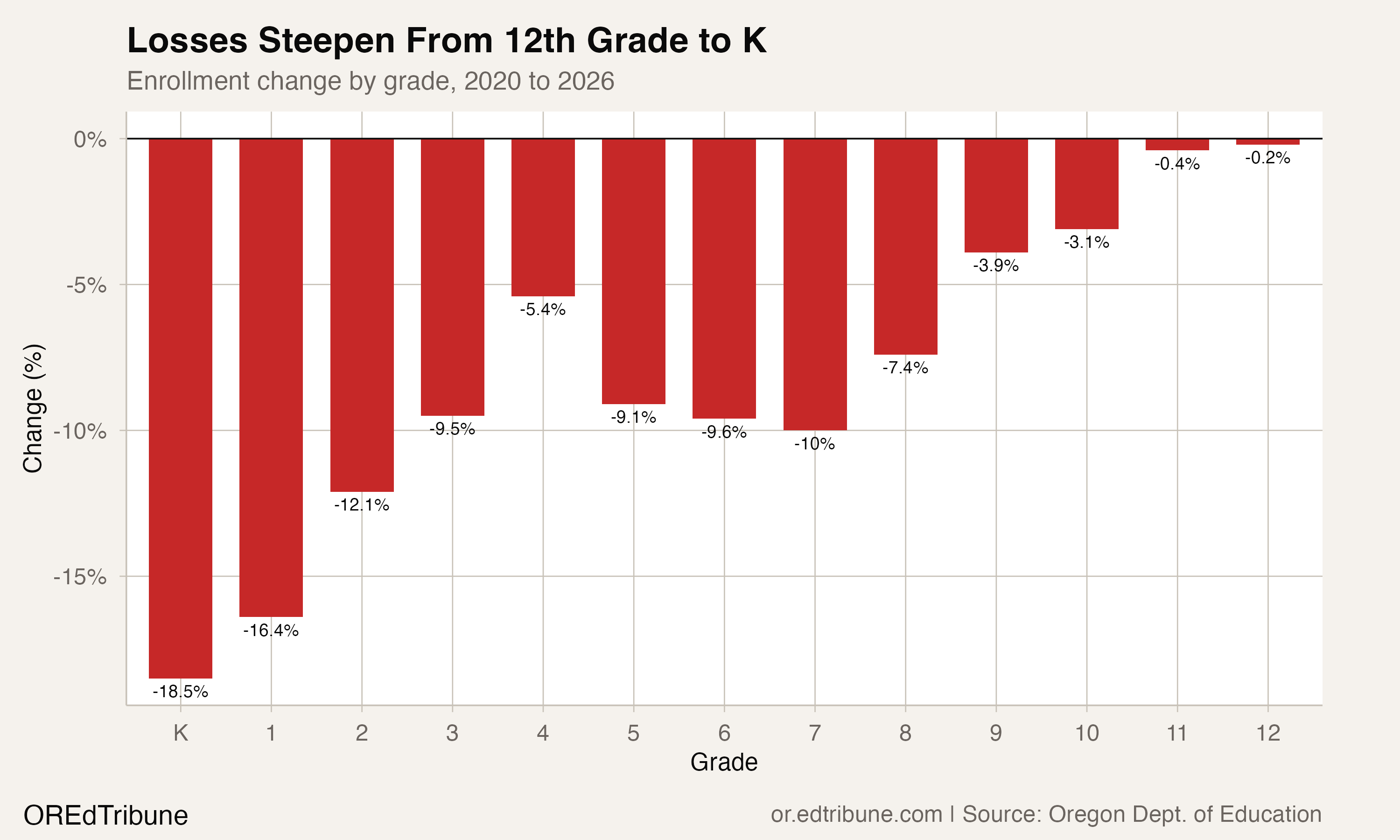
This gradient is the pipeline effect in real time. The smaller cohorts that entered K in 2021 and after are now moving through the elementary grades, pulling down enrollment as they go. Elementary (K-5) enrollment has fallen from its 2017 peak of 266,496 to 231,058 in 2026, a loss of 35,438 students (13.3%). High school grades (9-12), still filled with the larger pre-pandemic cohorts, have barely budged: their share of total enrollment has risen from 31.1% in 2020 to 33.1% in 2026, not because more students are entering high school, but because fewer are entering elementary school.
Fewer babies, fewer kindergartners
The most direct driver of the K decline is straightforward: Oregon is producing fewer children. The state's birth rate ranks among the lowest in the nation, at roughly nine births per 1,000 residents, below every state except Maine, New Hampshire, and Vermont. Since 2021, Oregon has recorded more deaths than births every year, a reversal of a pattern that had held since records began. Prior to 2010, the state averaged about 15,000 more births than deaths annually.
The population of Oregonians aged 0 to 4 dropped by 37,000 between 2020 and 2024, the largest decline of any age group. Those children are the kindergarten classes of 2025 through 2029. The pipeline has not yet finished emptying.
Birth rates alone do not explain the full 18.5% K decline since 2020, however. An OPB investigation found that 37,000 students have left Oregon public schools since 2020, and the Oregon Department of Education estimates that more than 20,000 students currently residing in the state have left public K-12 enrollment for other educational settings. Homeschooling registrations surged 72% in the first two years of the pandemic, and private school enrollment absorbed some families as well, though researchers note the shift to non-public education does not fully account for the missing students.
"We do not see the increase in the share of school-aged children not attending public schools to be fully explained by a corresponding bump in private school enrollment." -- Sofoklis Goulas, Yale University researcher, OPB, Nov. 2025
Housing affordability is a plausible contributing factor, though difficult to quantify with enrollment data alone. Oregon's housing deficit stands at 128,000 affordable units for low-income households, and costs in the Portland metro area run well above the national average. Whether high housing costs are suppressing birth rates, pushing young families to other states, or both, is an open question the enrollment data cannot answer.
Where the losses concentrate
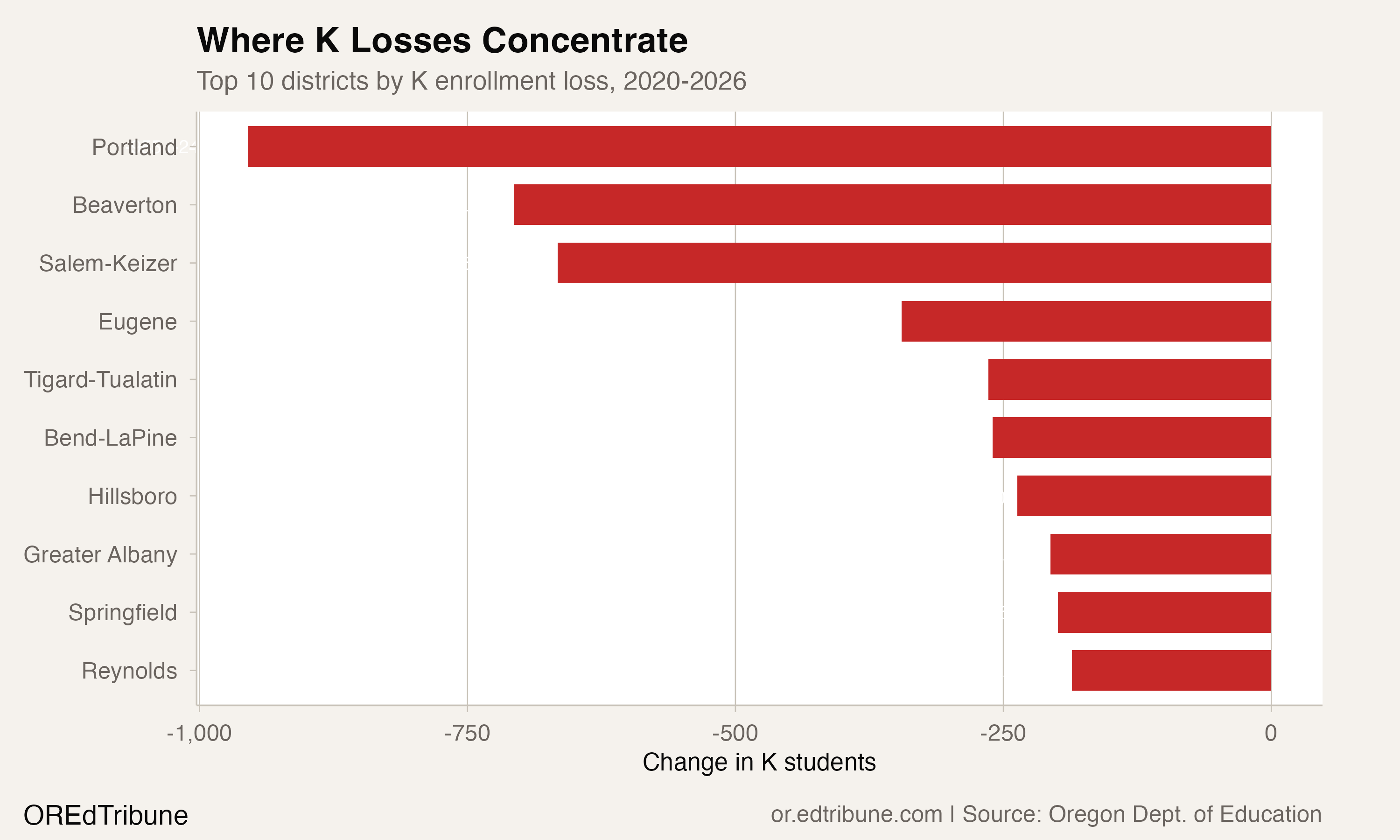
Nearly three in four Oregon districts (154 of 209, or 73.7%) enrolled fewer kindergartners in 2026 than in 2020. The losses are heavily concentrated in the state's largest districts. Portland lost 955 K students (24.7%), Beaverton lost 707 (22.9%), and Salem-Keizer lost 666 (22.6%). Those three districts alone account for nearly 30% of the statewide K loss. The top 10 losing districts account for more than half the statewide K decline.
The fiscal consequences are already materializing. Portland Public Schools faces a $40 million budget shortfall for 2025-26, with 228 positions on the line. Salem-Keizer, which has lost 4,900 students since 2018, is cutting $23 million and may eliminate 120 teaching positions.
What to watch next
The 2021 COVID kindergarten class, the smallest in the dataset at 36,151, is now in 5th grade. By 5th grade this cohort has grown to 41,226 students, partly because late enrollees and students from non-public settings rejoined the system. But every K class since 2021 has been even smaller. The 2026 kindergartners, numbering 34,490, will flow through the system for the next 12 years, and the classes behind them will likely be smaller still given ongoing birth rate declines.
Oregon's K enrollment will not recover to pre-pandemic levels absent a reversal in birth rates that demographers have not predicted, a sustained wave of in-migration with young children, or a substantial shift of families from private and home education back to public schools. None of those is impossible. None is expected. The 34,490 children who walked into Oregon kindergartens this September are the first grade class of 2027, the fifth grade class of 2031, the seniors of 2039. Every year between now and then, total enrollment will fall — not because something went wrong, but because fewer children exist.
Detailed code that reproduces the analysis and figures in this article is available exclusively to EdTribune subscribers.
Discussion
Sign in to join the discussion.
Loading comments...