Fossil, Oregon has fewer than 500 residents and one school. That school enrolled 3,312 students last year.
Fossil SD 21J↗ET, a district whose sole campus is the Fossil Charter School, reports enrollment more than six times the population of its host town. The students are not in Fossil. They are scattered across Oregon, logging into a virtual distance learning program from bedrooms and kitchen tables in Portland, Eugene, and Bend. In state enrollment data, they count as Fossil students, making a tiny Wheeler County district appear to be growing faster than Beaverton.
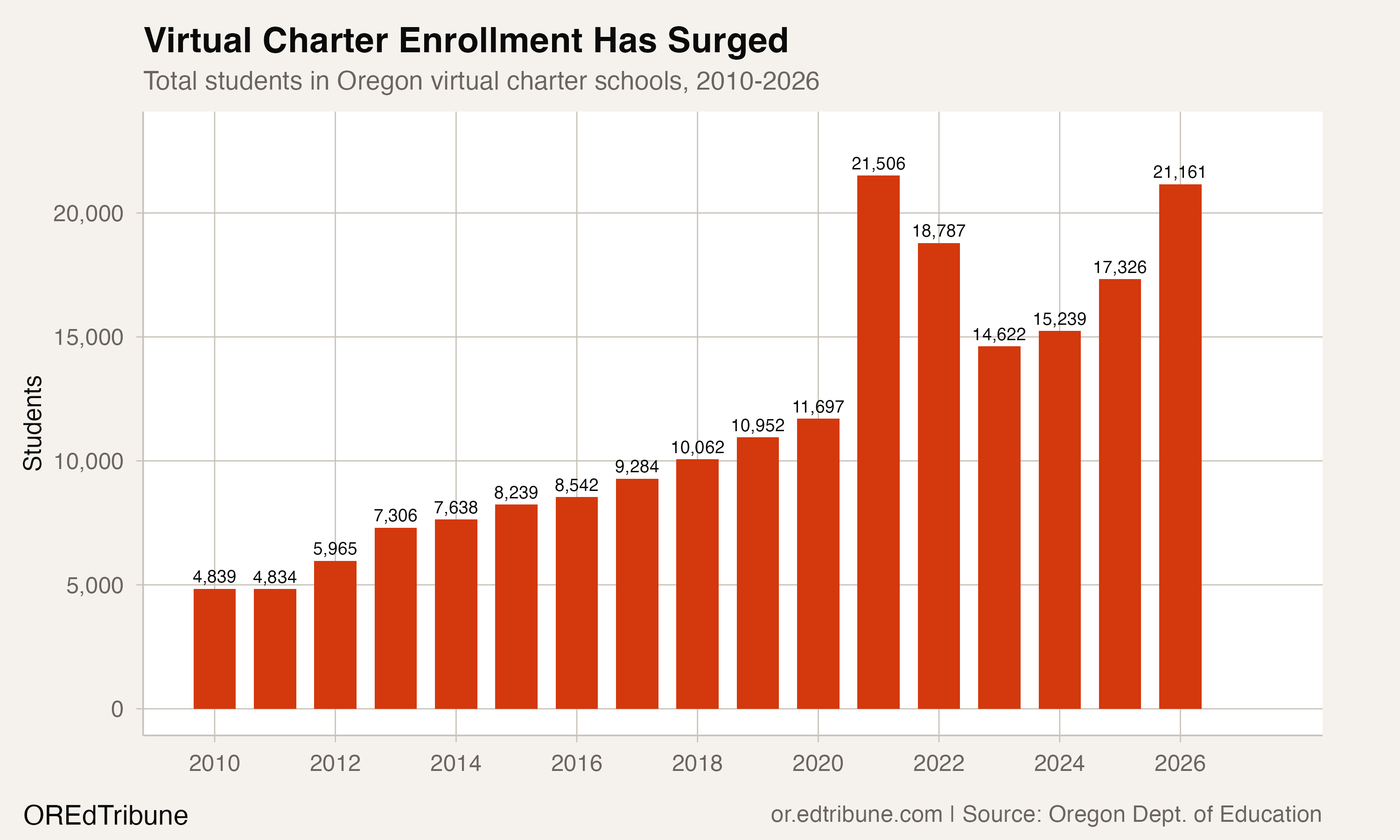
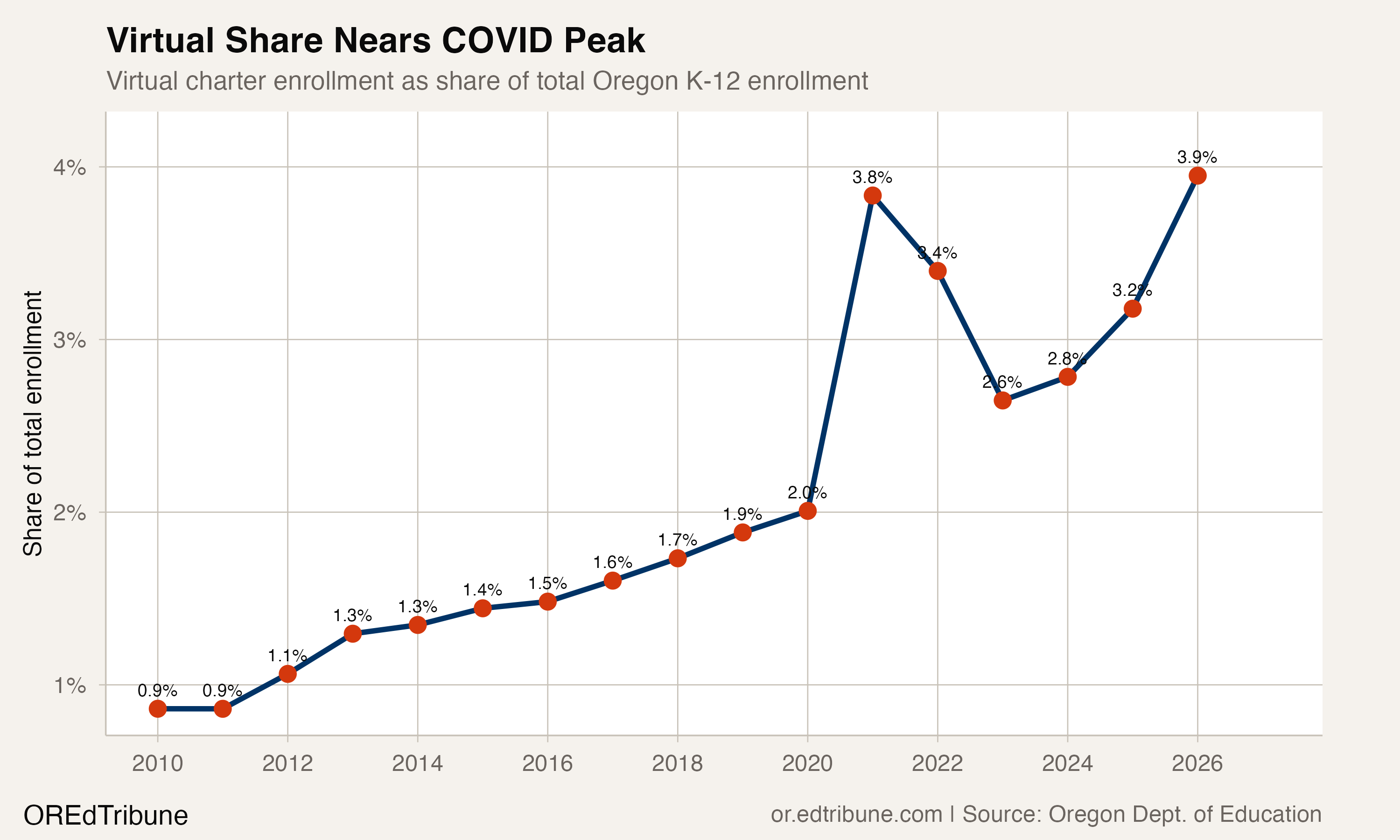
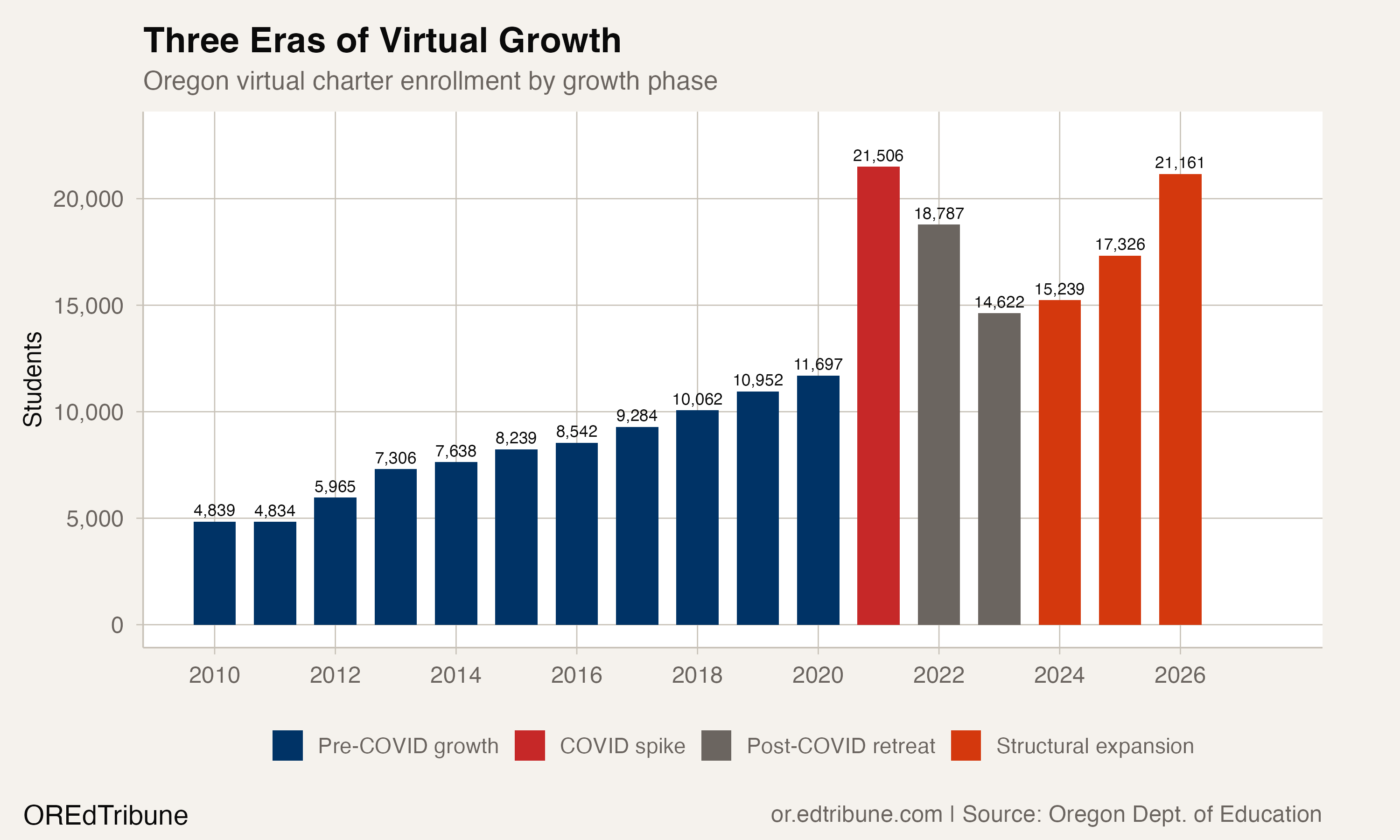
This is not an anomaly. It is the design of Oregon's virtual charter system, and it is accelerating. In 2025-26, 26 virtual schools enrolled 21,161 students, 3.9% of Oregon's total K-12 enrollment. That figure has nearly matched the COVID-era peak of 21,506 in 2020-21, but the composition is different: in 2021, the spike was emergency-driven and temporary. In 2026, it is structural and still climbing.
From emergency to infrastructure
Oregon's virtual charter sector predates the pandemic by more than a decade. In 2010, 18 online schools enrolled 4,839 students, less than 1% of total enrollment. Growth was steady but modest through the 2010s, averaging about 690 additional students per year, reaching 11,697 by 2020.
Then COVID hit. Virtual enrollment nearly doubled in a single year, jumping 9,809 students (83.9%) to 21,506 in 2020-21 as families sought alternatives to closed or disrupted classrooms. What followed was a partial retreat: enrollment fell 32.0% over the next two years, bottoming at 14,622 in 2022-23 as in-person instruction resumed.
The retreat did not hold. Since that 2023 low, virtual enrollment has grown 44.7%, adding 6,539 students in three years. The 2025-26 figure of 21,161 sits at 98.4% of the pandemic peak. Oregon's virtual charter sector is now larger than all but three of the state's school districts: only Portland, Salem-Keizer, and Beaverton enroll more students.
Eight schools over 1,000
The sector is top-heavy. Eight virtual schools each enroll more than 1,000 students, and together they account for 16,161 of the sector's 21,161 total, 76.4%.
Baker Web Academy, hosted by Baker SD 5J↗ET, is the largest at 3,752 students. The school describes itself as a K-12 online program and has more than doubled since 2019, when it enrolled 1,808.
Fossil Charter School is second at 3,312, followed by Oregon Charter Academy (2,511) in Santiam Canyon SD 129J↗ET and Cascade Virtual Academy (1,470) in Mitchell SD 55↗ET.
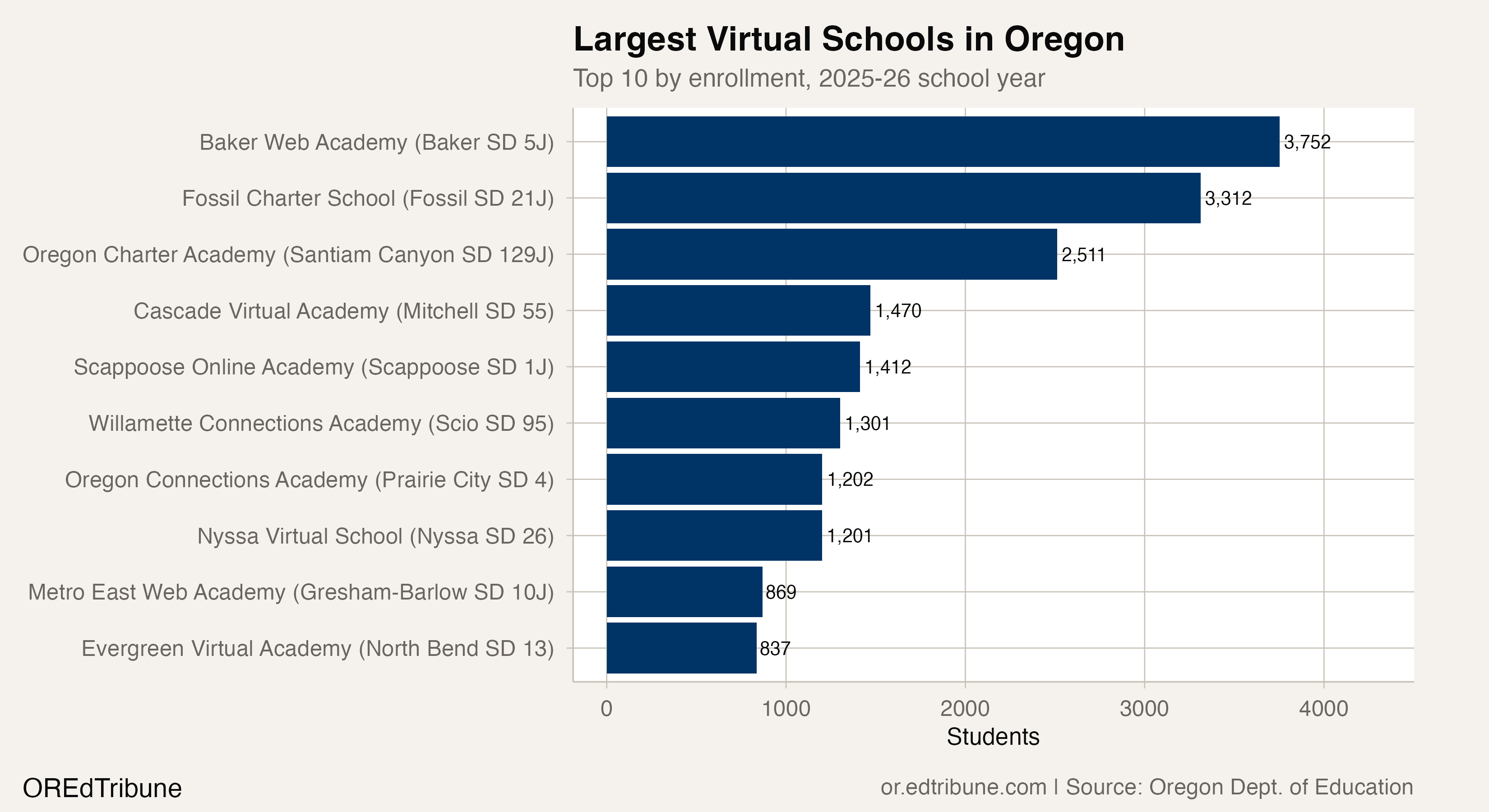
Fifteen of the 26 virtual schools did not exist in 2019. Those 15 new schools collectively enroll 8,380 students, accounting for 39.6% of the sector. Oregon Charter Academy, Willamette Connections Academy, Nyssa Virtual School, and Oregon Connections Academy are each post-2019 entrants enrolling more than 1,000 students.
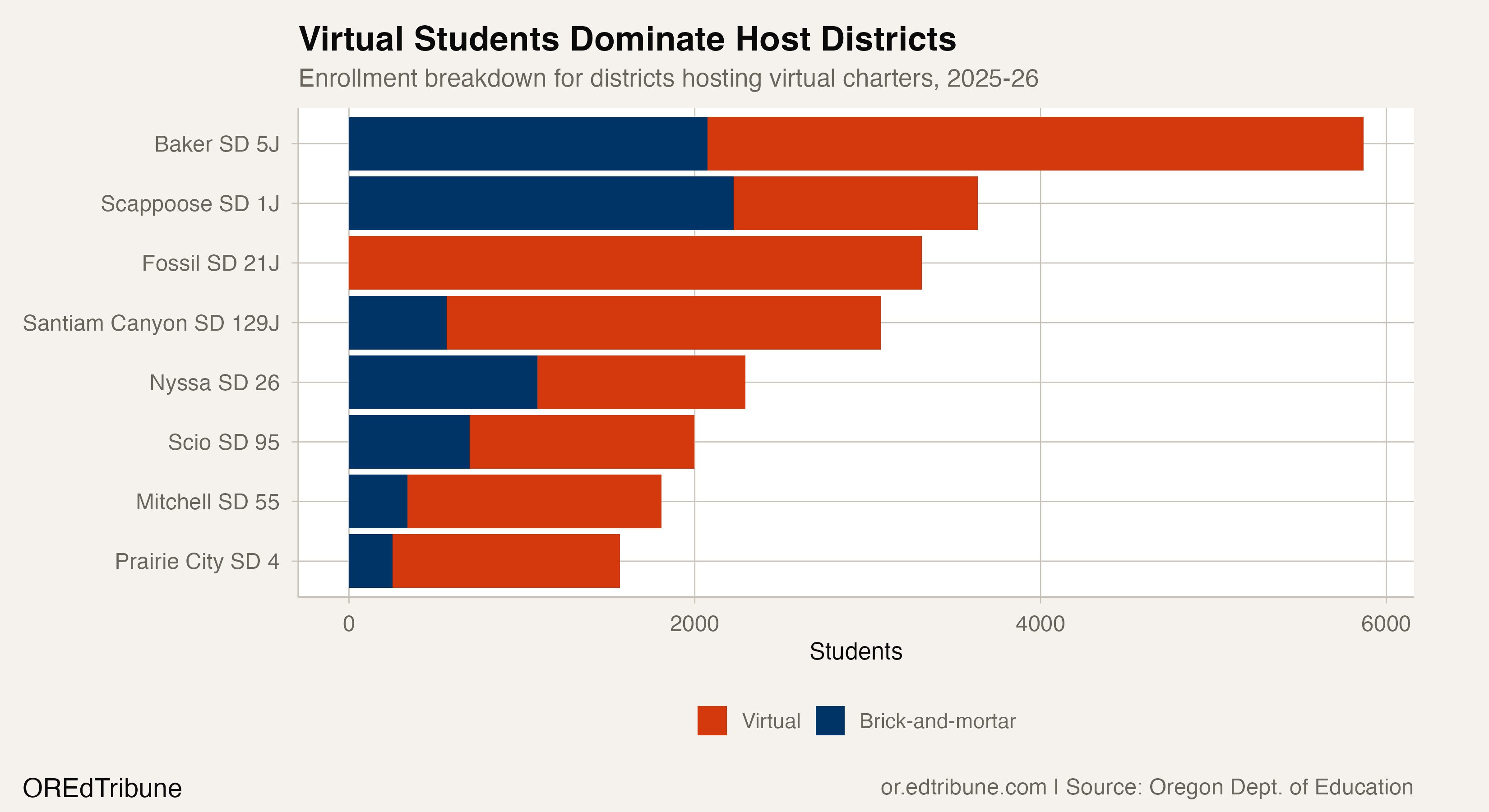
The Oregon Connections Academy case illustrates how these schools migrate between host districts. The school operated under Scio SD 95↗ET from 2010 to 2015, enrolling up to 3,558 students. It left Scio in 2016, eventually reappearing in 2021 under Prairie City SD 4↗ET, where it now enrolls 1,202. Meanwhile, Willamette Connections Academy took its place at Scio in 2020, growing to 1,301 students by 2026. Scio's brick-and-mortar enrollment has hovered near 700 the entire time.
The fiscal logic of hosting
Oregon law allows sponsoring districts to retain up to 20% of per-pupil State School Fund money for K-8 virtual charter students and 5% for grade 9-12 students. For small rural districts, the revenue is substantial relative to their base budgets. ThinkingOregon estimated that Mitchell SD 55 retained approximately $727,000 in 2020-21 from sponsoring three virtual charters with 1,054 students. By 2025-26, Mitchell's virtual enrollment has grown to 1,470 in Cascade Virtual Academy alone, plus 113 in Virtual Preparatory Academy of Oregon (hosted by Prairie City SD 4 but previously associated with Mitchell).
"The Oregon Department of Education doesn't know how much it is spending in support of virtual charter schools." -- ThinkingOregon, August 2023
The result is a set of districts whose reported enrollment bears no resemblance to local reality. Of 19 Oregon districts at all-time enrollment highs in 2025-26, six have virtual students comprising more than 25% of their total. Fossil SD 21J↗ET is 100% virtual. Prairie City SD 4↗ET is 83.9% virtual. Mitchell SD 55↗ET is 81.4%. Santiam Canyon SD 129J↗ET is 81.6%. Strip out virtual enrollment and four of these six districts would no longer be at all-time highs.
What regulation looks like
Oregon operates a 3% cap on virtual charter transfers: if more than 3% of a district's students are already enrolled in an out-of-district virtual charter, the district may deny additional transfer requests. The cap is designed to prevent unlimited fiscal drain from resident districts. Oregon Charter Academy argues the rule "introduces more inequity into our public school system" by denying families access based on geography rather than student need.
The 2025 legislative session has brought renewed attention to virtual charter governance. HB 2583, sponsored by Representative McIntire, would make non-profit virtual charters eligible for Student Investment Account grants, from which they are excluded. Virtual public charter schools are barred from SIA funding under the Student Success Act, a distinction that creates a two-tier system among public schools.
Meanwhile, the sector's relationship with for-profit education management organizations remains under scrutiny. Oregon Connections Academy and Willamette Connections Academy both contract with Pearson's Online & Blended Learning division for their educational programs, a common model in which a non-profit charter board outsources curriculum and operations to a for-profit provider.
The invisible decline
The most consequential effect of virtual charter growth is statistical distortion. Oregon's total enrollment fell from 581,730 in 2018-19 to 535,826 in 2025-26, a loss of 45,904 students (7.9%). But virtual enrollment grew by 10,209 over the same period. Brick-and-mortar enrollment, the count that determines how many teachers stand in front of how many students in physical classrooms, fell by 56,113, a 9.8% decline.
That 1.9 percentage point gap between the headline number and the brick-and-mortar reality matters for planning. A superintendent reading the state's enrollment reports sees a 7.9% decline. The staffing model in actual school buildings reflects a 9.8% decline. The difference is 10,000 students who exist in the data but not in the hallways.
What to watch
Whether 2026 represents a new plateau or a waypoint depends on several open questions. The 3% cap constrains growth in districts where virtual transfers are already near the threshold, but the cap applies district by district, so families in districts below 3% still have access. Legislative action on HB 2583 could change the funding calculus: SIA eligibility would bring additional per-pupil revenue to non-profit virtual charters, potentially accelerating their growth at the expense of for-profit competitors.
The number to watch is not the virtual total. It is the brick-and-mortar count. Oregon lost 56,113 in-classroom students in seven years while its enrollment reports showed a loss of 45,904. Every year virtual enrollment grows, the gap between the reported number and the operational reality widens. For districts making staffing and facility decisions, the reported total increasingly describes a state that does not physically exist.
Detailed code that reproduces the analysis and figures in this article is available exclusively to EdTribune subscribers.
Discussion
Sign in to join the discussion.
Loading comments...