In 2010, Salem-Keizer SD 24J↗ET enrolled 2,256 more students than Beaverton SD 48J↗ET. In 2026, that cushion has shrunk to 93.
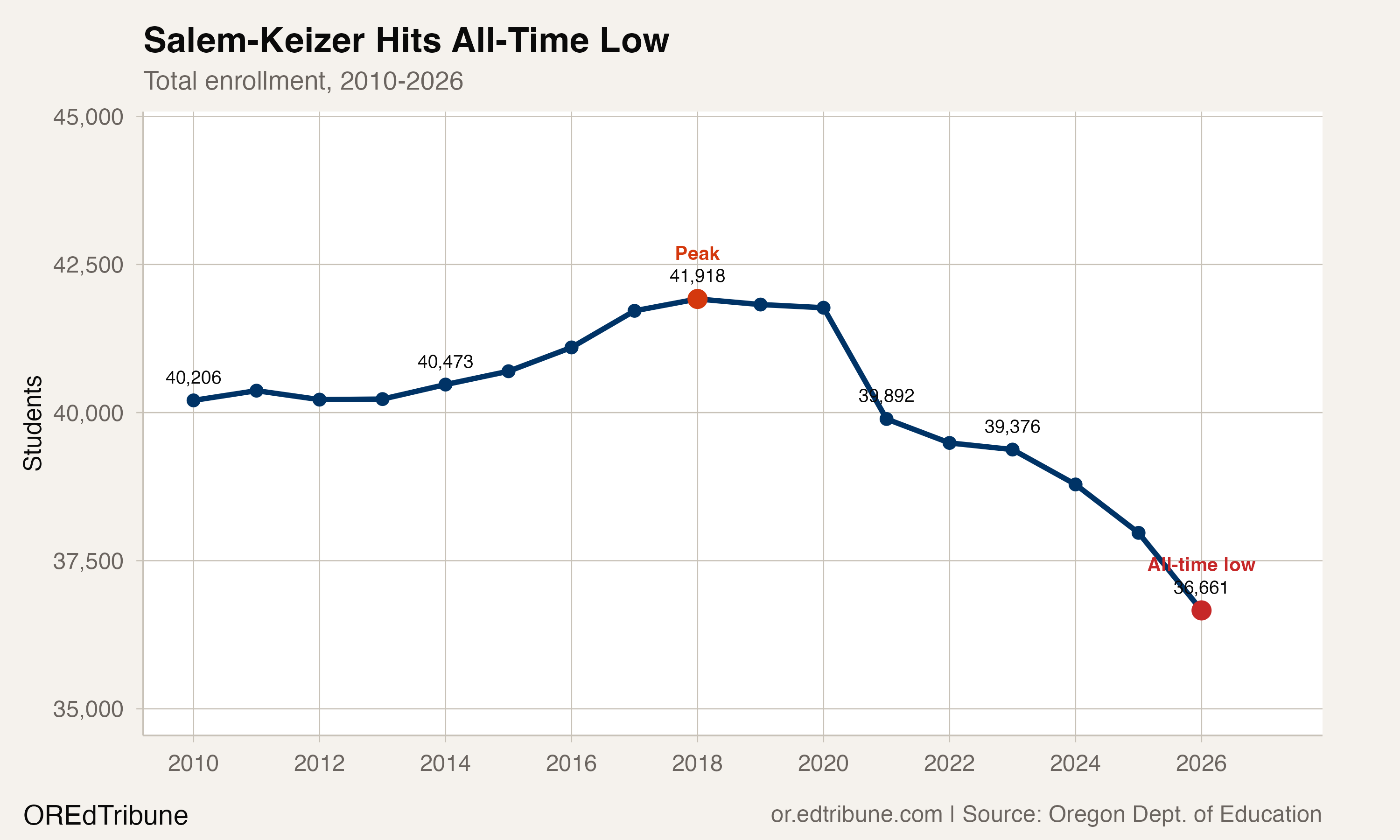
Oregon's second-largest school district has now lost students for eight consecutive years, a streak unmatched among the state's major districts. Its 2026 enrollment of 36,661 is an all-time low, down 5,257 from a 2018 peak of 41,918. Its single-year loss of 1,309 students was the largest of any Oregon district in 2025-26, exceeding both Portland↗ET (-1,213) and Beaverton (-1,258).
The decline is not just long. It is accelerating.
Eight years, no bottom
Salem-Keizer's enrollment peaked at 41,918 in the 2017-18 school year. The initial slide was gentle: 94 fewer students in 2019, 54 fewer in 2020. Then COVID hit, and the district lost 1,878 students in a single year, a 4.5% drop.
What makes Salem-Keizer's trajectory unusual is not the COVID crash itself. Most Oregon districts experienced that. It is what happened afterward. Many districts partially recovered in 2022 and 2023, with the statewide decline slowing to just 632 students in 2023. Salem-Keizer never paused. Its losses were 404 in 2022, 112 in 2023, then 589, 817, and 1,309 in the three years since. Each year has been worse than the one before it.
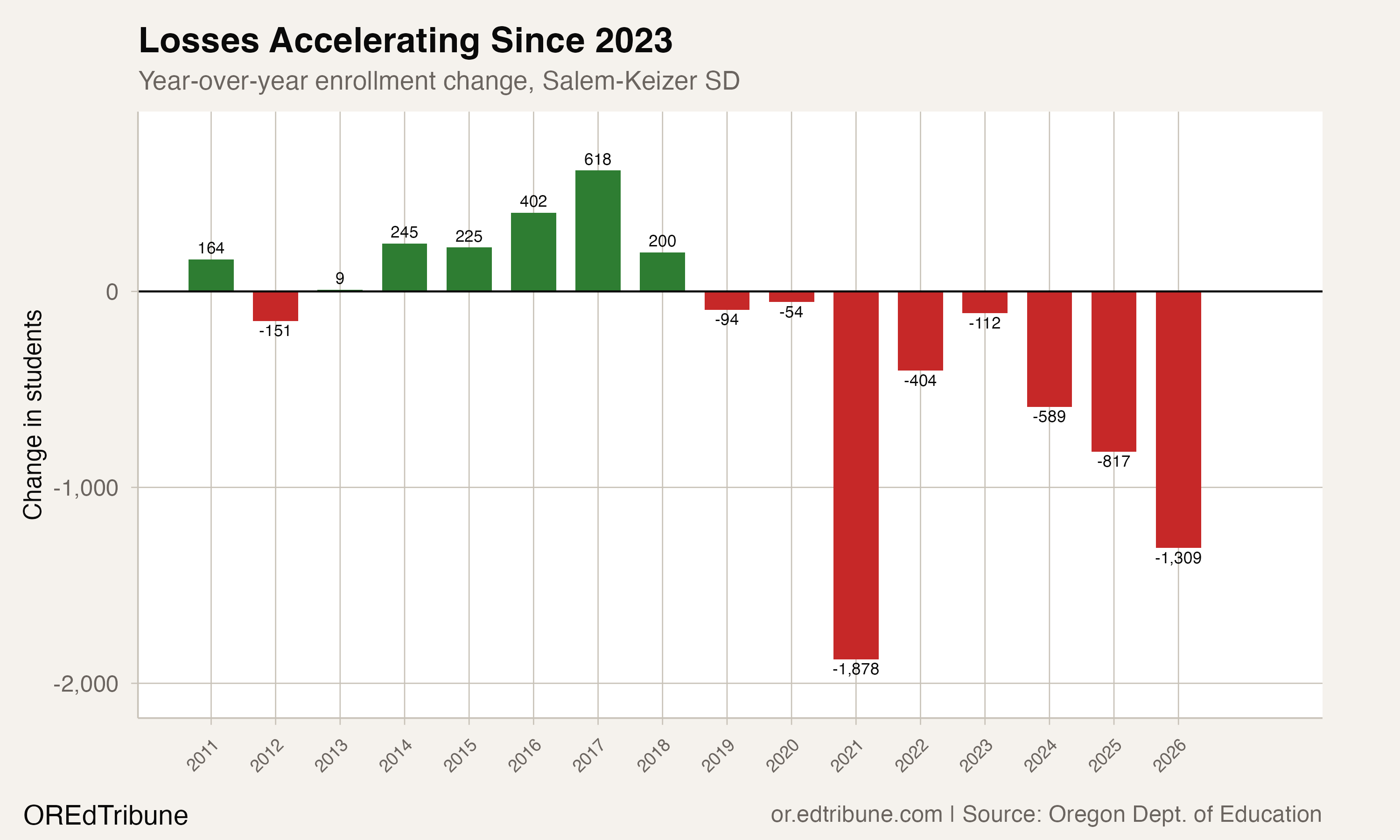
The 2025-to-2026 decline of 3.4% is Salem-Keizer's second-worst single-year loss after the COVID year. It accounts for 11.2% of Oregon's entire statewide enrollment drop of 45,904 students since 2019, a disproportionate share for a district that held 7.2% of the state's students at the start of that period.
The Beaverton crossover
For decades, the hierarchy of Oregon's largest districts was stable: Portland first, Salem-Keizer second, Beaverton third. That order held from at least 2010, when Portland had 45,678 students, Salem-Keizer had 40,206, and Beaverton had 37,950.
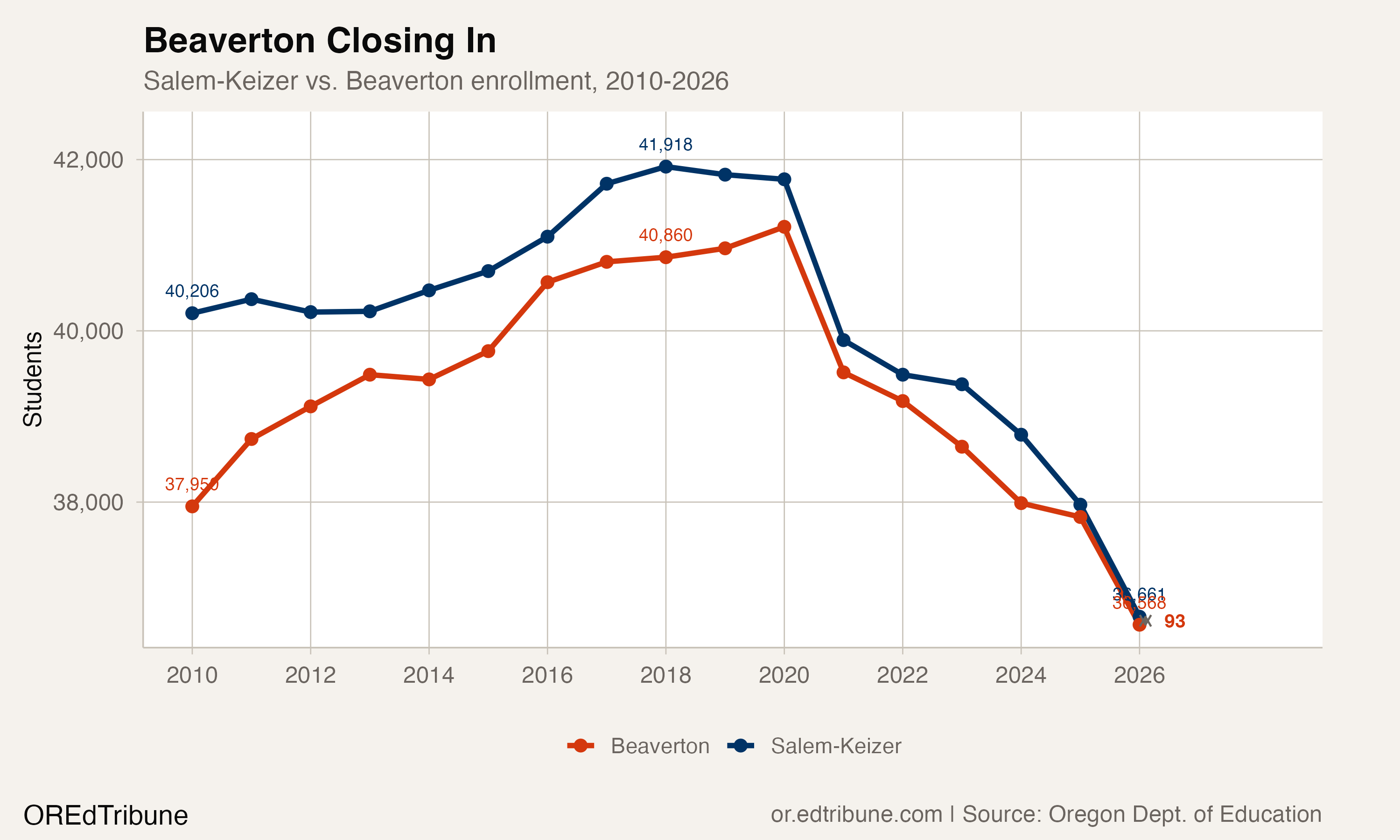
Both districts have been declining since 2021, but Salem-Keizer has been falling faster. The gap that was 2,256 students in 2010 narrowed to 1,058 at Salem-Keizer's peak in 2018. By 2025, it was 144. In 2026, it is 93.
If both districts lose students at their current rates, Beaverton will overtake Salem-Keizer during the 2026-27 school year, a reshuffling that would be the first change in Oregon's top-three ranking in the data available since 2010.
Fewer children entering, more leaving
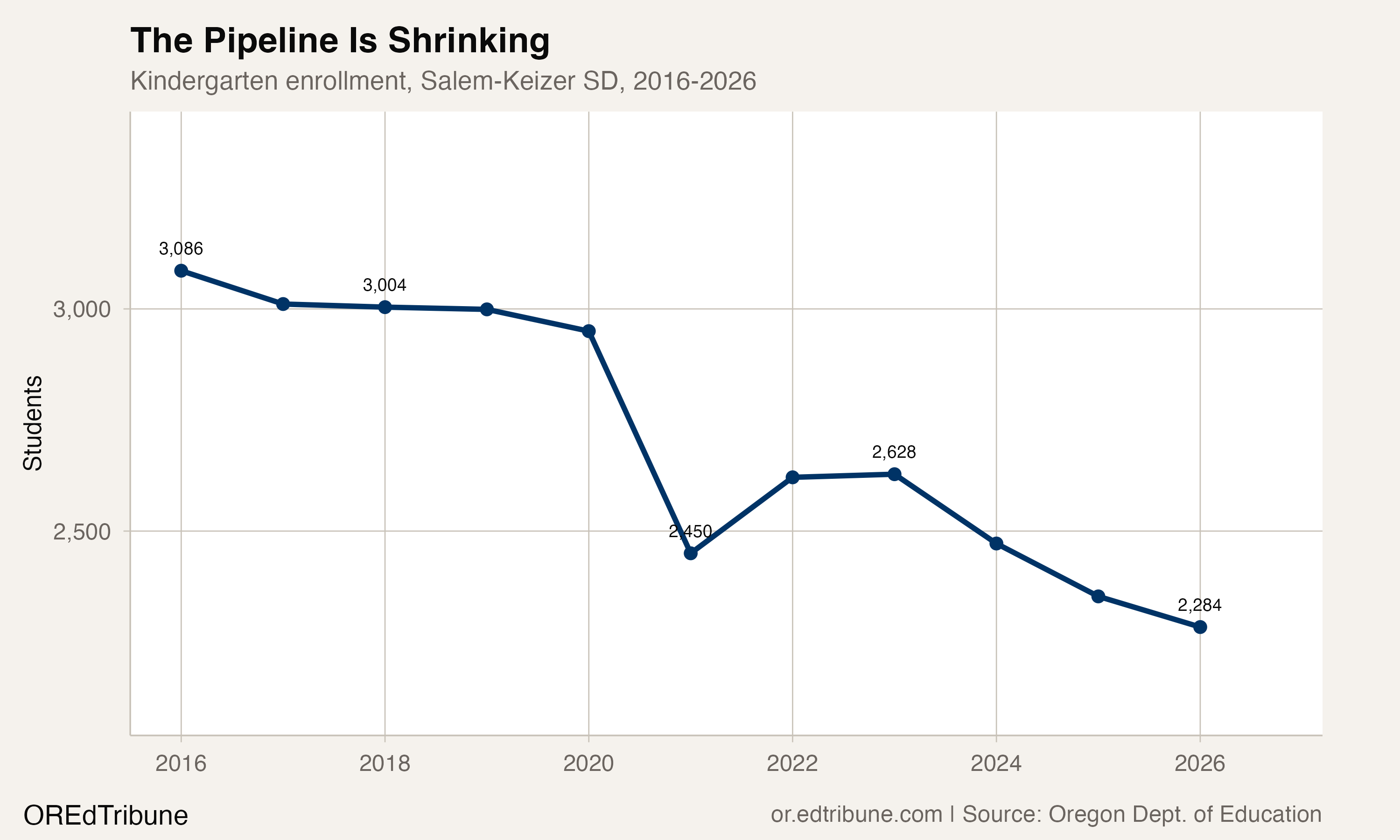
The root of the streak is visible in the district's grade-level data. Kindergarten enrollment has fallen from 3,086 in 2016 to 2,284 in 2026, a 26.0% decline. The district is graduating roughly 3,100 seniors each year while enrolling about 2,300 kindergartners, a structural gap of 800 students that guarantees continued shrinkage even if no family moves away.
Superintendent Andrea Castaneda has attributed the shrinking pipeline to falling birth rates.
"What it comes down to is mostly that people are having fewer babies than they once did and as those smaller number of babies hit kindergarten, it just starts squeezing our enrollment down and down and moves to the grades." — Keizertimes, Jan. 2026
But birth rates are only part of the story. The district's chief operations officer, Paul Odenthal, told the Keizertimes that in 2019, about 90% of kindergarten-age children in the district's boundaries attended public school. That figure has fallen to roughly 75%, with families choosing homeschooling, micro schools, co-ops, and other alternatives that proliferated during the pandemic.
The grade-level pattern reinforces both explanations. Losses are heaviest at the bottom: kindergarten through second grade are down 20% to 24% since 2018. By contrast, 10th grade actually gained 48 students over the same period, the only grade in the district that grew. The smaller cohorts born during Oregon's declining-birth-rate years are now working their way through the system, and each year the pipeline narrows further.
A district that no longer looks like it did
Salem-Keizer is not simply shrinking. Its composition is shifting faster than any large Oregon district. In 2016, white students made up 51.9% of enrollment. In 2026, they are 37.4%, a decline of 7,645 students in absolute terms, a 35.8% loss. Hispanic students crossed over white students to become the district's largest group in 2021 and now comprise 48.1% of enrollment.
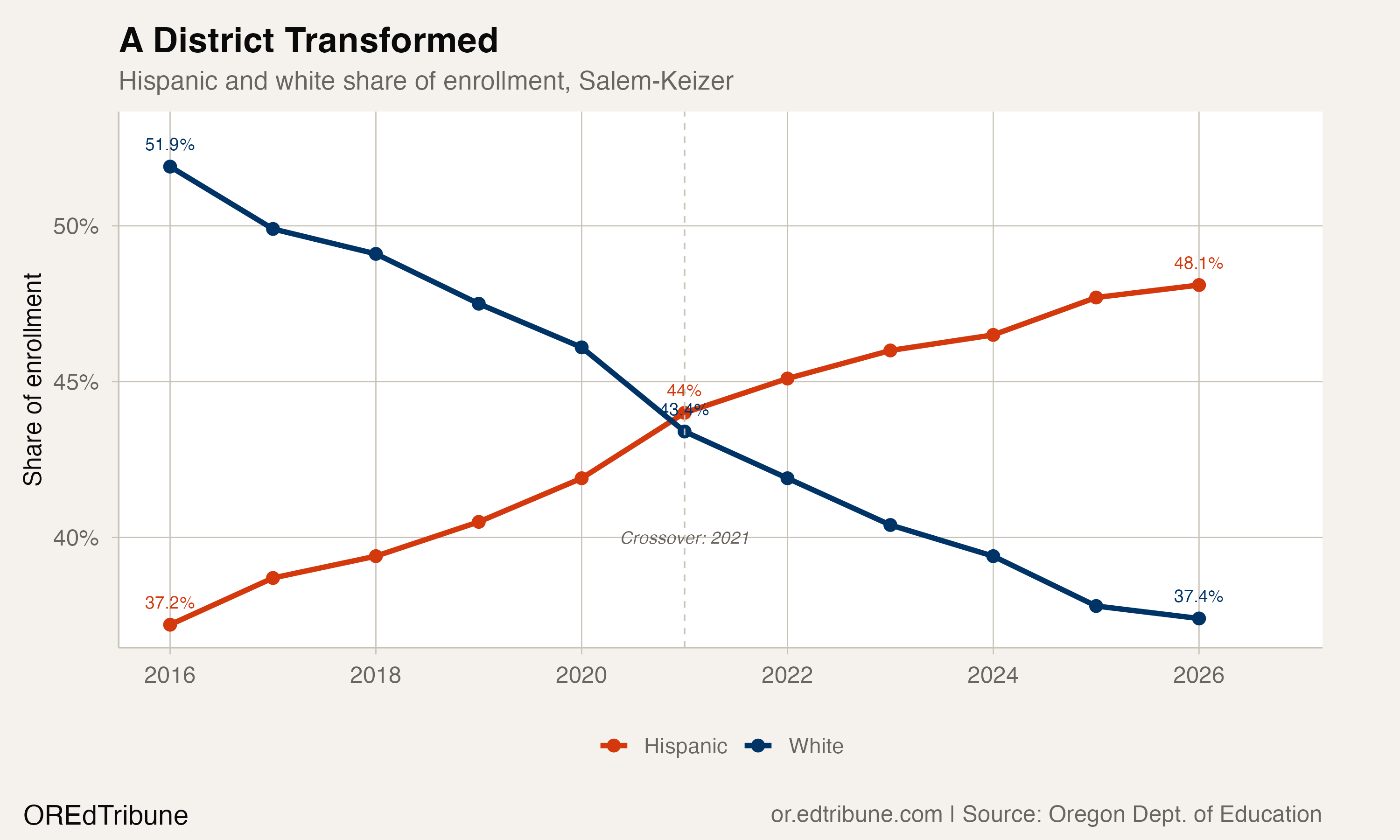
The demographic shift is driven by divergent trends. White enrollment has fallen every year since at least 2016, losing roughly 700 to 1,000 students annually. Hispanic enrollment grew through 2025, reaching 18,096, but declined for the first time in the available data in 2026, dropping by 472 to 17,624. Whether that single-year dip represents a new trend or a blip will be one of the most consequential enrollment questions the district faces going forward.
Pacific Islander students, while a smaller group at 3.4% of enrollment, have grown 44.5% since 2016, from 867 to 1,253. Black enrollment has also increased, from 453 to 681.
$94 million in cuts and counting
Oregon allocates school funding through a weighted per-pupil formula. The state set the School Fund at $11.36 billion for the 2025-27 biennium, which works out to roughly $10,000 per student per year before weighting. At that scale, losing 5,257 students since 2018 represents a substantial reduction in the revenue the district receives from the state.
The fiscal response has been severe. In April 2024, the district announced $71 million in cuts and eliminated approximately 400 positions, about 7% of its 5,800-person workforce. In February 2026, it proposed another $23 million in reductions, cutting 60 teachers, 60 classified staff, and nine central office positions. The district projects a further $25 million deficit for 2026-27.
"Salem-Keizer is not in financial crisis. We're getting ahead of a predictable problem, so that we do not start burning our reserves too early." — Superintendent Andrea Castaneda, Salem Reporter, Feb. 2026
Whether "getting ahead" is the right framing depends on perspective. The district has already cut nearly $94 million over two budget cycles, with a third round of similar magnitude on the horizon. Personnel costs consume 95% of the budget and grow roughly $50 million annually, outpacing state funding increases regardless of enrollment.
School closures on the table
The district last closed schools between 2008 and 2014, shuttering five rural elementary buildings during a previous budget crunch. With enrollment projected to fall another 4,500 students by 2030, consolidation is back in the conversation.
"With the enrollment going down I think we have to consider that as a very viable option for our way going forward." — Paul Odenthal, chief operations officer, Keizertimes, Jan. 2026
No specific closure timeline has been announced. The district has said the new Portland State University enrollment forecast, which projects 32,000 students by 2031, will inform facility planning decisions.
What to watch
The 93-student gap between Salem-Keizer and Beaverton will likely close within a year at current rates. But the ranking question is secondary to the fiscal one. Salem-Keizer is losing students at an accelerating pace with no floor in sight, cutting staff at a scale that reshapes what the district can offer, and watching its kindergarten pipeline narrow year after year. The protected programs, including sports, arts, career-technical education, mental health services, and dual language instruction, are the ones the district has explicitly said it will not cut. Everything else is on the table.
The children who enter Salem-Keizer kindergarten in September 2026 were born in 2021, when Oregon's birth rate was among the lowest on record. The squeeze the superintendent described is not going to ease.
Detailed code that reproduces the analysis and figures in this article is available exclusively to EdTribune subscribers.
Discussion
Sign in to join the discussion.
Loading comments...