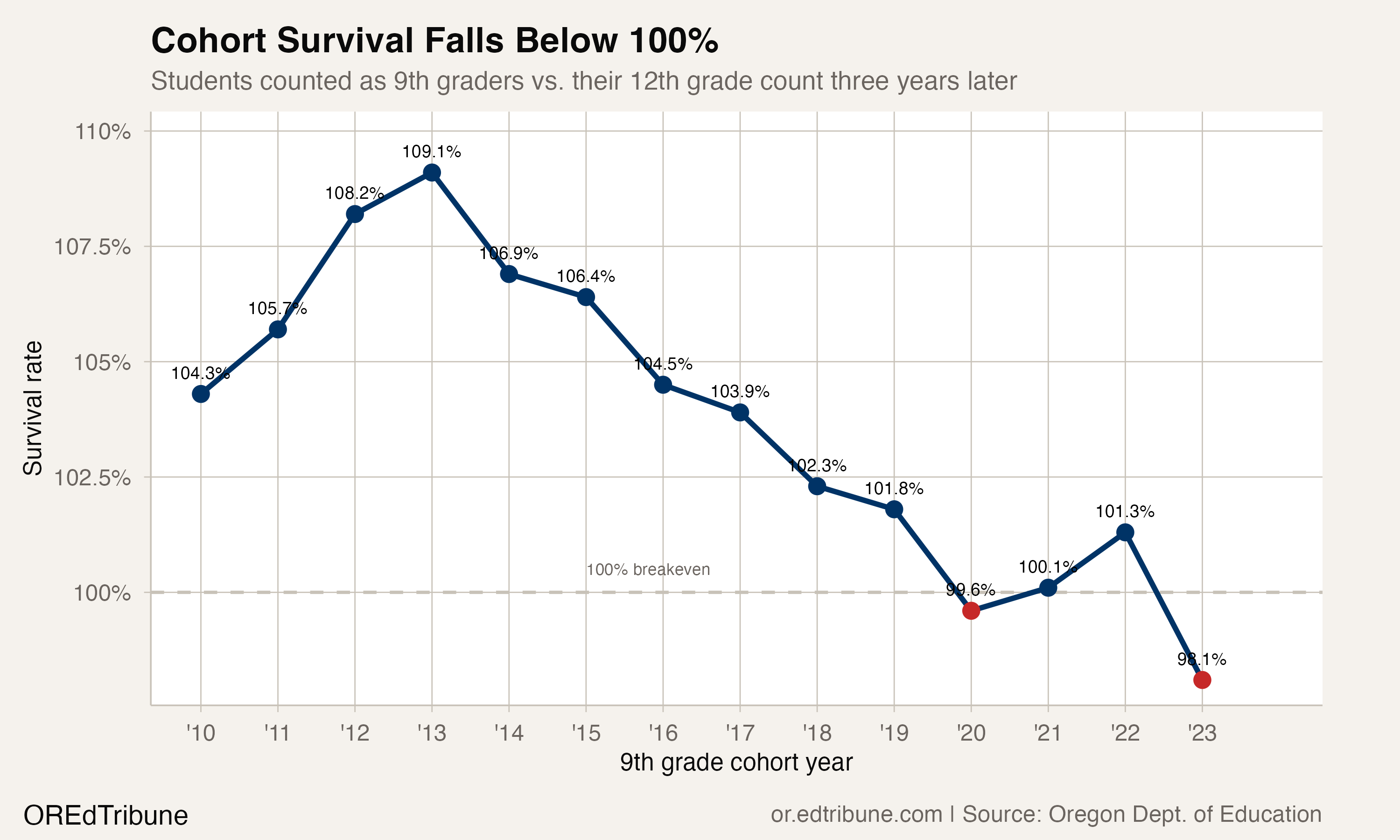
For more than a decade, Oregon's high schools operated with a quiet structural advantage: more students left 12th grade each year than had entered 9th grade three years earlier. Held-back students, GED seekers, transfer-ins, and late re-enrollees swelled senior classes well beyond the size of the freshman cohorts that preceded them. At its peak in the 2013 cohort, the 9th-to-12th survival rate hit 109.1%, meaning 12th grade enrollment exceeded the corresponding 9th grade class by more than 4,000 students.
That pattern is over. The 2023 cohort, which entered 9th grade in the 2022-23 school year and reached 12th grade in 2025-26, posted a survival rate of just 98.1%. It is the first time in at least 17 years of Oregon enrollment data that fewer students appeared in 12th grade than had been counted as freshmen three years prior. The 879 students who vanished from this cohort's pipeline represent a small share of the class, about 1.9%. But the reversal itself, from a surplus that once exceeded 9% to a deficit, marks a structural shift in how students move through Oregon's high schools.
Where the senior surplus went
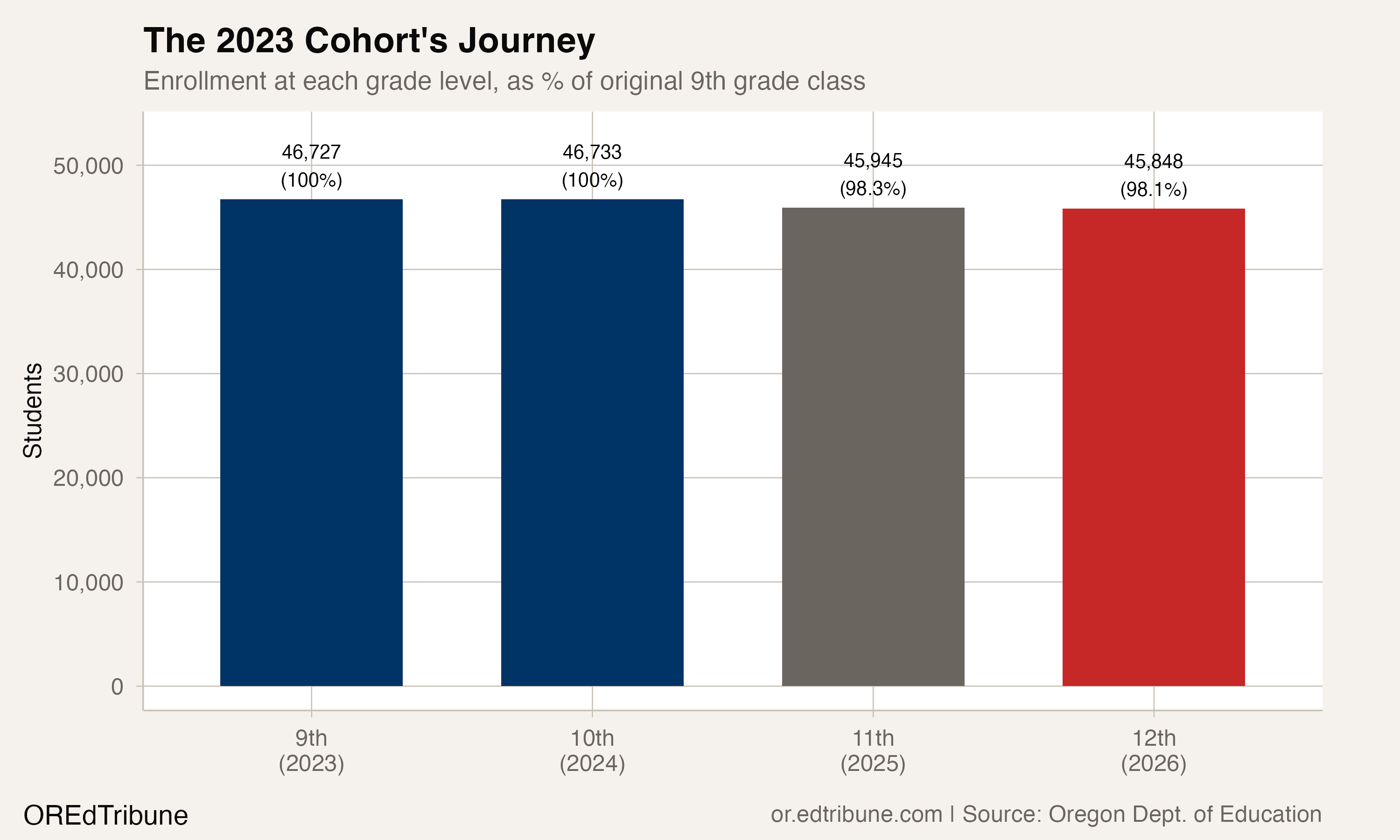
The pipeline break is not primarily a story about 9th graders dropping out before 12th grade. The 2023 cohort's grade-by-grade journey was largely unremarkable through its first three years: 46,727 students in 9th grade, 46,733 in 10th (essentially flat), 45,945 in 11th (a 1.7% dip consistent with historical patterns). The anomaly appeared at the final transition.
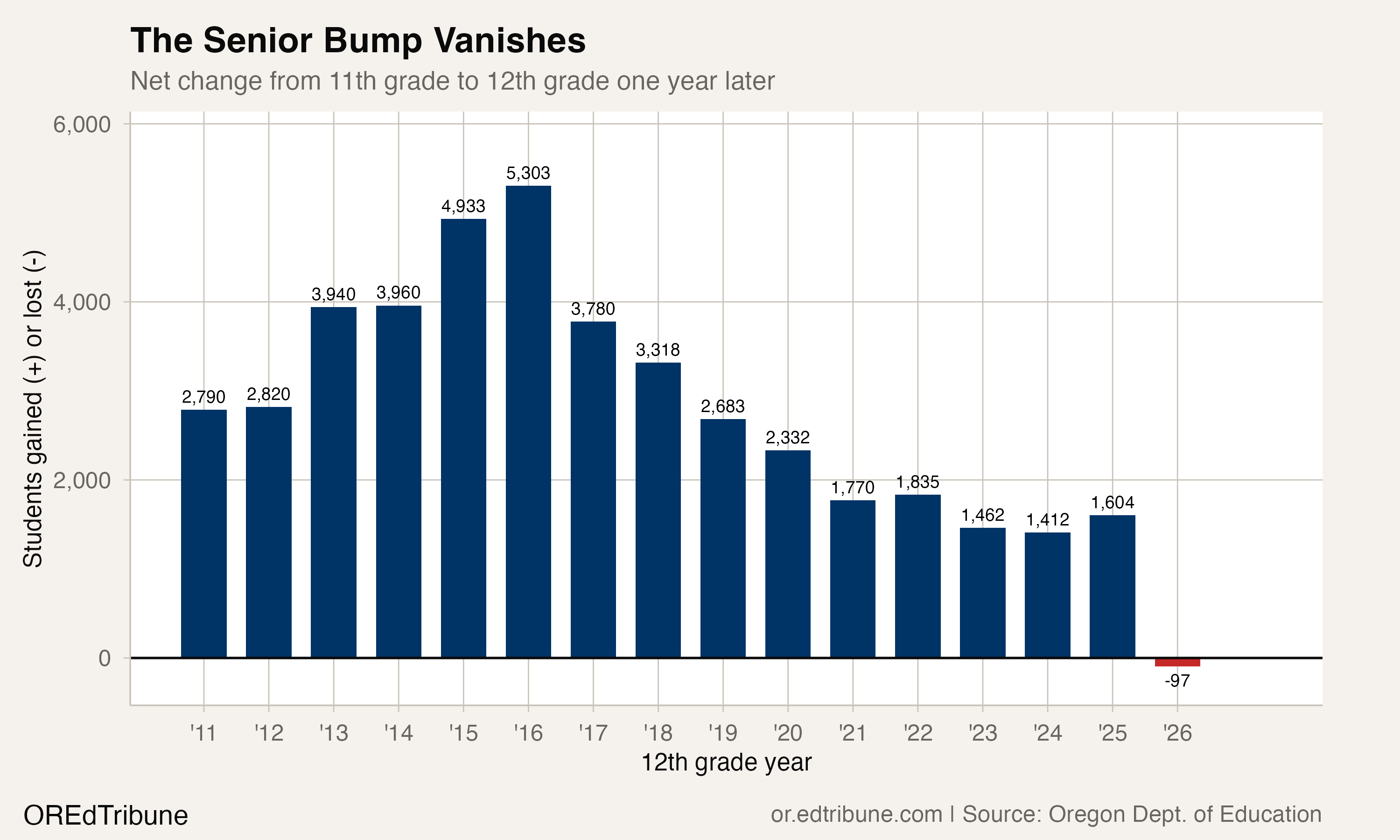
In every prior year in the dataset, 12th grade enrollment exceeded the previous year's 11th grade class. This "senior bump" added between 1,400 and 5,300 students annually, a combination of students who had been retained in earlier grades finally reaching senior year, students returning to public school after time in alternative programs, and students enrolling for a fifth year to complete graduation requirements. Some districts offer structured "super senior" or 13th-year programs that allow students additional time to complete graduation requirements.
In 2025-26, the bump turned negative for the first time: 12th grade enrolled 97 fewer students than the previous year's 11th grade class. That swing, from a typical gain of 1,400-1,600 in recent years to a loss of 97, accounts for the entire pipeline break.
A decade of erosion, not a single-year shock
The collapse of the senior bump did not happen overnight. It has been shrinking steadily since peaking at 12.2% in 2015-16 (when 5,303 more students appeared in 12th grade than had been in 11th grade the prior year). By 2022-23, the bump had already fallen to 3.3%. The 2026 data simply crossed zero.
Three forces likely contributed to the long decline, though Oregon's enrollment data cannot isolate their individual contributions.
The most direct explanation is that fewer students are cycling through the system on a delayed timeline. The senior bump was partly composed of retained students catching up. If retention rates fell, or if students who previously would have been retained are instead exiting the system entirely, the pool of delayed graduates shrinks. Oregon's four-year graduation rate reached a record 83% for the Class of 2025, up from 69% in 2013. Higher on-time completion mechanically reduces the number of students available to inflate future 12th grade counts.
A competing explanation points to students leaving the public school system altogether rather than persisting to graduation. Homeschool registrations remain roughly 40% above pre-pandemic levels, and the Oregon Department of Education estimated more than 20,000 students left public K-12 enrollment for other educational settings within two years of the pandemic. Students who exit the system between 9th and 12th grade do not show up as dropouts if they never formally withdraw.
The attendance paradox
Oregon's chronic absenteeism data offers a third mechanism, one that is suggestive but harder to connect directly. In 2024-25, 33.5% of students were chronically absent statewide, down from a peak of 38% in 2022-23 but still well above the 20% rate recorded in 2019. Oregon ranks 47th among states in total instructional hours per academic year.
The paradox is that graduation rates are rising while attendance remains historically poor. A record 86.6% of Oregon's 9th graders in 2024-25 were on track to graduate in four years. ODE Director Charlene Williams called the improvements "small but encouraging progress." Assistant Superintendent Dan Farley was more direct: "Regular attendance for many student groups remains concerningly low."
"What we offer to children in terms of instruction directly connects to academic success." — Sarah Pope, Stand for Children, Jan. 2026
Students who are chronically absent but not formally dropping out may simply stop appearing in enrollment counts at some point during high school. Oregon does not track how many students transition from chronic absenteeism to non-enrollment between 11th and 12th grade, making this pathway invisible in the enrollment data.
The 2023 cohort up close
Following the 2023 cohort year by year reveals how thin the margins have become. The class started at 46,727 in 9th grade, held essentially steady at 46,733 in 10th, shed 788 students between 10th and 11th grade (a 1.7% loss, consistent with a decade of prior cohorts), then lost another 97 between 11th and 12th. In prior years, that final transition would have added students, not subtracted them.
The 2020 cohort, which entered high school during the pandemic, also crossed below 100%, posting a survival rate of 99.6%. But the 2021 and 2022 cohorts bounced back to 100.1% and 101.3%, respectively, making the 2023 cohort's 98.1% stand out as a new, lower trajectory rather than a one-time pandemic artifact.
What comes next for 9th grade
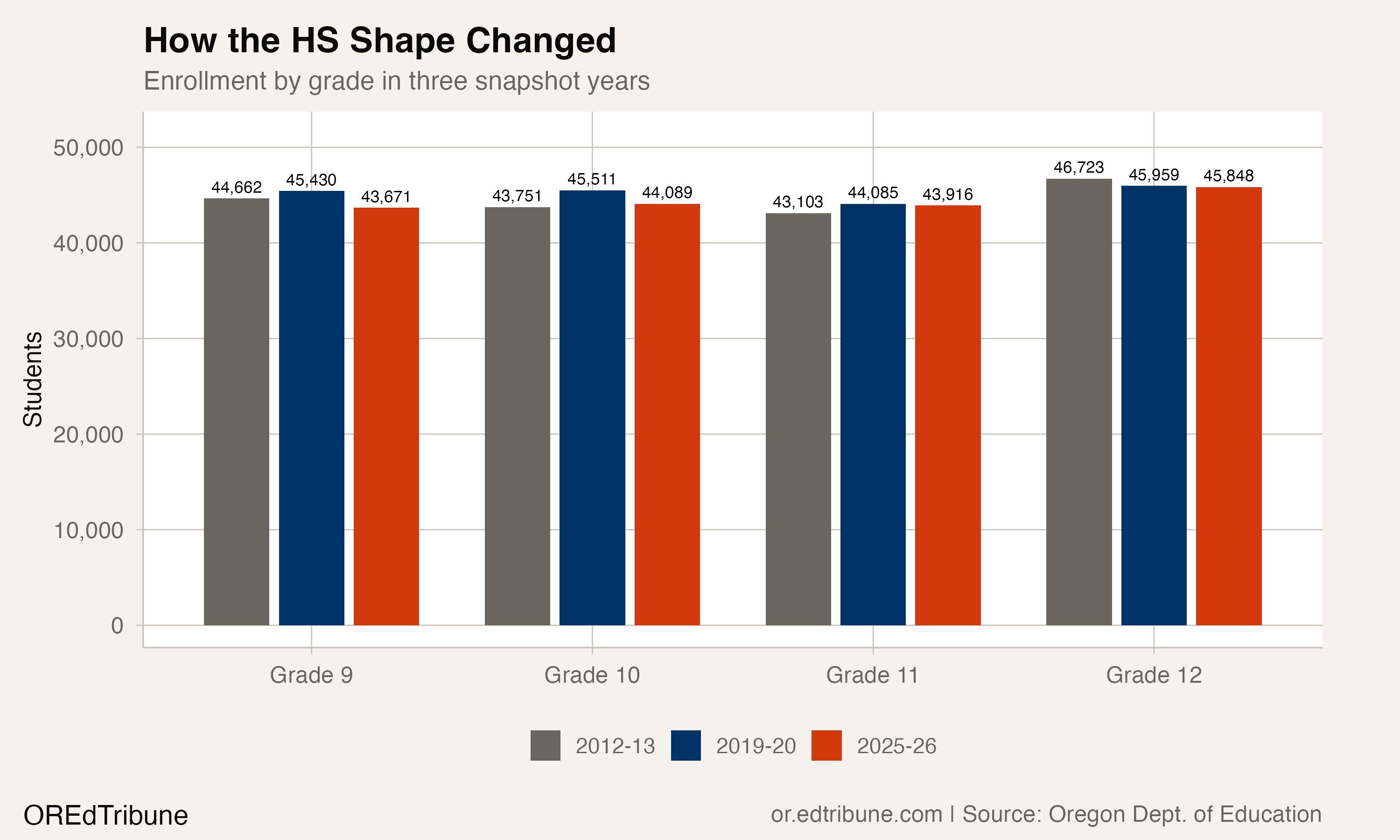
The pipeline break is a high school story in 2025-26. It will become a bigger one. The 2025-26 kindergartners are future freshmen, and kindergarten enrollment has fallen 18.5% since 2020, from 42,322 to 34,490. The 9th grade classes that will arrive in the early 2030s will be substantially smaller than the 43,000-47,000 range of recent years.
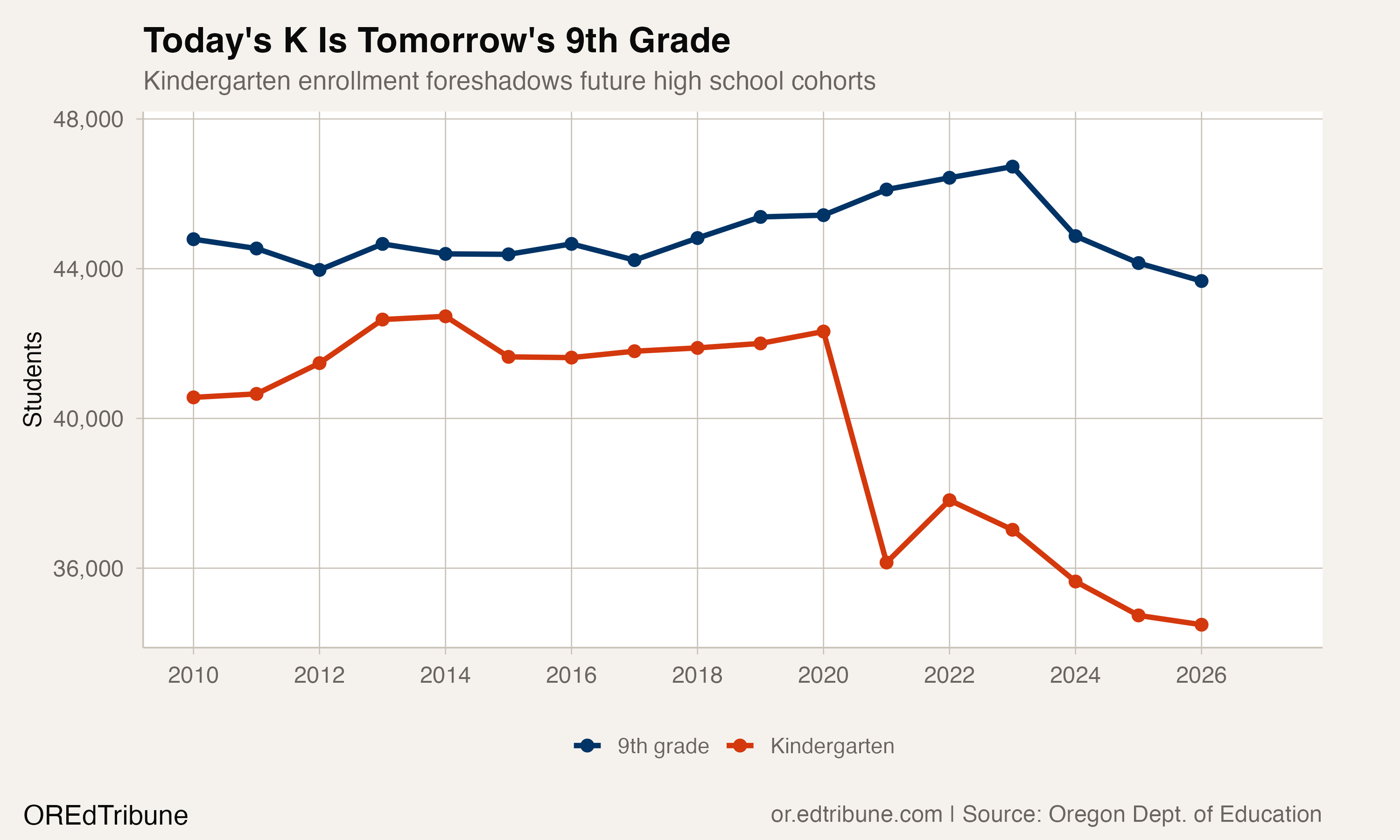
The Western Interstate Commission for Higher Education projects that Oregon's high school graduates will decline roughly 19%, about 8,000 fewer students, by 2041. Ben Cannon, director of Oregon's Higher Education Coordinating Commission, warned that "declining high school and college completion numbers will stretch an already-tight labor force."
Salem-Keizer, the state's second-largest district, is already planning around this reality. The district projects losing another 5,000 students over the next decade on top of the 4,900 it has lost since 2018, and announced $23 million in budget cuts affecting roughly 120 educators.
Oregon does not track where students go when they leave public school. The state cannot say whether the vanishing senior bump reflects more students graduating on time — a genuine success — or more students disappearing from the system entirely. The record 83% four-year graduation rate for the Class of 2025 points toward the first explanation. The 33.5% chronic absenteeism rate points toward the second. Both can be true at once, and the enrollment data does not distinguish between them.
Detailed code that reproduces the analysis and figures in this article is available exclusively to EdTribune subscribers.
Discussion
Sign in to join the discussion.
Loading comments...