Six years after the pandemic emptied Oregon classrooms, the state's school districts are not recovering. They are falling further behind.
Only 58 of 209 Oregon districts, 27.8%, have returned to their 2019 enrollment levels. That number peaked at 34.3% in 2023, then began sliding. In 2024, it was 32.4%. In 2025, 32.1%. Now it has dropped to 27.8%, the lowest point since the initial COVID crash. The window for a bounce-back has closed. What Oregon has instead is a deepening structural decline that the pandemic accelerated but did not cause alone.
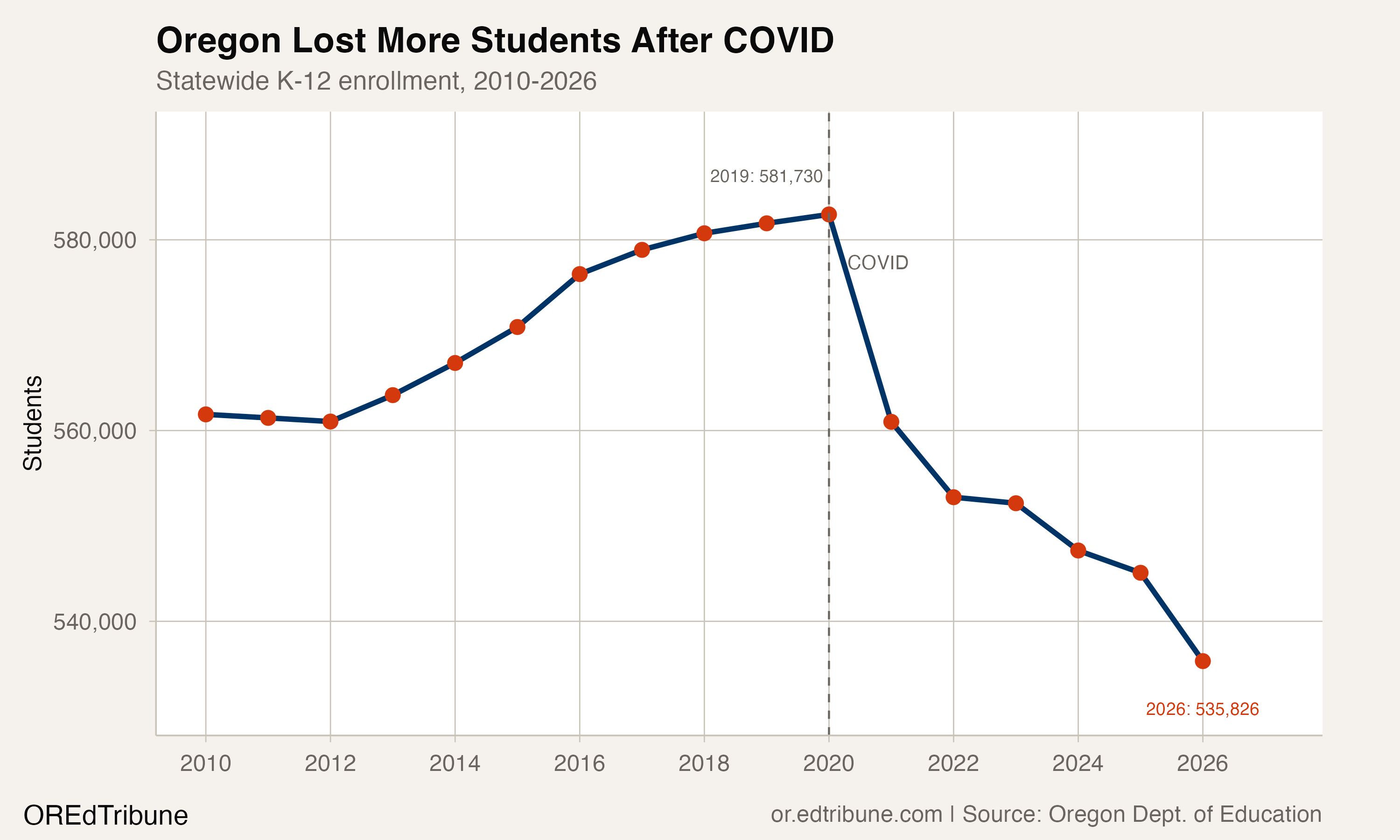
The second crash
Oregon enrolled 581,730 K-12 students in 2019. The COVID crash between 2019 and 2021 wiped out 20,813 of them, a 3.6% loss. The conventional framing treated this as a one-time shock with a recovery period to follow.
The recovery never came. Between 2021 and 2026, Oregon lost an additional 25,091 students, a 4.5% decline. The post-COVID slide now exceeds the COVID crash itself by 20.6%. Total enrollment stands at 535,826, down 45,904 from 2019, a 7.9% loss.
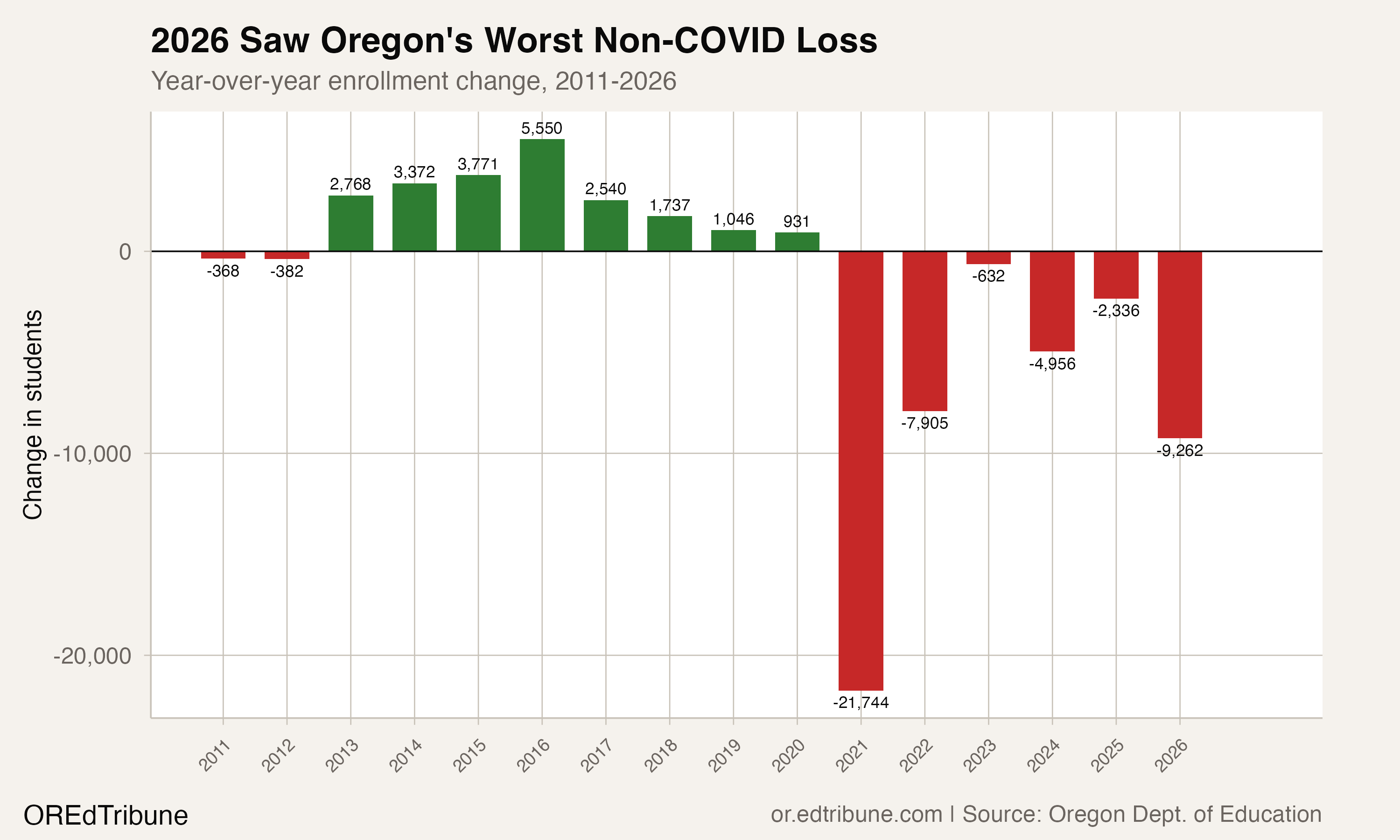
The 2025-2026 school year was the worst non-pandemic year on record: a single-year drop of 9,262 students, or 1.7%. That followed what looked like stabilization in 2023, when Oregon lost only 632 students. The stabilization was a mirage.
Where 16,130 students used to be
Three districts account for more than a third of the statewide loss. Portland↗ET lost 6,571 students since 2019, dropping from 48,677 to 42,106, a 13.5% decline. Salem-Keizer↗ET lost 5,163, falling from 41,824 to 36,661. Beaverton↗ET lost 4,396, declining from 40,964 to 36,568. Together, those 16,130 missing students represent 35.1% of the state's entire enrollment loss.
Expand to the 10 largest losers and the concentration becomes starker: 28,752 students, or 62.6% of the statewide decline, are concentrated in just 10 districts.
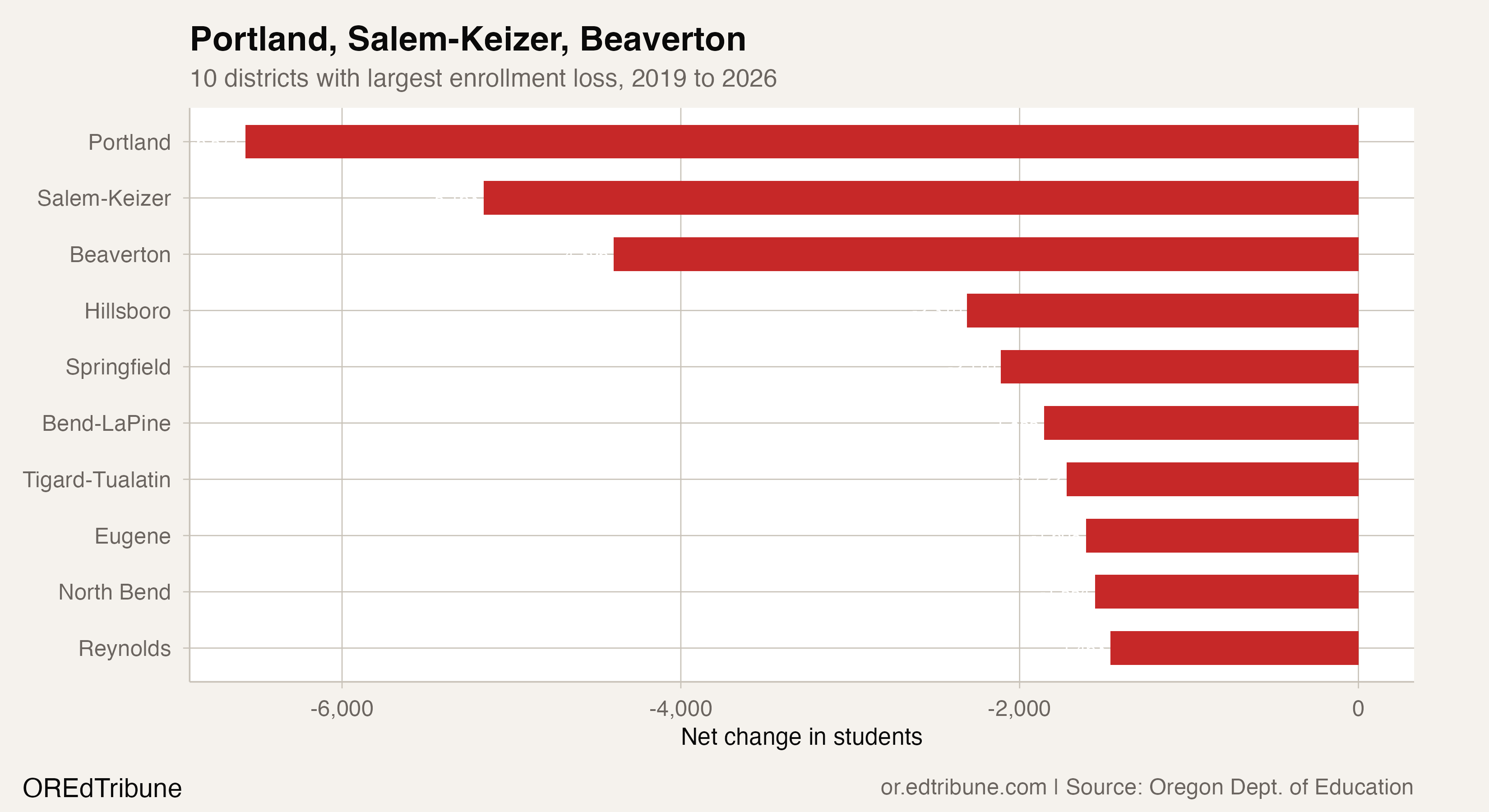
The percentage losses among large districts are remarkably uniform. Springfield↗ET leads at 19.5%, having lost 2,110 of its 10,838 students. Every district with more than 5,000 students in 2019 had fewer students in 2025-26. Every one. The closest to recovery is Klamath County, which gained six students.
Size determines fate
Not a single Oregon district enrolling 10,000 or more students in 2019 has recovered to pre-pandemic levels. Zero of 13. Among mid-sized districts (2,000 to 10,000 students), only six of 52 have recovered, an 11.5% rate. Small districts under 500 students fare better at 41.4%, but even that rate is declining.
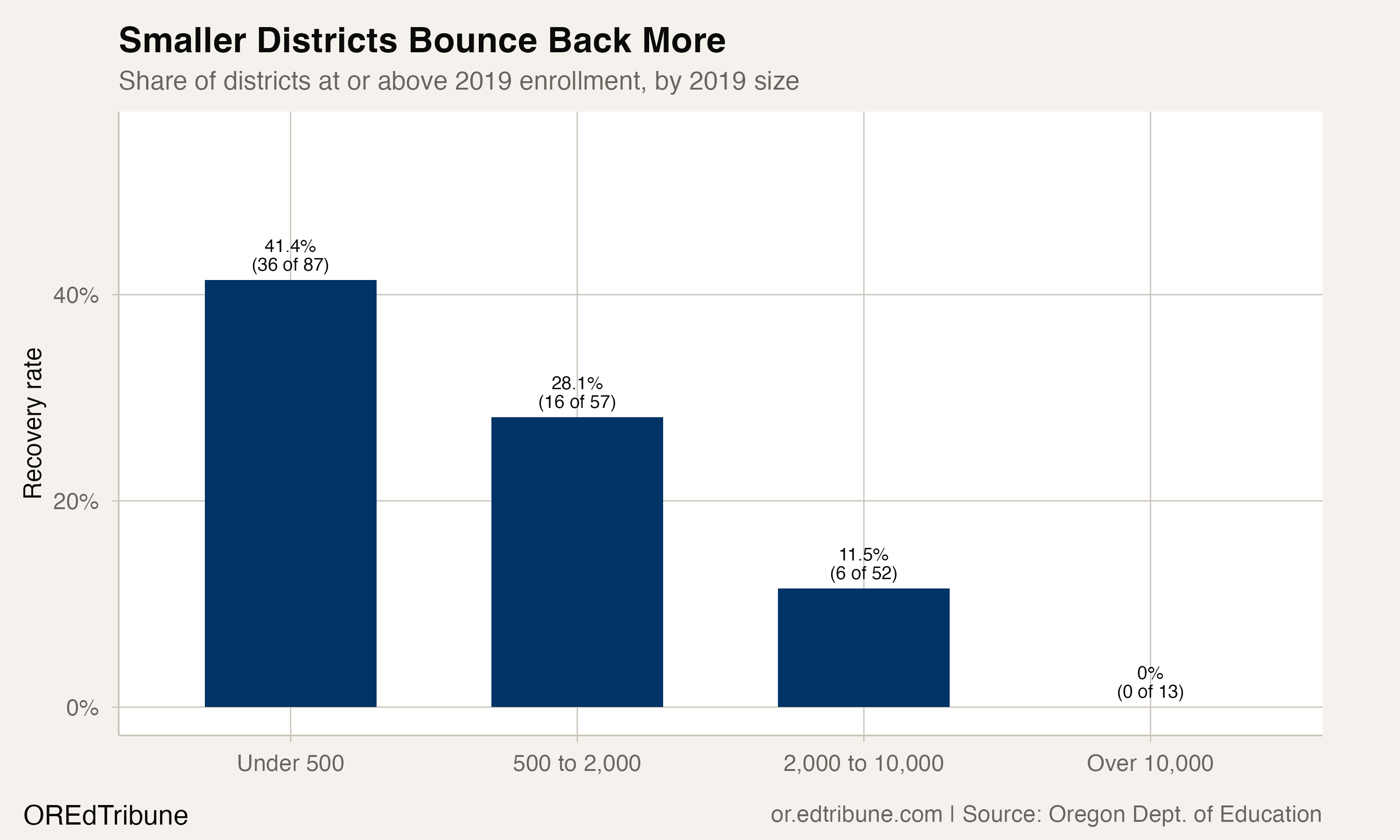
The pattern is not coincidental. Larger districts are disproportionately urban and suburban, where the alternatives to public schooling, including private schools, homeschooling, and virtual charters, are most accessible. Smaller rural districts often remain the only educational option in their communities.
The virtual school asterisk
Even the 27.8% headline recovery rate overstates the actual return of students to traditional classrooms. Of the 58 districts that appear to have recovered, 16 owe their gains primarily to virtual charter schools hosted within their boundaries. Baker Web Academy, based in tiny Baker City, enrolled 3,752 students statewide in 2026. Fossil Charter School, in a town of fewer than 500 people, enrolled 3,312. These virtual schools draw students from across Oregon, inflating their host district's enrollment without adding a single student to a physical classroom.
Excluding districts where virtual charters account for more than 30% of total enrollment, the real recovery rate drops to 23.6%: 42 of 178 districts.
Fewer babies, more exits
The most likely driver of the sustained decline is Oregon's falling birth rate. The state's total fertility rate sits near 1.4, well below the 2.1 replacement level, and natural population increase (births minus deaths) turned negative in 2020. Oregon's 2025-26 kindergartners were born during the lowest birth years the state has recorded.
But demographics alone do not explain where 45,904 students went. Homeschooling in Oregon increased 72% in the first two pandemic years and remains elevated. Private school enrollment also rose, though Oregon lacks comprehensive statewide tracking. A Brookings Institution analysis found that 12% of Oregon's school-age children were "unaccounted for" in enrollment data for 2021-22, the widest gap of any state in the country. Some of those children may have left Oregon entirely. Others may have entered informal homeschooling arrangements that are difficult to track.
"We do not see the increase in the share of school-aged children not attending public schools fully explained by a corresponding bump in private school enrollment." -- Brookings Institution, 2024
Portland Public Schools launched a survey to ask departing families why they left. Results have not been published.
The budget arithmetic
Oregon funds schools primarily through the State School Fund, which allocates money on a per-pupil basis. Fewer students means fewer dollars. Portland Public Schools faces $43 million in reductions for the 2025-26 school year. Salem-Keizer is cutting $23 million and eliminating 120 positions, 60 teachers and 60 classified staff. Reynolds↗ET, which lost 1,463 students since 2019, is cutting more than 100 educators and considering shortening the school year by 10 days. Eugene↗ET is preparing for $19 million in cuts.
These cuts arrive just as federal pandemic relief funding (ESSER) has expired, removing a cushion that masked the enrollment-driven revenue decline for several years.
A Roosevelt High School student, Ian Ritorto, told Oregon legislators in blunt terms: "We stopped cutting fat a long time ago. We're choosing muscles and arteries to sever at this point."
19 districts lost ground in two years
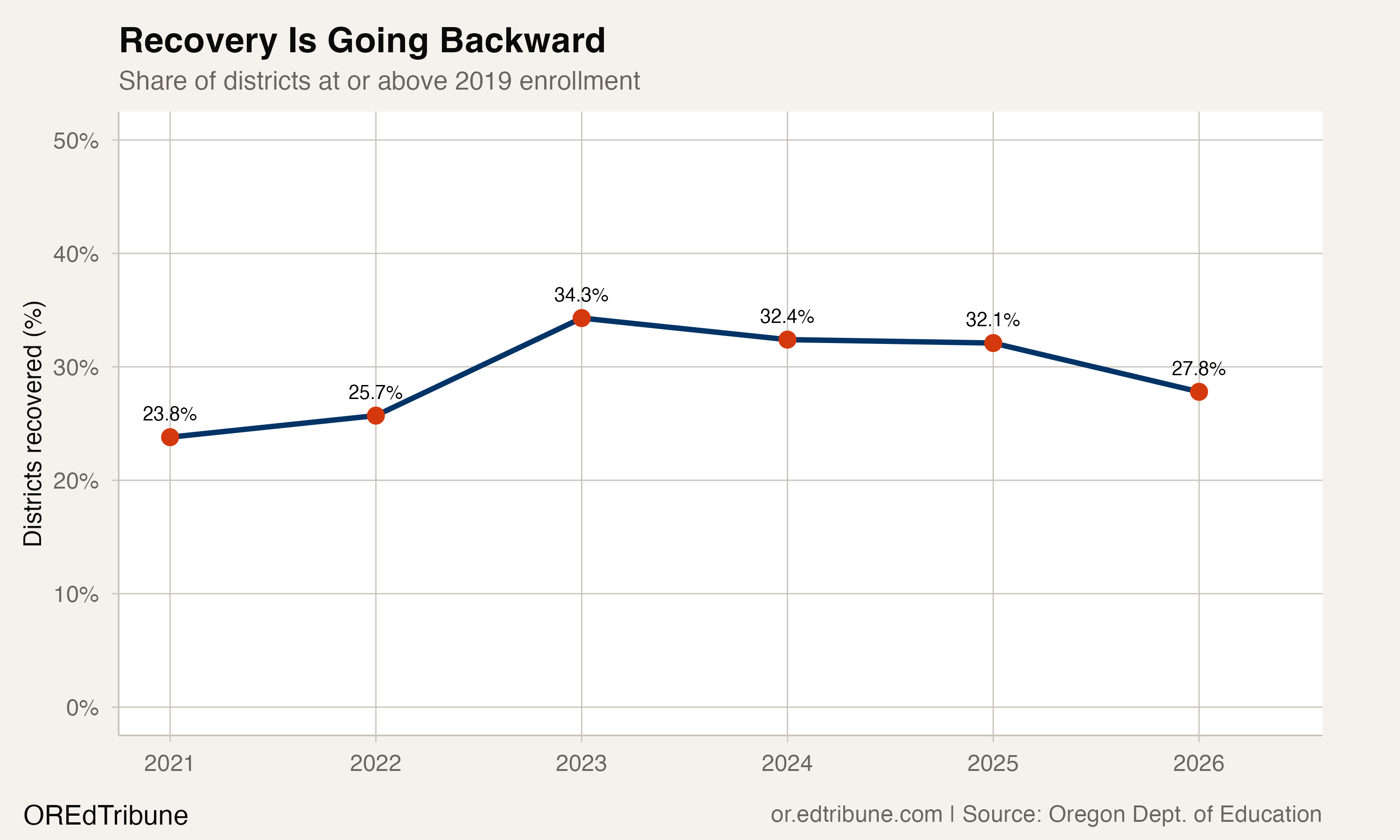
Between 2024 and 2026, 19 districts that had been at or above their 2019 enrollment fell back below it. Only nine districts crossed the recovery threshold in the other direction, and several of those are virtual-charter-inflated. The recovery rate peaked in 2023 at 34.3% and has declined in every year since.
Among the 159 districts that lost students during COVID, 100 have continued to decline below even their 2021 pandemic-year enrollment. These are not districts waiting for a rebound. They are districts in structural contraction.
What to watch next
The 2027 kindergarten class, born in 2021-22 during Oregon's lowest recorded birth year, will test whether the enrollment floor has been reached or whether the decline has further to fall. Salem-Keizer projects losing another 4,500 students over the next decade. If that trajectory holds across the state, Oregon could drop below 500,000 K-12 students before the end of this decade, a level not seen since the early 2000s.
Portland Public Schools launched a survey to find out why departing families left. The results have not been published. Until someone counts not just the students who remain but the ones who disappeared — and learns what it would take to bring them back — Oregon's districts are managing a contraction whose bottom they cannot see.
Detailed code that reproduces the analysis and figures in this article is available exclusively to EdTribune subscribers.
Discussion
Sign in to join the discussion.
Loading comments...