Correction (Aug. 17, 2026): An earlier version used a stale statewide enrollment total and carried several related counts forward incorrectly. The corrected 2025-26 total is 539,644 students; 29 districts have fewer than 100 students, 22 have fewer than 50, and the 87 districts under 500 enroll 16,365 students, or 3.0% of statewide enrollment. The top 10 districts account for 40.8%. The all-time-low count is 70 districts, including 19 under 500. The 2016 Gini peak is 0.738.
Ashwood SD 8↗ET enrolled one student in 2025-26. So did Frenchglen SD 16. Pine Creek SD 5 had two. These are not rounding errors or data artifacts. They are school districts — with boards, budgets, and legal obligations — operating in the high desert and mountain corners of Oregon where the nearest alternative campus may be an hour away on a two-lane road.
Oregon has 209 school districts. Eighty-seven of them, 41.6%, enroll fewer than 500 students. Twenty-nine have fewer than 100. Twenty-two have fewer than 50. Together, the 87 districts under 500 serve 16,365 students, exactly 3.0% of the state's 539,644 total enrollment. The top 10 districts, by contrast, serve 40.8%.
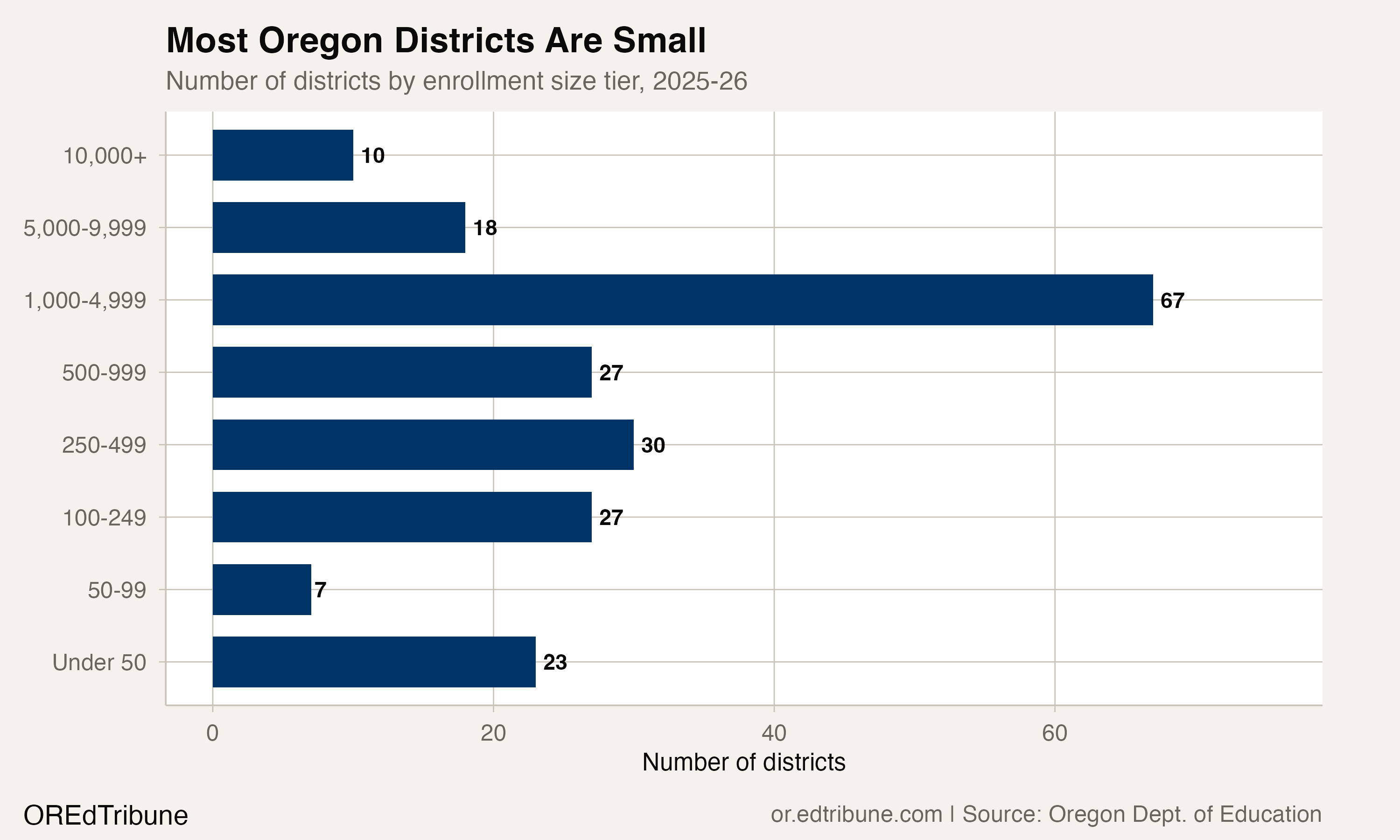
The asymmetry is the story
The gap between what these districts represent by count and what they represent by enrollment is staggering. More than four in ten Oregon districts — districts with superintendents, transportation budgets, board meetings — educate fewer students than a single large elementary school. The enrollment Gini coefficient, a measure of how unevenly students are distributed across districts, stands at 0.716 in 2026. It has been declining since peaking at 0.738 in 2016, but the decline reflects large districts losing students faster than small ones, not any movement toward balance.
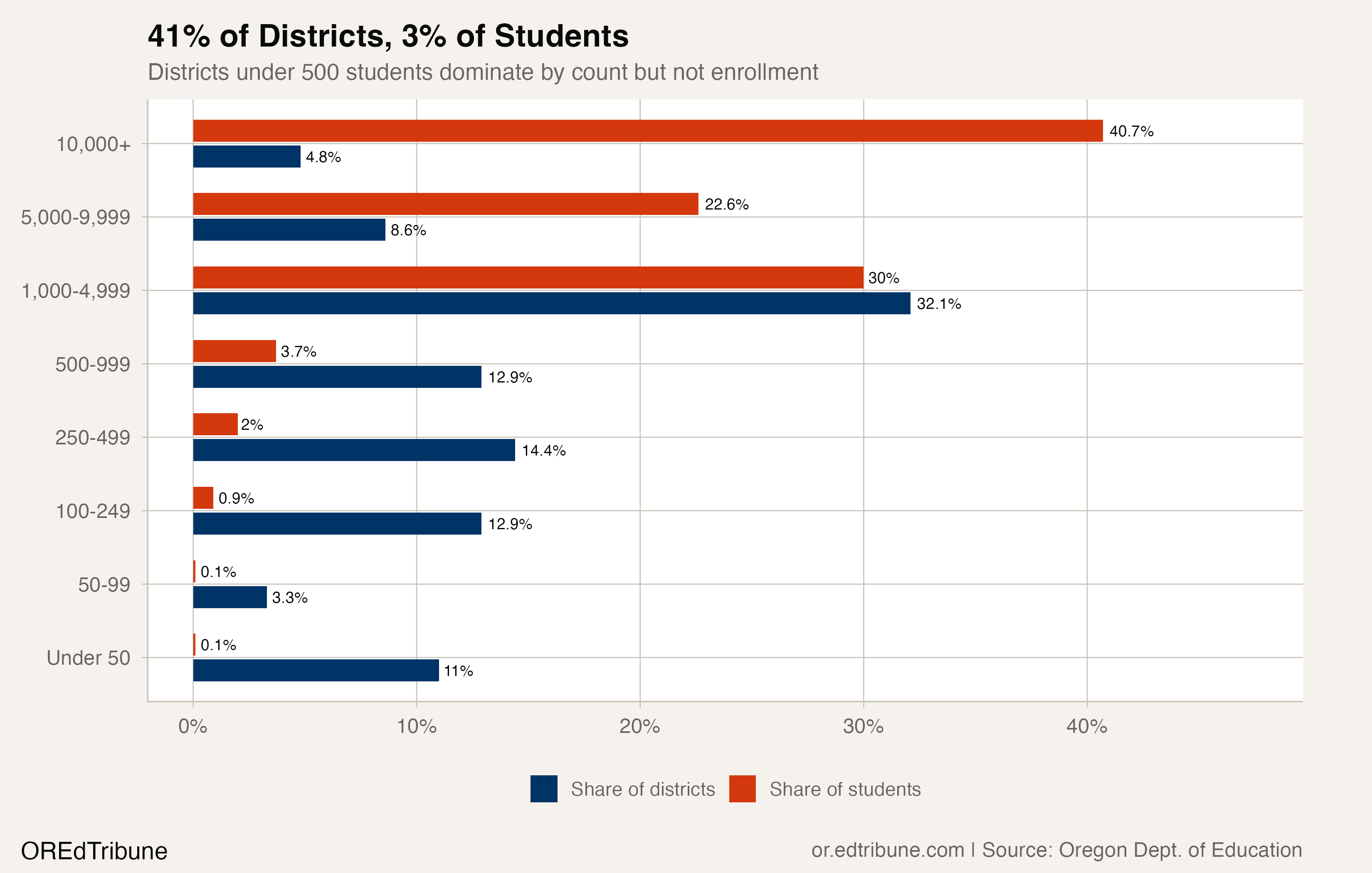
The median Oregon district enrolls somewhere around 400 students. The mean enrolls roughly 2,560. That sixfold gap between median and mean tells you the distribution is not a bell curve. It is a cliff with a long tail.
Virtual charters are rewriting the rural map
The most dramatic distortion in the small-district data comes not from declining enrollment but from virtual schools that inflate host district headcounts far beyond their brick-and-mortar reality.
Baker SD 5J↗ET officially enrolls 5,867 students in 2026. But 3,752 of them, 64.0%, attend Baker Web Academy, an online school that draws students from across the state. Strip out the Web Academy enrollment, and Baker's brick-and-mortar operation serves 2,115 students. The Web Academy alone enrolls more students than all but 13 districts in Oregon.
Fossil SD 21J↗ET, in the John Day Fossil Beds country of Wheeler County, tells an even more striking story. In 2010, it enrolled 129 students. By 2026, its enrollment had ballooned to 3,312 — a 2,467% increase driven entirely by virtual programs. Fossil itself has a population of roughly 470 people.

Mitchell SD 55↗ET enrolls 1,807 students. Prairie City SD 4↗ET enrolls 1,567. In both cases, virtual schools account for more than 80% of the total. These districts are administratively large and physically tiny — a governance arrangement that benefits from Oregon's per-pupil funding formula while raising questions about oversight and connection to the communities those funds are supposed to serve.
Statewide, 22 virtual schools enrolled 14,590 students in 2026, 2.7% of Oregon's total. Nine districts have virtual enrollment exceeding 15% of their headcount.
50 schools vanished in a single year
Oregon operated 1,484 schools in 2010. By 2025, that number had drifted down to 1,402, a loss of 82 schools over 15 years. Then 2026 happened: 50 schools disappeared in a single year, dropping the count to 1,352. It was the sharpest one-year decline in the dataset by a wide margin.
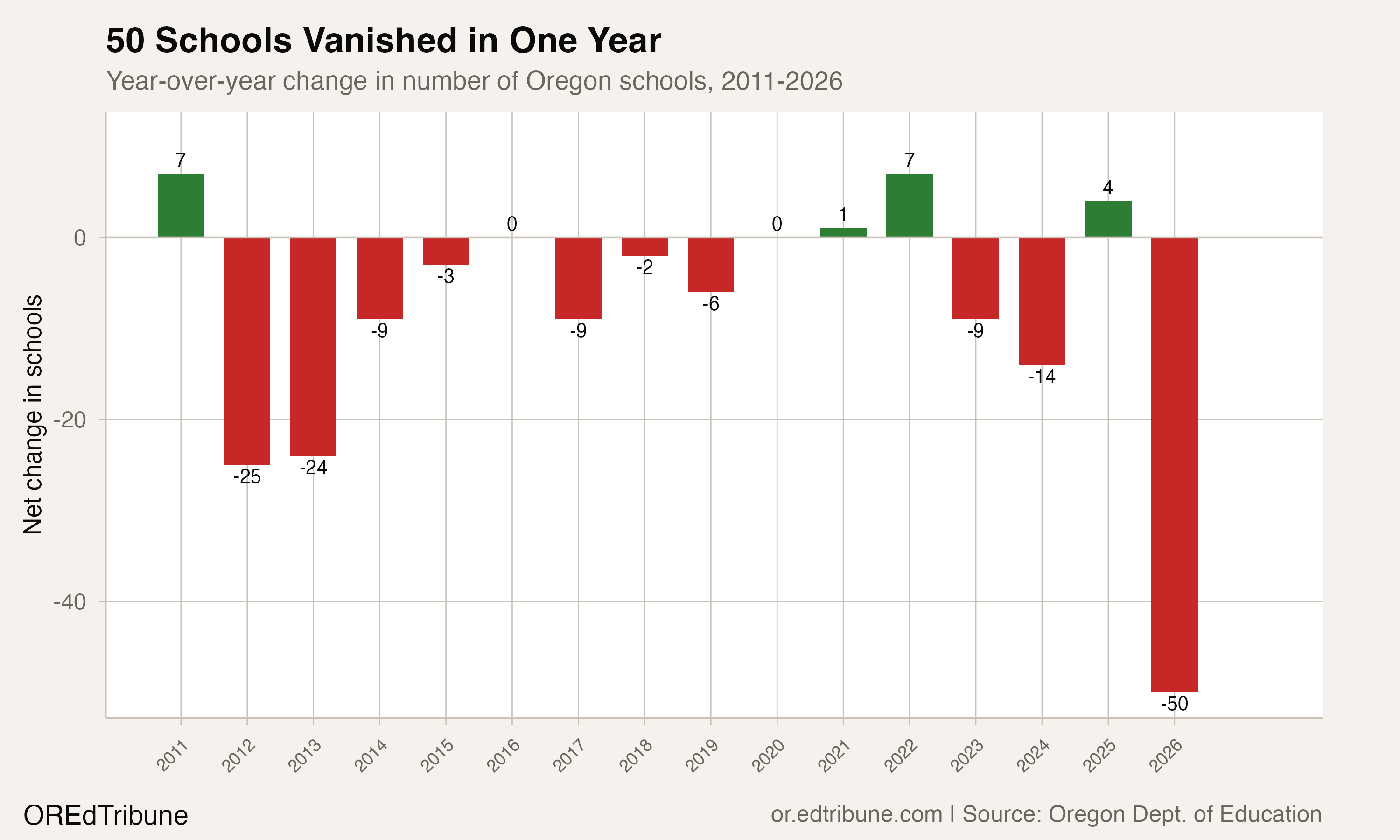
The 132 total schools lost since 2010 represent an 8.9% reduction in Oregon's school infrastructure. The pace was uneven — some years saw small gains — but the 2026 cliff makes the direction unmistakable. Schools are closing faster than at any point in the available data.
The smallest ones are not consolidating
Among districts under 500 students, 50 operate exactly one school. Twenty-five operate two. Twelve have three or more. A one-school district with declining enrollment has no internal consolidation option. It either continues to operate or it ceases to exist.
John Day SD 3↗ET, in Grant County, illustrates the slow grind. It enrolled 683 students in 2010. By 2026, it had 468 — a 31.5% decline spread across 16 years. The losses were steady: no single year catastrophic, every year a little worse. Six small districts in the under-500 tier have been declining for six or more consecutive years. Arlington SD 3, Knappa SD 4, and Northwest Regional ESD are all on six-year streaks.
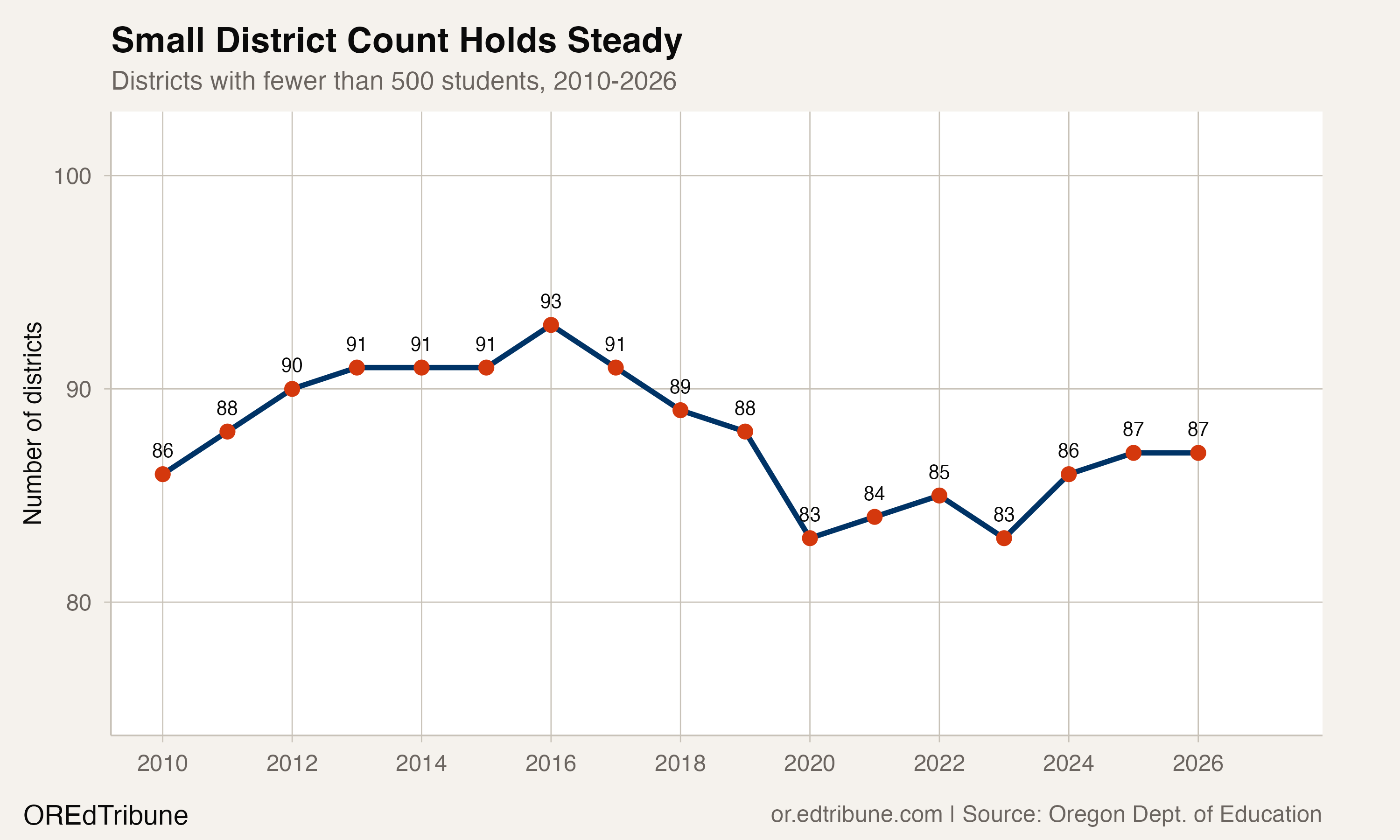
Oregon's under-500 district count has stayed remarkably stable — hovering around 87 despite the state losing students overall. The small-district threshold acts like a floor: districts reach it and then simply persist at diminished scale, occasionally dropping below 100 or below 50 but rarely disappearing entirely.
The state distributes approximately $2.5 million per year through its Small School District Supplement (ORS 327.013), a recognition that per-pupil funding alone cannot sustain districts below a viable threshold. The supplement helps. It does not address the underlying question of whether a district with five students should exist as a separate administrative entity.
70 districts at all-time lows, 19 of them under 500
Seventy Oregon districts hit their lowest enrollment on record in 2026. Nineteen of those, more than a quarter, have fewer than 500 students. For the larger districts at record lows — Salem-Keizer, Beaverton, Hillsboro — the losses are painful but the institutions are resilient. For a district at 20 students that loses five, the math is existential.
The Gini coefficient's decline from 0.729 in 2010 to 0.716 in 2026 might look like progress toward equity. It is not. Large districts are shrinking faster than small ones, compressing the distribution from the top rather than building up the bottom. Oregon lost 45,870 students between 2020 and 2026. The small districts shed their share, but they were already so small that their absolute losses barely register in the state totals.
The result is a system where more than 40% of districts are structurally marginal by enrollment, sustained by supplements and community will rather than by the economies of scale that make a school system work. Ashwood SD 8, with its single student, still has a school board that meets, a budget that must be filed with the state, and a superintendent who is likely also the bus driver. Oregon has never forced a district to merge. The enrollment data suggests the state may not have to. At some point the last family moves away, and the district simply stops.
Detailed code that reproduces the analysis and figures in this article is available exclusively to EdTribune subscribers.
Discussion
Sign in to join the discussion.
Loading comments...