In 2016, Salem-Keizer↗ET was a majority-white school district. White students made up 51.9% of enrollment; Hispanic students, 37.2%. Nine years later, those numbers have inverted. White enrollment has fallen to 37.4%. Hispanic enrollment has risen to 48.1%. Oregon's second-largest district, the one that serves the state capital, is less than two percentage points from becoming majority-Hispanic.
The shift happened faster than anyone watching statewide averages would expect. Oregon as a whole moved from 63.4% white to 57.1% over the same period, a 6.3-point drop. Salem-Keizer's white share fell 14.5 points, more than twice the state rate. This is not a district that tracks the Oregon average. It is pulling away from it.
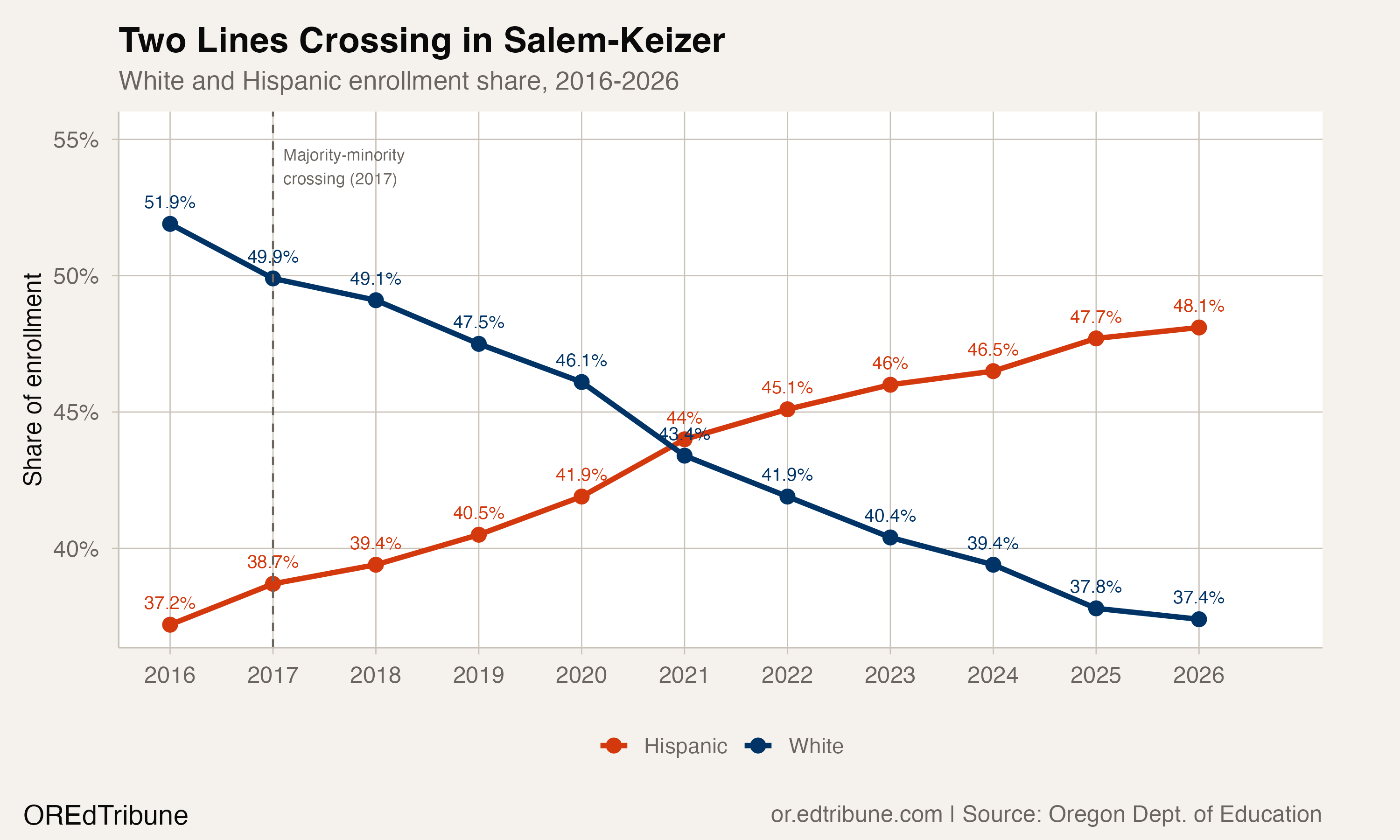
The arithmetic of a transformation
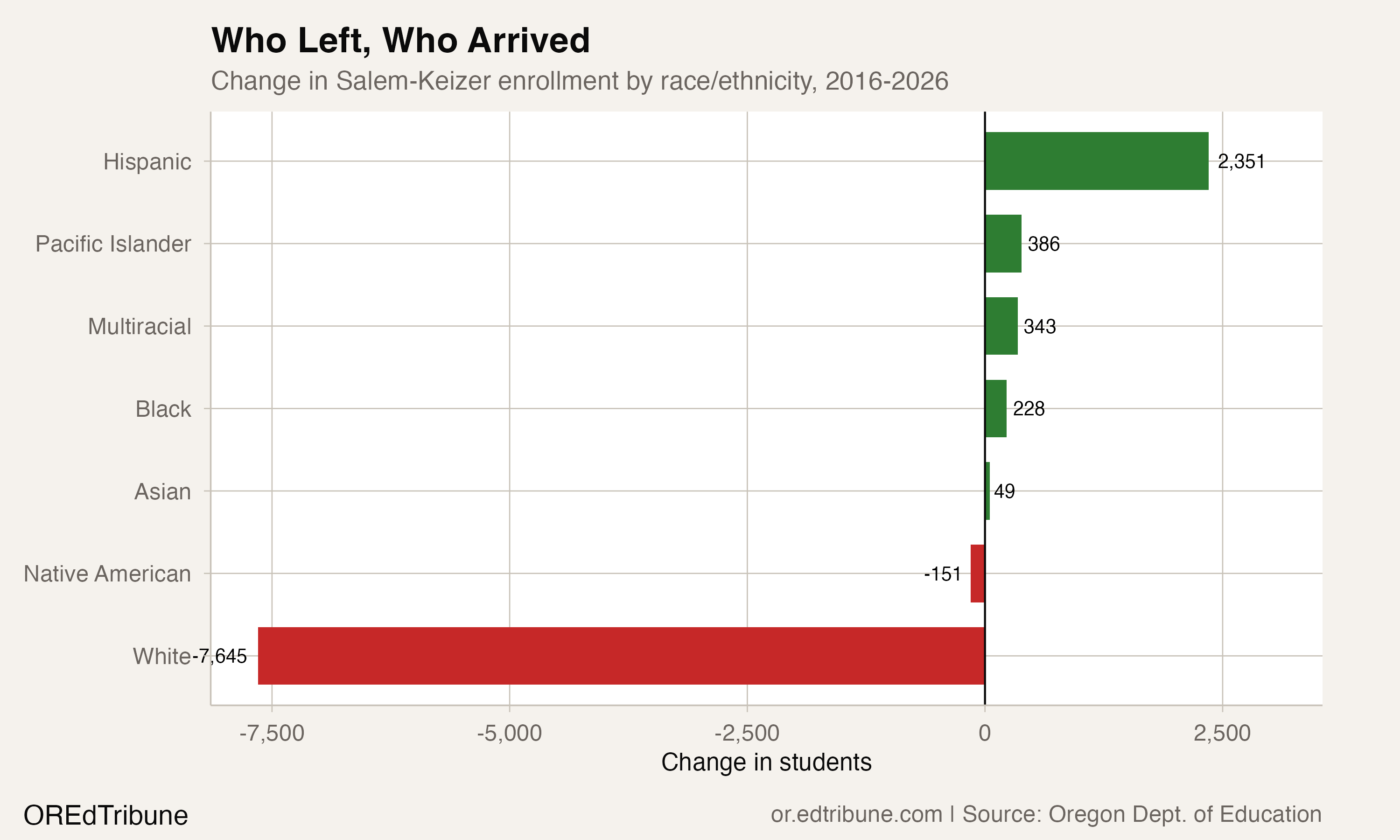
The headline number, 48.1% Hispanic, is a share. Shares can rise even when the underlying count falls. What makes Salem-Keizer unusual is that Hispanic enrollment actually grew in absolute terms, adding 2,351 students since 2016, even as the district shrank by 4,439 students overall. The district lost 7,645 white students over the same period, a 35.8% decline. Every other racial group grew or held roughly steady. The entire enrollment loss, and then some, came from white families leaving the system.
| Group | 2016 | 2026 | Change |
|---|---|---|---|
| White | 21,344 | 13,699 | -7,645 |
| Hispanic | 15,273 | 17,624 | +2,351 |
| Pacific Islander | 867 | 1,253 | +386 |
| Multiracial | 1,964 | 2,307 | +343 |
| Black | 453 | 681 | +228 |
| Asian | 798 | 847 | +49 |
| Native American | 401 | 250 | -151 |
| Total | 41,100 | 36,661 | -4,439 |
That table contains a striking fact: the district lost 7,645 white students but only 4,439 students total. Growth among Hispanic, Pacific Islander, multiracial, and Black students absorbed more than 3,200 of the white departures, keeping the district from shrinking even faster.
The Willamette Valley's agricultural roots
Salem-Keizer's Hispanic concentration, at 48.1%, is nearly double the statewide share of 26.6%. That gap has deep roots. The Willamette Valley has been a destination for Latino farmworkers since the 1940s, when the Bracero Program brought thousands of Mexican workers to Oregon's fields. Marion County, where Salem sits, has an estimated 19,277 farmworkers, according to the Farmworker Housing Development Corporation. Many families that arrived as seasonal agricultural labor over the past several decades have settled permanently.
The 2020 Census captured Salem's demographic acceleration: the city added roughly 20,000 residents over the prior decade, and half of that growth was Hispanic. Salem's Hispanic population reached 41,302, about a quarter of the city. As City Councilor Jose Gonzalez told Salem Reporter:
"Before, it was okay to say our receptionist was bilingual... Now the need for bilingual services is spread deep and wide." — Salem Reporter, Aug 2021
But community population growth alone does not explain the speed of the enrollment shift. Part of the story is differential birth rates. Part is where families with school-age children choose to live. And part is that white enrollment is falling for reasons that have nothing to do with Hispanic growth: Oregon's birth rate has been declining for years, and the pandemic accelerated the exit of families from public schools statewide. "It compounded the decline," Portland State University population researcher Ethan Sharygin told OPB. "There would still be a decline, but the enrollment would be quite a bit higher."
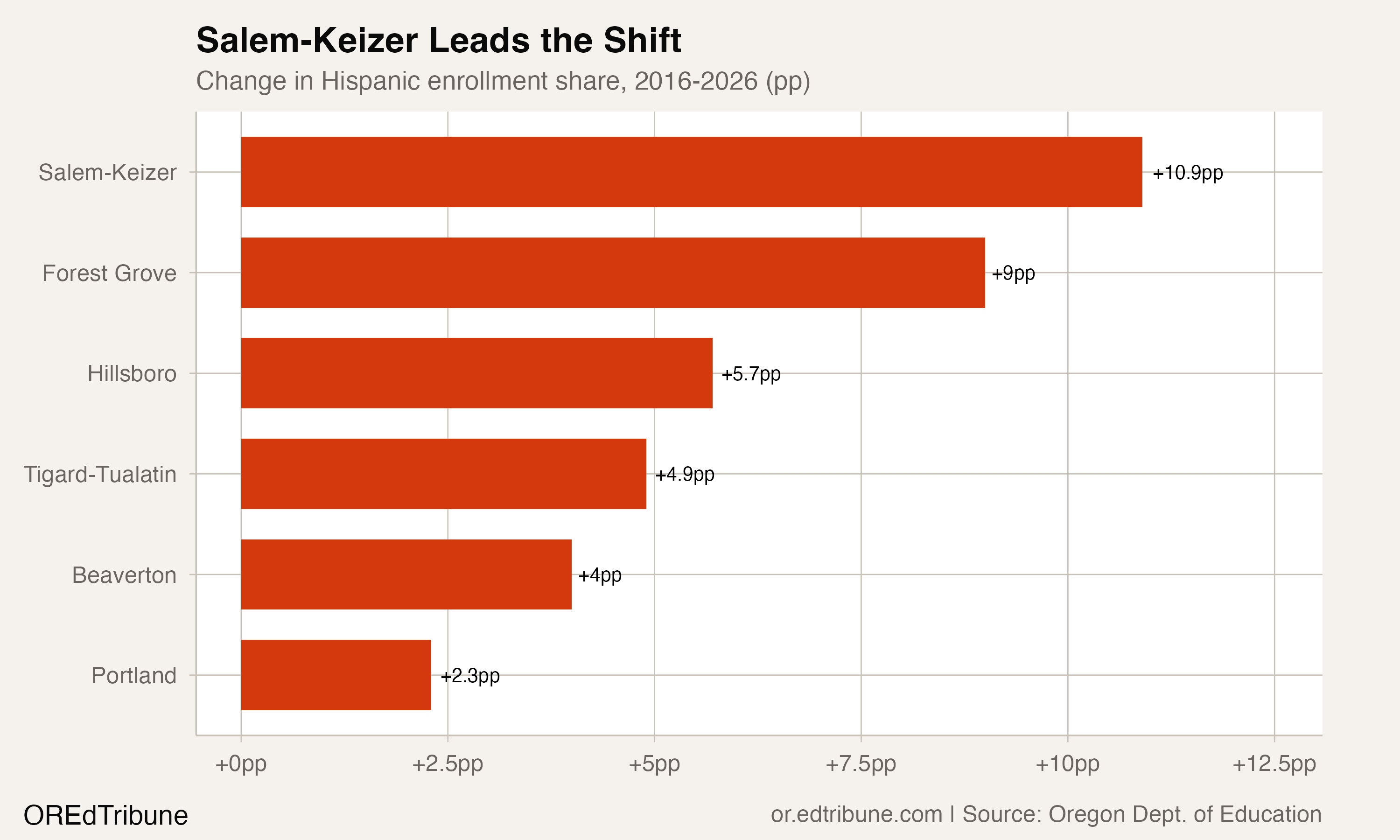
Salem-Keizer is not alone in this transformation, but it is leading it. Among large Willamette Valley districts, its Hispanic share grew by 10.9 percentage points since 2016, nearly double the gain in Hillsboro (+5.7pp) and Beaverton (+4.0pp). Forest Grove, a smaller district, gained 9.0 points but was already majority-Hispanic in 2016.
The Pacific Islander dimension
One demographic group growing even faster than Hispanic students in Salem-Keizer is Pacific Islanders. Their enrollment rose from 867 to 1,253, a 44.5% increase, and their share climbed from 2.1% to 3.4%. In a district of 36,661, that makes Salem-Keizer home to one of the largest Pacific Islander student populations in the Pacific Northwest.
Much of this growth is tied to the Marshallese community. Citizens of the Marshall Islands can live and work in the United States without a visa under the Compact of Free Association, which became law in 1986. Oregon has become a major mainland destination. The Oregon Marshallese Community Association, based in Salem, was established in 2019 to provide educational, cultural, and healthcare support.
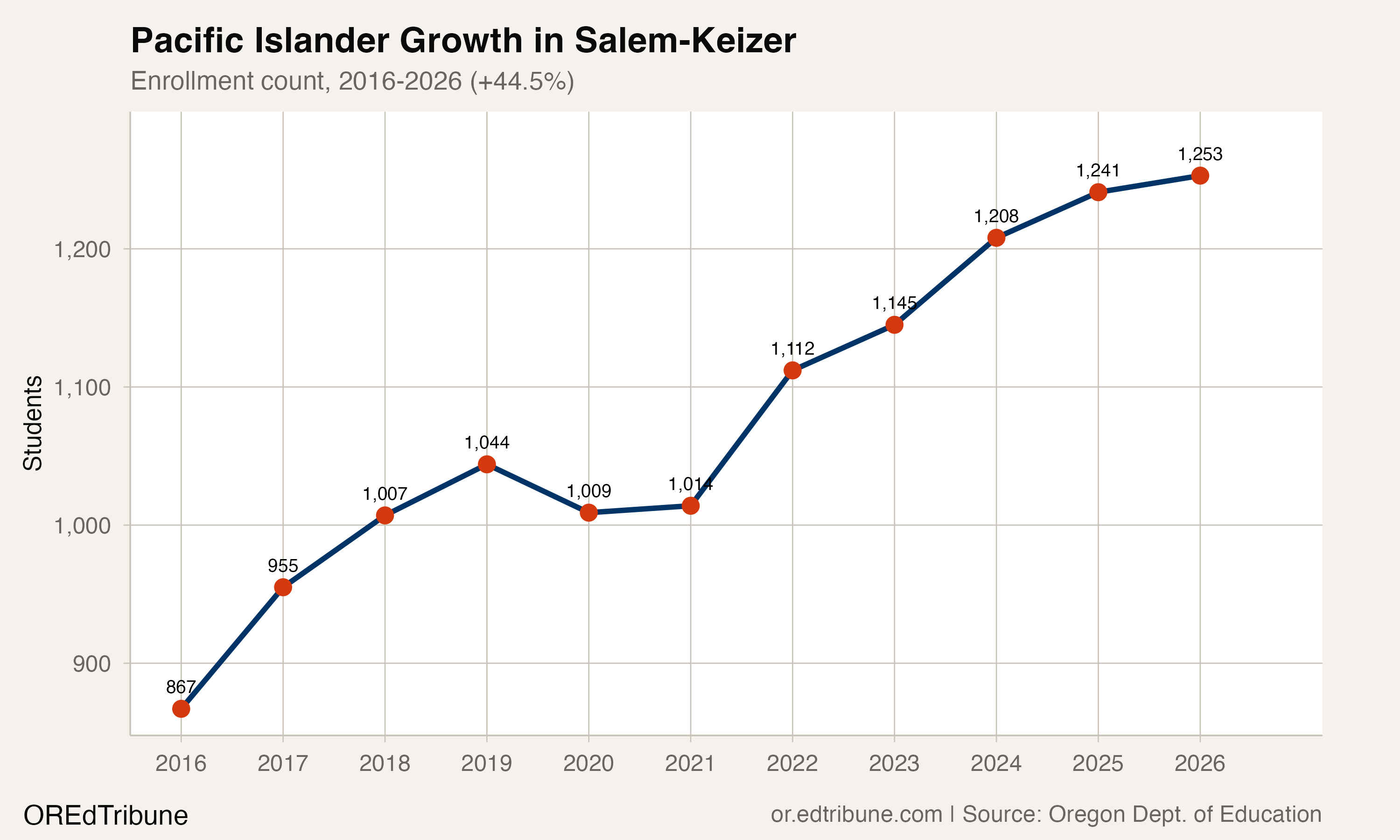
Salem's Pacific Islander community grew 62% in the 2020 Census, reaching 2,293 residents citywide. School enrollment data suggests the pace has not slowed.
Eight years of shrinking, and accelerating
The demographic transformation is unfolding against a backdrop of sustained enrollment decline. Salem-Keizer peaked at 41,918 students in 2018 and has fallen every year since, an eight-year losing streak. The losses are accelerating: the district shed 1,309 students in 2026 alone, a 3.4% single-year drop and the steepest in the dataset. The COVID year of 2021 saw a larger absolute loss (1,878) but the post-pandemic losses have not reversed.
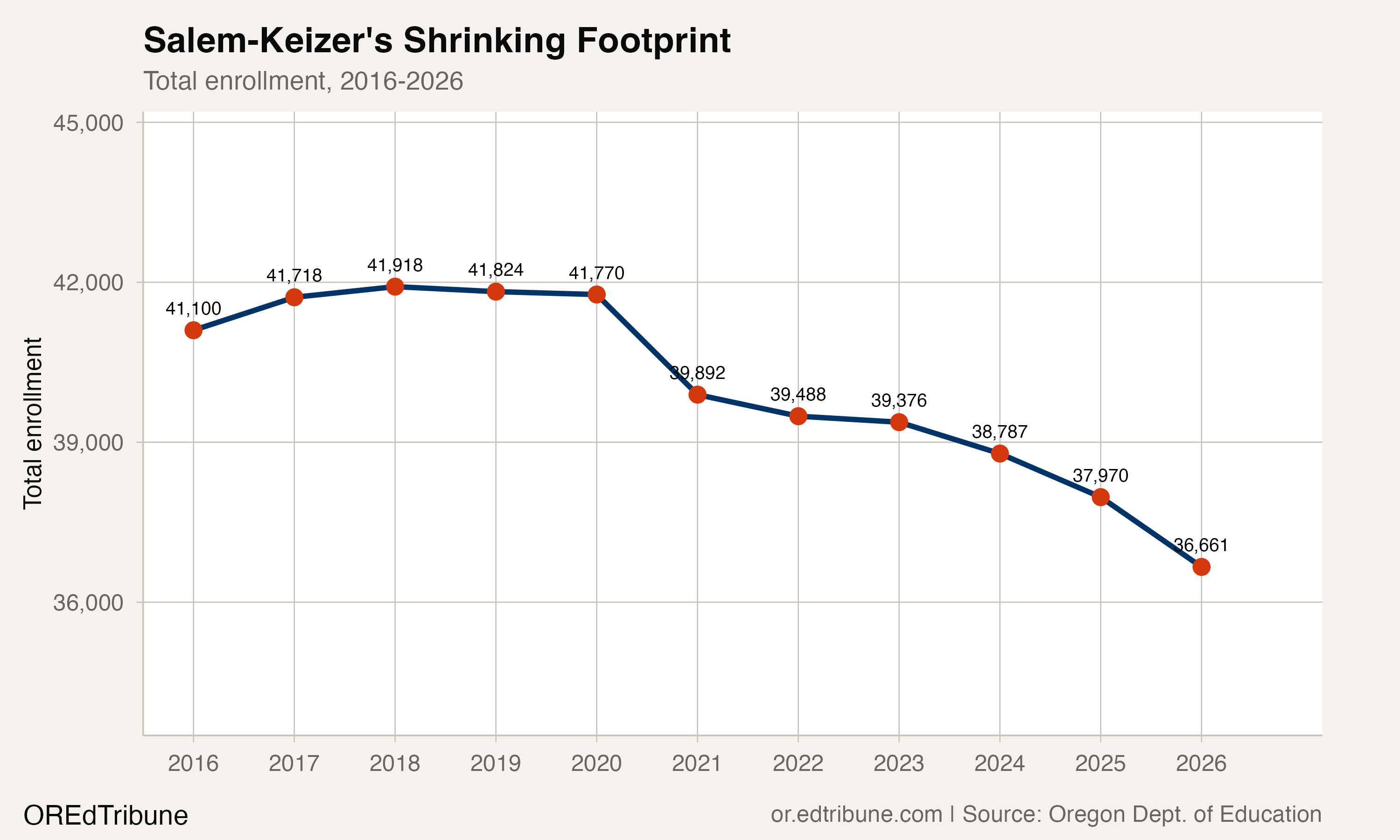
Kindergarten enrollment tells the pipeline story. Salem-Keizer enrolled 3,086 kindergartners in 2016. In 2026, it enrolled 2,284, a 26% decline. That shrinking entry cohort will work its way through the system for the next 12 years, locking in further enrollment loss even if no additional families leave.
The district is already bracing for the fiscal consequences. In February 2026, Salem-Keizer announced $23 million in proposed budget cuts, including 60 teaching positions and 60 classified staff roles. Superintendent Andrea Castaneda framed the cuts as proactive: "Salem-Keizer is not in financial crisis. We're getting ahead of a predictable problem, so that we do not start burning our reserves too early." Projections show another 4,500 students leaving by 2030.
The district also made deep cuts in 2024, eliminating roughly 400 positions in a $40 million reduction. The year before that, the district announced layoffs in December 2023. Three consecutive years of significant staffing reductions reflect the compounding pressure of Oregon's per-pupil funding formula: each departing student takes state dollars with them.
A district adapting to who it serves
Salem-Keizer has responded to its demographic reality more aggressively than most Oregon districts. The district now offers dual language instruction at 24 of its 65 schools, spanning elementary through high school. In 2023 alone, 11 schools added new dual language programs. The two-way immersion model pairs native Spanish speakers with native English speakers, beginning with 80% Spanish instruction in early grades and reaching a 50-50 balance by fourth grade.
That expansion signals an institutional recognition: Salem-Keizer's student body is not temporarily diverse. It is structurally, permanently transformed. But the 2026 budget cuts eliminated teaching positions at schools where those dual language programs run. At McKay High School, where 61% of students are Hispanic, the district cut counselor positions even as the student body it serves becomes more linguistically complex. The programs and the budget are moving in opposite directions.
What the data cannot answer
Enrollment data shows who is in the system. It does not explain who left or why. The 7,645 white students who disappeared from Salem-Keizer's rolls between 2016 and 2026 may have moved out of the district, enrolled in private schools, shifted to homeschooling, or aged out of the system as smaller white kindergarten cohorts replaced larger graduating classes. The data cannot distinguish among these pathways, and any single explanation is almost certainly incomplete.
The Hispanic growth, likewise, reflects some combination of new families arriving in the Willamette Valley, higher birth rates among resident Hispanic families, and possibly improved enrollment of children who were previously uncounted. Statewide, Oregon's Department of Education has estimated that roughly 20,000 students left public K-12 enrollment for other settings or dropped out of education entirely during and after the pandemic. Whether those losses fell disproportionately on white families in Salem-Keizer is plausible but unconfirmed.
The approach to 50%
One complication: in 2026, Hispanic enrollment actually fell in absolute terms for the first time, from 18,096 to 17,624 students. The share still rose because total enrollment fell even faster. If Hispanic headcount continues to decline alongside white enrollment, the 50% crossing may be driven more by who is leaving than by who is arriving. At its recent pace of roughly 0.7 percentage points per year in Hispanic share gain, Salem-Keizer could cross the 50% threshold within two to three years. That would make it the largest majority-Hispanic district in Oregon. Woodburn (86.5% Hispanic), Hermiston (63.6%), and Forest Grove (59.6%) already hold that distinction, but the largest of those three enrolls only 5,107 students. Salem-Keizer, at 36,661, would be a different kind of milestone: a state capital school district where Hispanic students are the outright majority, more than six times the size of any current majority-Hispanic district in the state.
Whether that crossing carries practical consequences depends on what the district does between now and then. The dual language expansion suggests institutional preparation. The budget cuts suggest fiscal strain pulling in the opposite direction. The next few kindergarten cohorts will determine whether Salem-Keizer stabilizes above 35,000 students or continues sliding toward 30,000, and whether the district that serves Oregon's capital can sustain the programs its increasingly diverse student body needs.
Detailed code that reproduces the analysis and figures in this article is available exclusively to EdTribune subscribers.
Discussion
Sign in to join the discussion.
Loading comments...