No single racial group makes up more than 30% of enrollment in David Douglas SD 40↗ET. Hispanic students account for 29.6%, white students 28.7%, Asian students 15.6%, Black students 13.4%. It is the most racially diverse school district in Oregon by Shannon diversity index, a statistical measure of how evenly a population is distributed across groups.
It is also shrinking fast. David Douglas has lost 2,219 students since 2010, a 20.6% decline, triple the 7.0% statewide average over the same period. The district that once served as east Portland's primary landing zone for immigrant and refugee families now enrolls fewer students than at any point in the dataset.
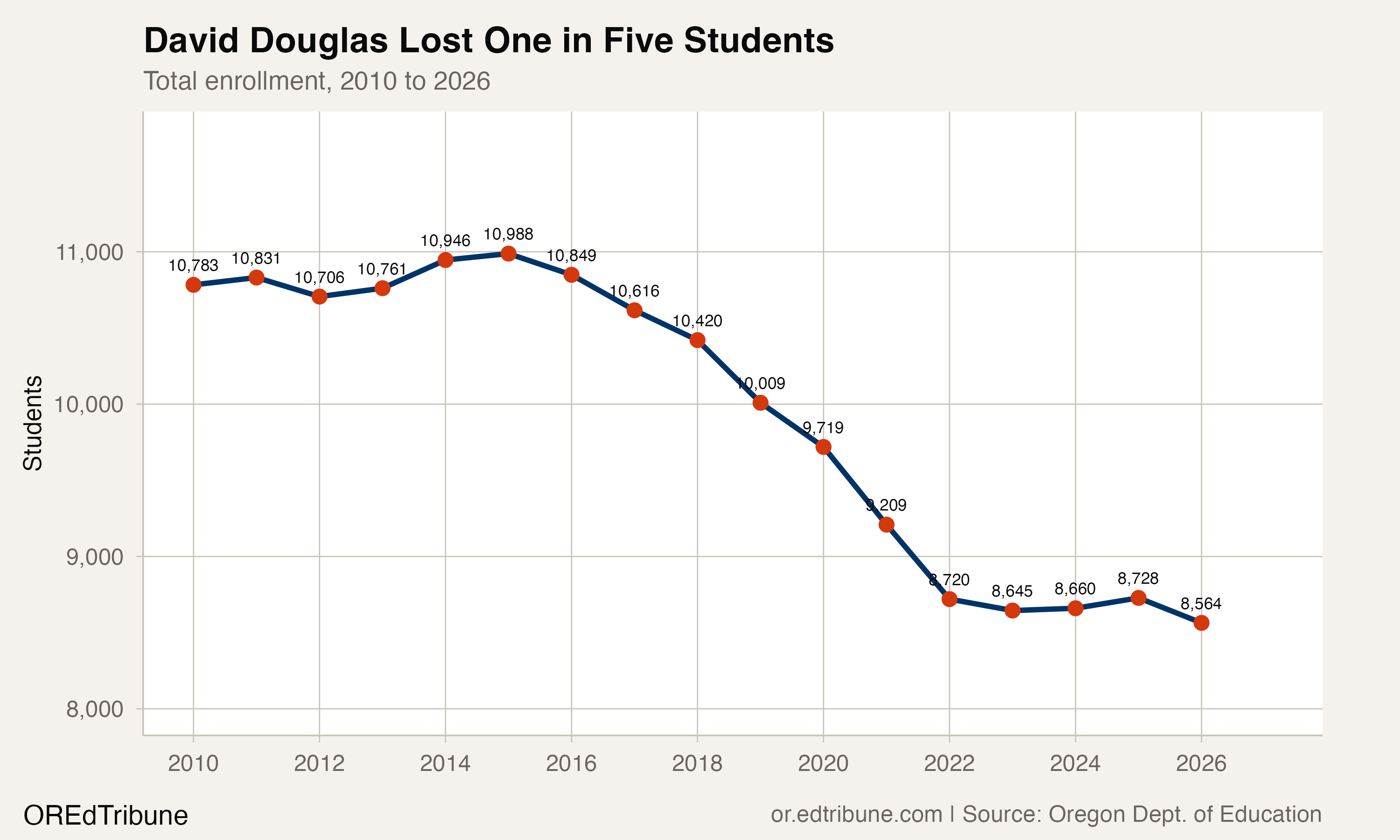
A district that diversified by disappearing
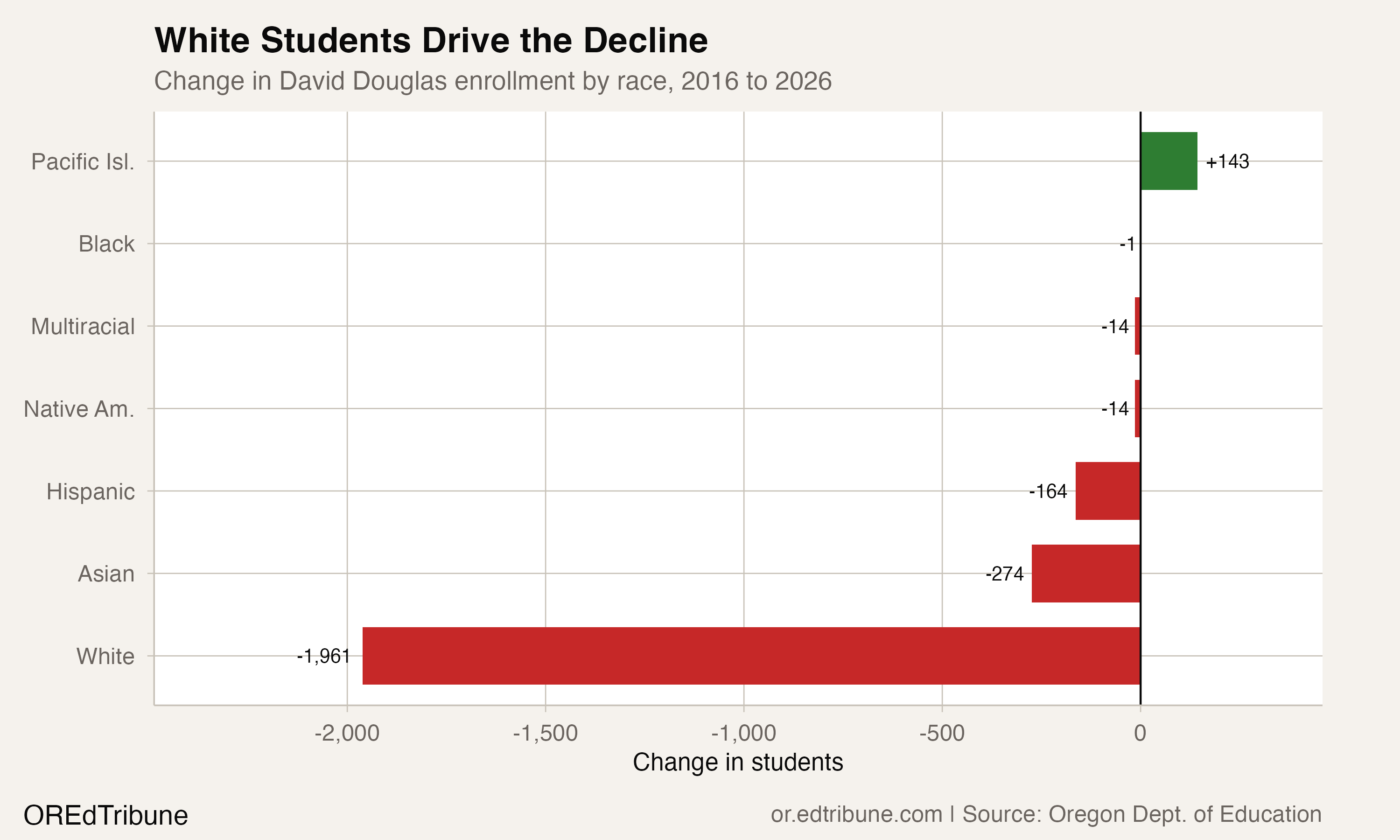
The paradox of David Douglas is that it became Oregon's most diverse district not by adding new groups but by losing its largest one. White enrollment fell from 4,419 in 2016 to 2,458 in 2026, a 44.4% decline that accounts for 85.8% of all students lost over that period. The statewide white enrollment decline was 16.3% over the same years. David Douglas lost white students at nearly three times the state rate.
Black enrollment held essentially flat, dropping by a single student. Multiracial enrollment barely budged. Hispanic enrollment fell by 164, a 6.1% decline, modest relative to the white exodus. Asian enrollment dropped by 274, a 17.0% loss.
One group grew: Pacific Islander students nearly doubled, from 153 to 296, a 93.5% increase. Portland's Micronesian and Marshallese communities, served by organizations like the Immigrant and Refugee Community Organization's Pacific Islander and Asian Family Center, have concentrated in east Portland neighborhoods within the David Douglas boundary.
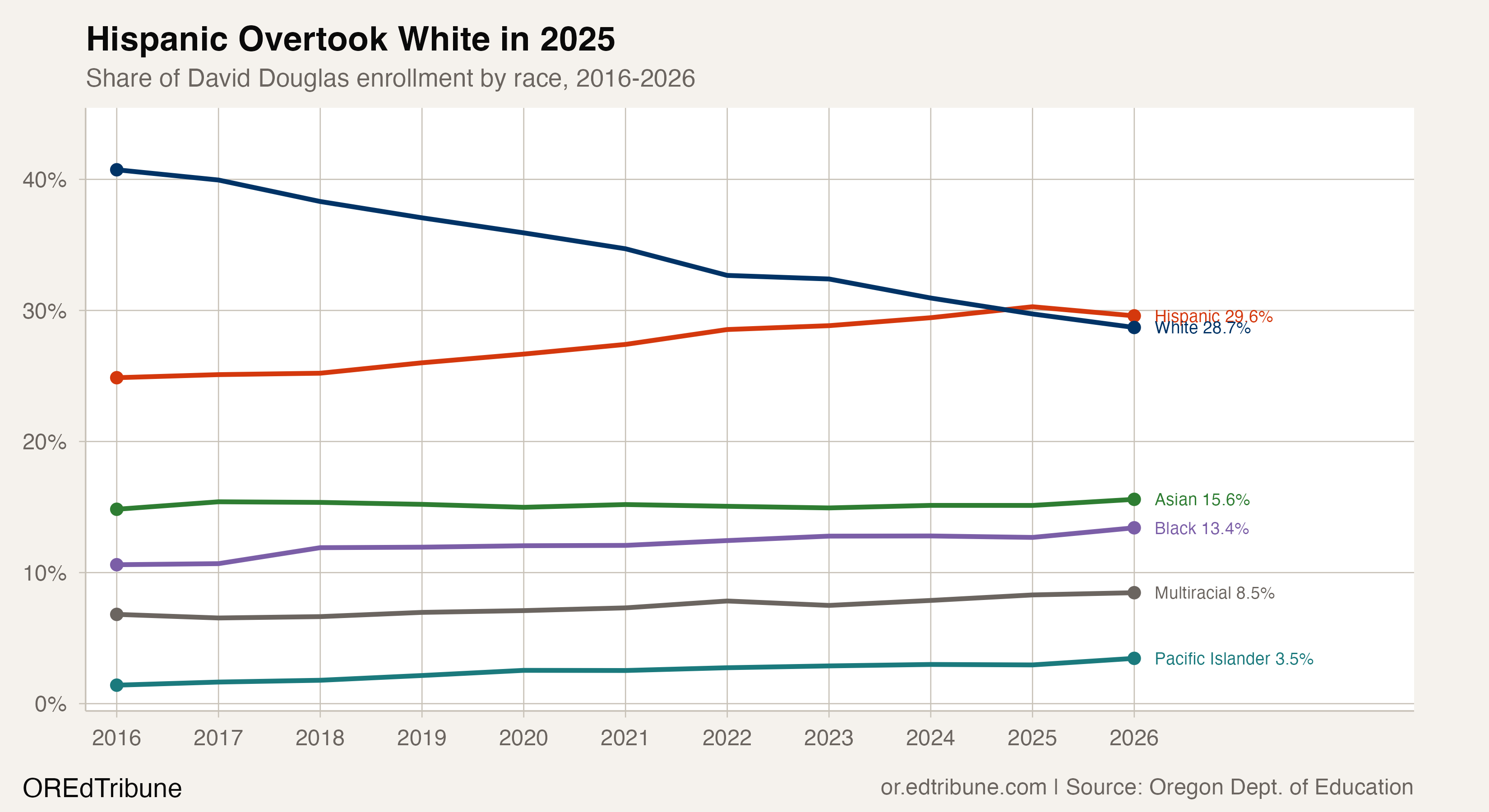
The crossover came in 2025: Hispanic students (2,643) surpassed white students (2,595) as the plurality group for the first time. In 2026, the gap widened to 76 students.
The Shannon diversity index, which measures how evenly enrollment is spread across racial groups (higher values mean no single group dominates), has climbed every year. It rose from 1.512 in 2016 to 1.641 in 2026. David Douglas is more diverse than Parkrose (1.610), Centennial (1.553), Reynolds (1.492), and Beaverton (1.442), all of which serve far more students.
The housing pressure underneath the numbers
The enrollment data cannot explain why families left, but the pattern, concentrated white losses in an east Portland district with historically lower rents, is consistent with the displacement dynamics documented across the Portland metro area.
East Portland, including the David Douglas boundary, was for decades the affordable corner of the metro area. A Willamette Week profile described the area as a magnet for successive waves of immigrants:
"Students here speak more than 55 languages, and almost half started school speaking little or no English." -- Willamette Week
Portland's 2024 State of Housing report found that rents and home prices continue rising faster than incomes, that half of all Portland renters are cost-burdened, and that the average Black household could afford a two-bedroom unit in only one neighborhood area: 122nd-Division, which falls squarely within David Douglas's boundaries. Eviction filings in Multnomah County nearly doubled from 5,904 in 2019 to 11,761 in 2024.
Whether white families specifically left because of rising housing costs, declining birth rates, or decisions about school quality is impossible to isolate from enrollment data alone. Oregon's birth rate has been falling for years, a trend that OPB reported has contributed to the loss of more than 37,000 students statewide since 2020. Each of these mechanisms could explain part of the decline. The disproportionate white losses in David Douglas compared to the state average, however, suggest something beyond statewide demographics is at work.
Worst among its neighbors
David Douglas's 21.1% loss since 2016 is the steepest among east Portland metro districts. Parkrose lost 18.4%, Reynolds 17.3%, Centennial 15.4%, Portland 13.0%, and Gresham-Barlow 6.8%. All six districts declined. None came close to the state average of -7.0%.
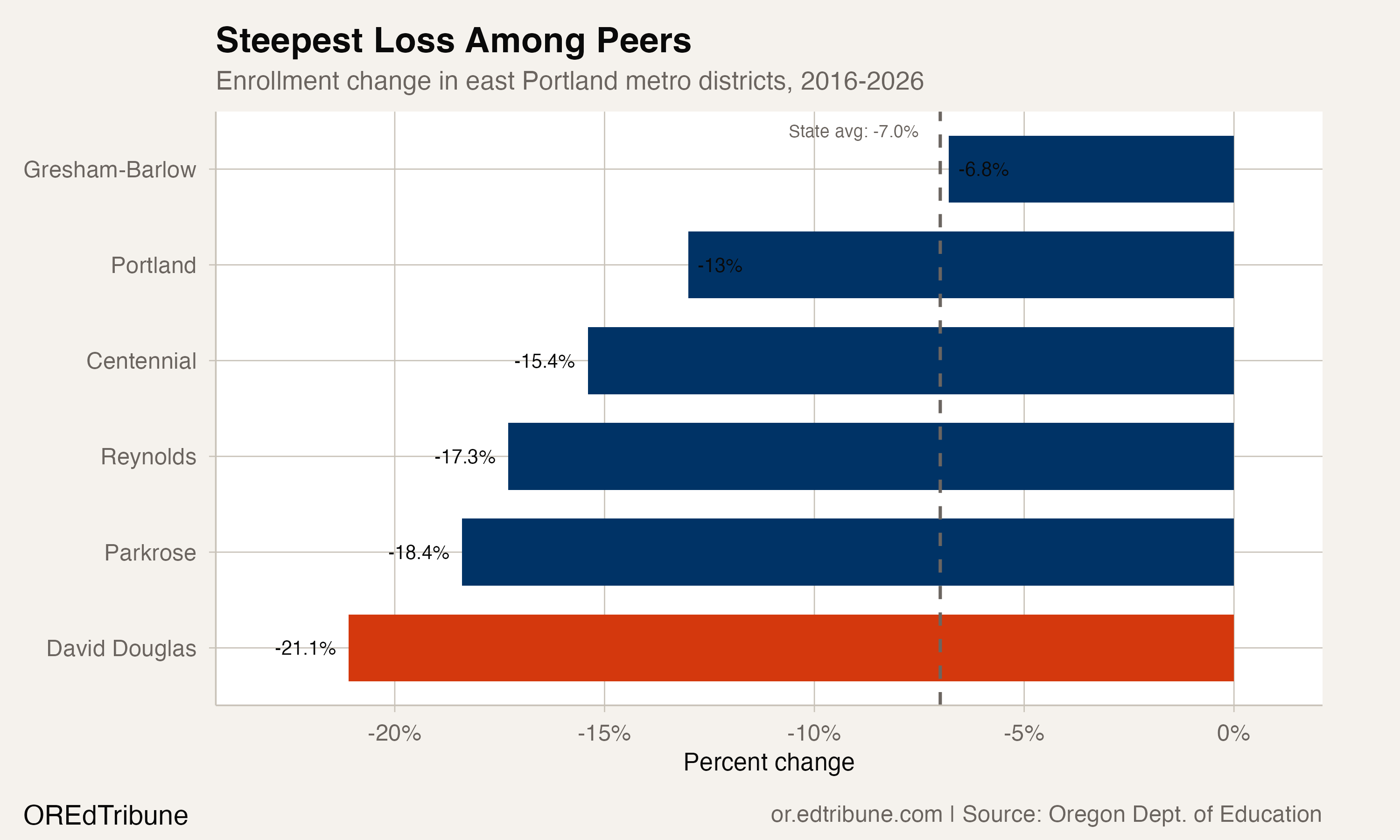
The east Portland metro corridor, stretching from inner Portland through David Douglas, Parkrose, Reynolds, and Centennial into Gresham-Barlow, has lost a combined 12,978 students since 2016. David Douglas alone accounts for 17.6% of that total despite enrolling only 10.8% of the corridor's 2016 students.
The budget follows the students
Each lost student represents roughly $14,000 in per-pupil funding to Oregon schools. For David Douglas, losing 2,285 students since 2016 means a revenue gap of approximately $32 million annually in current per-pupil terms. The consequences are concrete: in spring 2025, the district cut four graduation mentor positions and nine full-time-equivalent teaching positions at David Douglas High School, the largest high school in Oregon.
"Tough decisions, tough times." -- David Douglas Superintendent Ken Richardson, OPB, May 2025
The graduation mentors had each managed roughly 50 active students and monitored 50 more. The cuts came as the district's graduation rate, which had climbed to 86% for the Class of 2020, fell to 70% for the Class of 2024.
The pipeline does not suggest a turnaround
Kindergarten enrollment in David Douglas peaked at 946 in 2014. In 2026, it was 569, a 39.9% decline. The 2026 class tied 2021 as the smallest kindergarten cohort in the dataset. Those 569 kindergartners will define the district's total enrollment for the next 12 years as they move through the system.
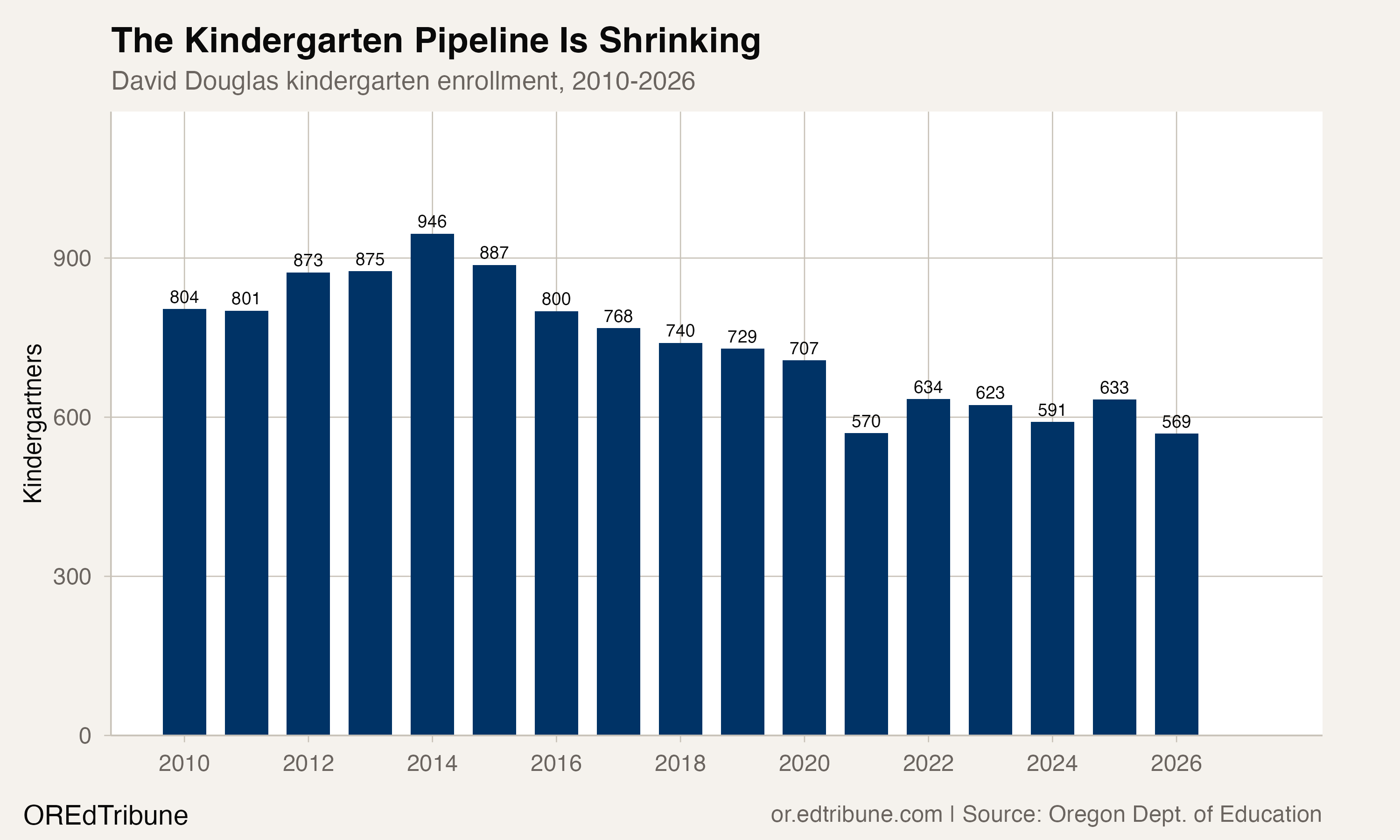
The brief recovery in 2022 and 2023, when kindergarten bounced back above 620, proved temporary. The 2026 figure wiped out those gains and set a new floor.
Portland State University's enrollment forecast for David Douglas projected continued decline through 2040. The four graduation mentors who were cut last spring had each carried caseloads of 50 active students. The graduation rate fell 16 points in four years. David Douglas High School, the largest in Oregon, now runs those 3,400 students through a building designed for more, with fewer adults in the hallways to notice when someone stops showing up.
Detailed code that reproduces the analysis and figures in this article is available exclusively to EdTribune subscribers.
Discussion
Sign in to join the discussion.
Loading comments...