Portland, Salem-Keizer, Beaverton, Hillsboro, Eugene, Tigard-Tualatin, and Gresham-Barlow range from urban Portland to college-town Eugene to the suburban ring communities between them. In 2025-26, all seven are at the lowest enrollment levels recorded in at least 17 years of state data. They are not alone. Seventy-four of Oregon's 209 school districts are at all-time lows in 2025-26. Those 74 districts collectively enroll 325,377 students, 60.7% of the state's public school population.
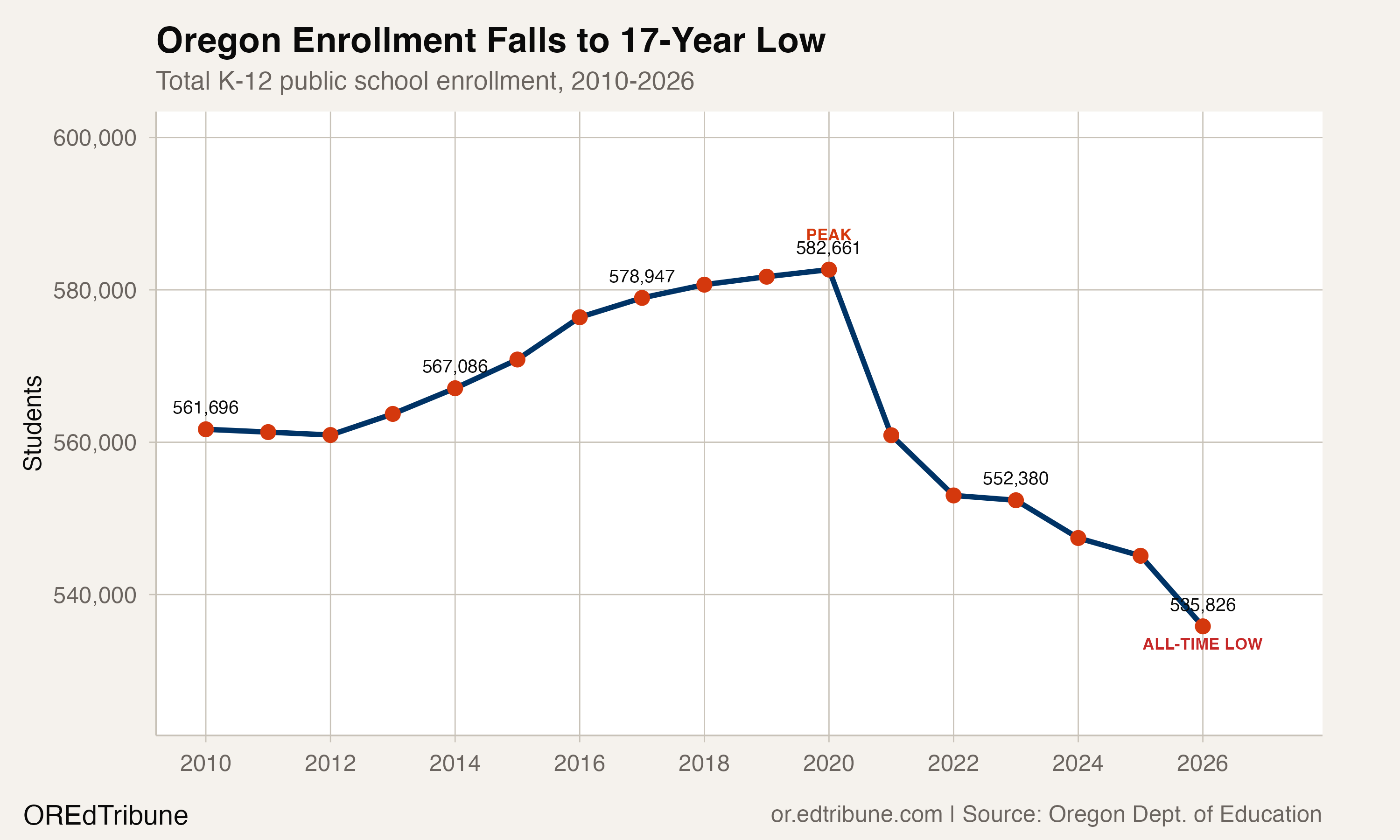
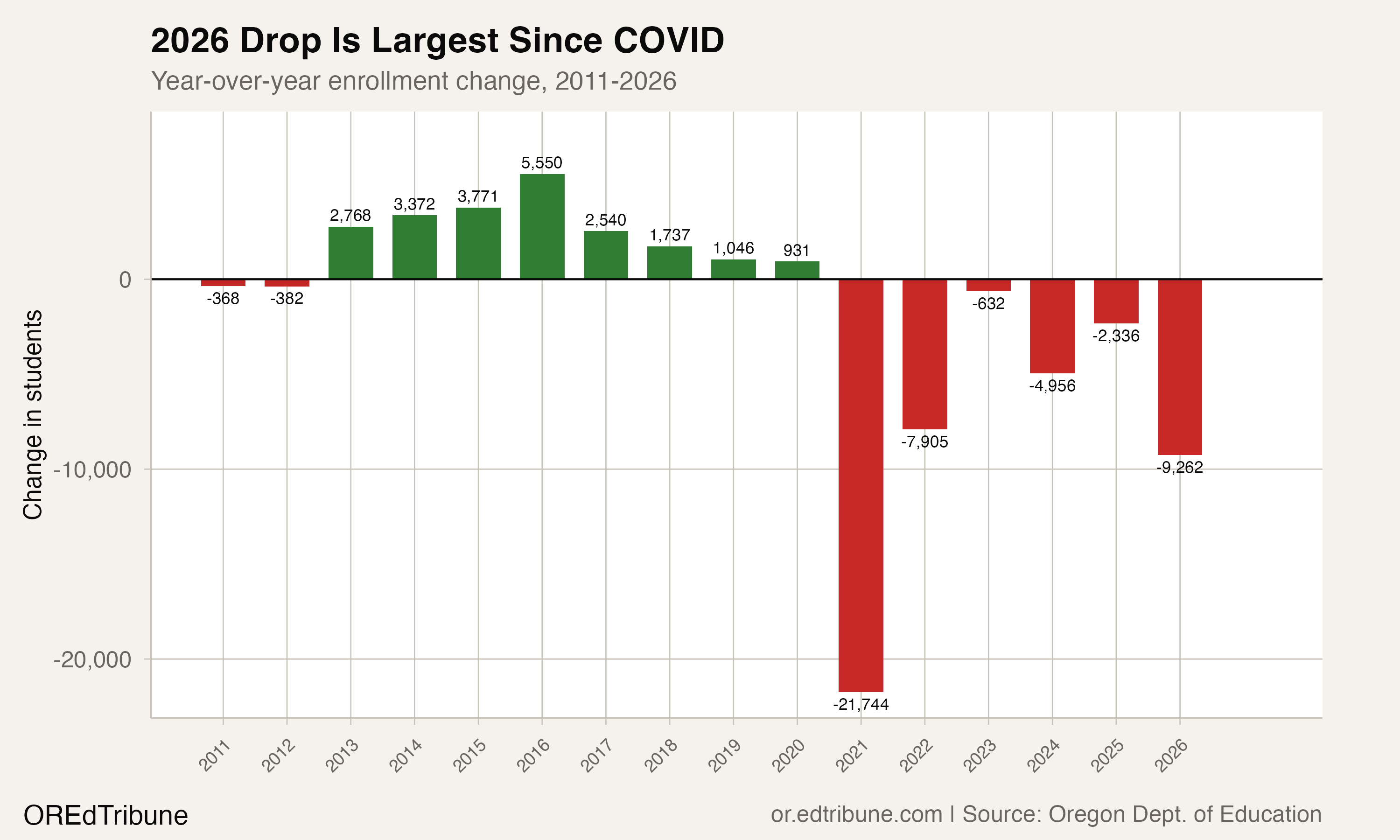
Oregon's enrollment has been falling since its 2020 peak of 582,661. The 2025-26 total of 535,826 represents a loss of 46,835 students, an 8.0% decline in six years. What makes 2025-26 different is the pace: the single-year drop of 9,262 students is the largest since the pandemic's initial shock in 2021, and nearly four times the 2,336-student loss recorded the year before.
Not just the big districts
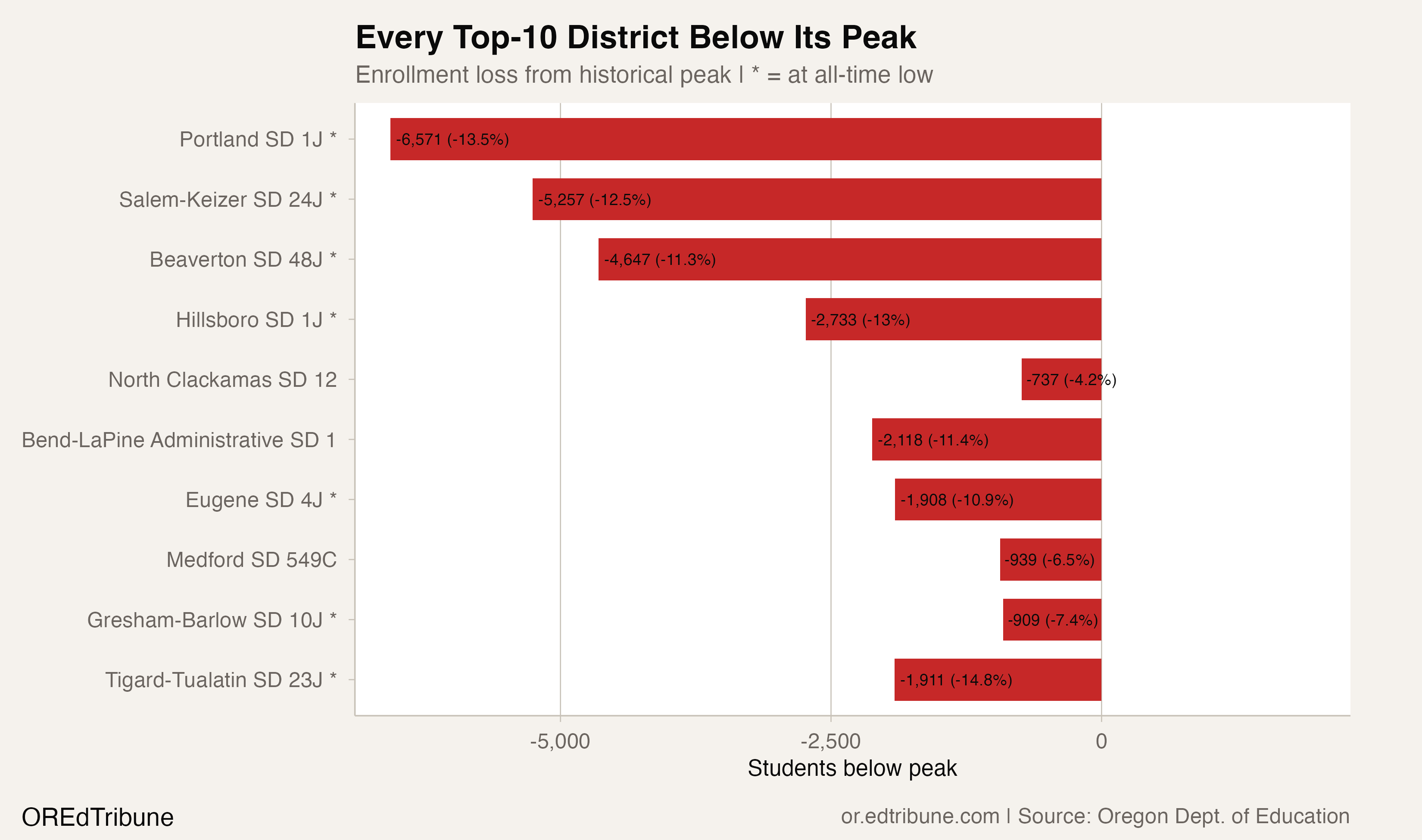
The concentration at the top is striking. Seven of Oregon's 10 largest districts are at all-time lows simultaneously. Portland has lost 6,571 students since its 2019 peak of 48,677, a 13.5% decline. Salem-Keizer is down 5,257 from its 2018 high, 12.5%. Beaverton has shed 4,647 students since 2020, 11.3%.
The three top-10 districts not at their all-time lows are close: North Clackamas is 409 students above its 2021 floor, Bend-LaPine is 710 above its 2010 level, and Medford is 1,467 above its 2010 count. All three declined in 2026.
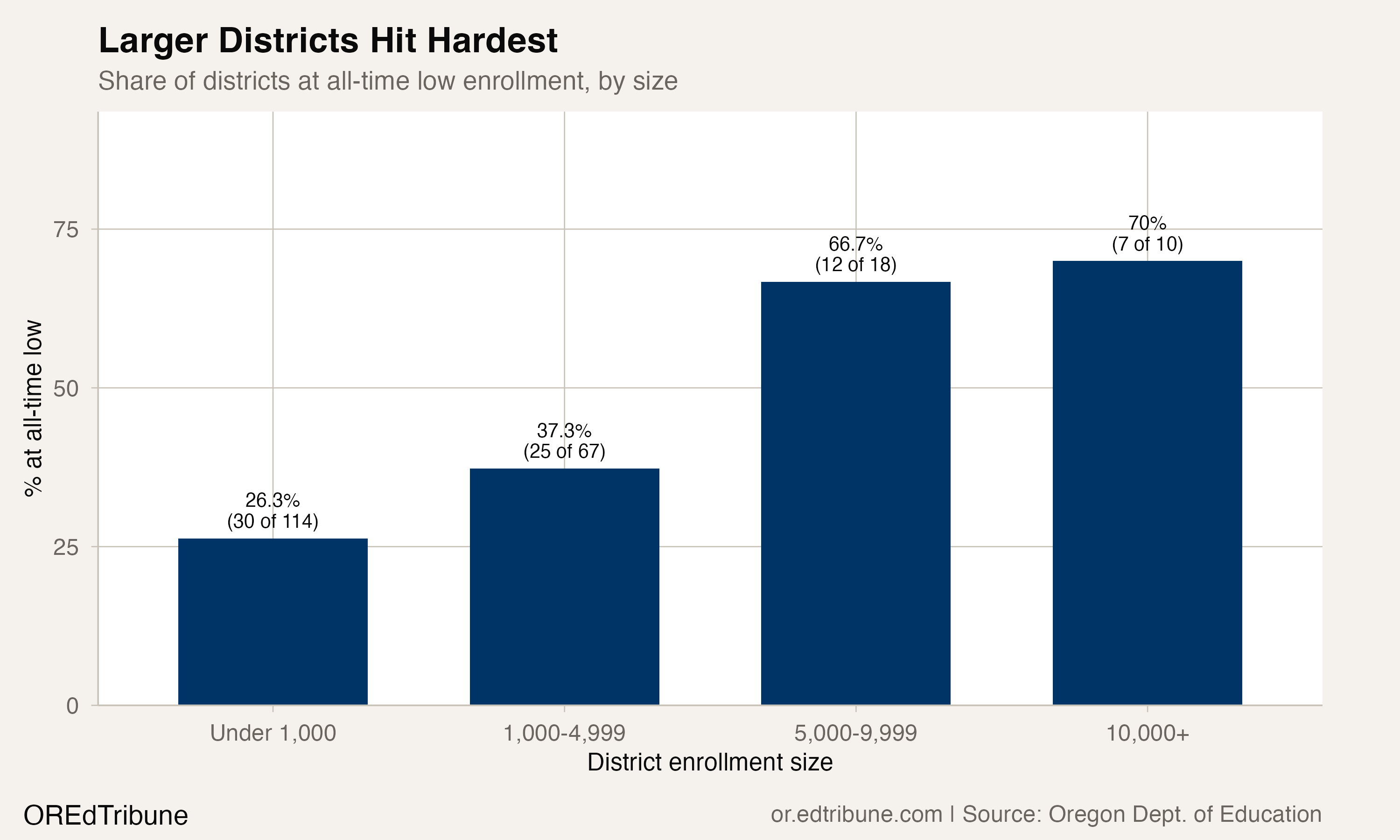
The pattern scales. Among districts enrolling 10,000 or more students, 70% are at record lows. Among mid-size districts (5,000 to 9,999), the figure is 66.7%. Even among the smallest districts, where year-to-year noise is greater, 26.3% are at their floor.
Across all size categories, 148 of 208 districts with comparable data declined between 2025 and 2026. Only 55 grew. The remaining five were flat.
The acceleration
For two years, Oregon's enrollment losses appeared to be moderating. The 2023 drop was just 632 students, small enough to raise hope of stabilization. Then 2024 brought a 4,956-student loss, and 2026 quadrupled the 2025 figure.
The largest single-year losses in 2026 came from the Portland metro area. Salem-Keizer lost 1,309 students (-3.4%), Beaverton lost 1,258 (-3.3%), and Portland lost 1,213 (-2.8%). Those three districts alone account for 40.8% of the state's net decline.
Further down the list, Springfield lost 488 students (-5.3%), Tigard-Tualatin lost 476 (-4.2%), and Ashland lost 346, a 13.6% single-year drop.
Where growth exists, it is largely a mirage
Nineteen districts reached all-time highs in 2026. The list includes Baker (5,867 students), Scappoose (3,636), Fossil (3,312), Mitchell (1,807), and Prairie City (1,567). Most of these gains trace to virtual charter schools hosted by small rural districts. Baker Web Academy alone enrolls 3,752 students; Fossil Charter School accounts for all 3,312 of Fossil's enrollment. Scappoose Online Academy added 1,412. At least 10 of the 19 "all-time high" districts host statewide virtual programs whose students live elsewhere.
The largest gainers in absolute terms tell the same story. Scappoose added 1,358 students year-over-year, nearly all from its online academy. Fossil added 818. Baker added 666. These numbers partially offset losses in the statewide total, but they reflect a shift in where students are counted, not a reversal of the underlying decline.
What is pushing enrollment down
Oregon had the fifth-lowest birth rate in the nation in 2023, at nine births per 1,000 residents. Deaths have already overtaken births in the state. The kindergarten pipeline makes the downstream effects visible: Oregon enrolled 42,322 kindergartners in 2020. In 2026, that number is 34,490, an 18.5% decline. The children born during the pandemic's lowest birth years are now entering kindergarten.
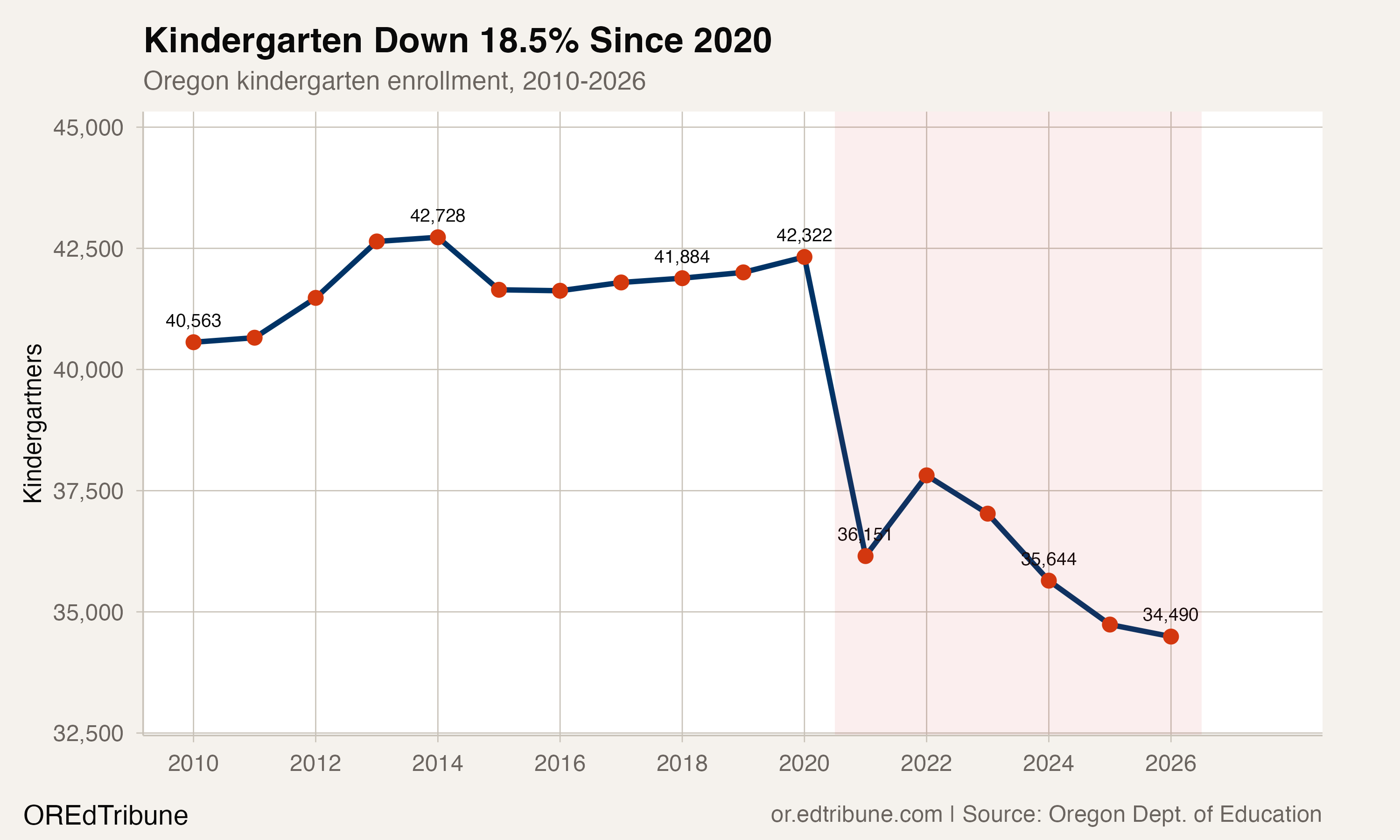
Salem-Keizer's chief operations officer Paul Odenthal put the arithmetic plainly: "Right now we're graduating 3,500 kids and we're bringing in 2,500 kindergarteners." The district expects to lose 4,500 more students by 2030.
Birth rate decline is the most widely cited mechanism, and the kindergarten data supports it as a primary driver. But it does not fully account for the losses. A WICHE report projects Oregon's high school graduates will decline 19% by 2041, a trajectory that incorporates flat graduation rates alongside shrinking cohorts.
The pandemic also accelerated departures from the public system. Homeschooling registrations increased 72% in the pandemic's first two years, according to the Oregon Department of Education, and not all of those families returned when classrooms reopened.
Housing costs are a contributing factor whose precise weight is difficult to measure. Oregon's housing prices outpaced incomes for four decades, and during the 2024-25 school year, more than 21,000 students statewide, roughly 4% of total enrollment, were identified as eligible for McKinney-Vento services due to housing instability.
The budget math
Because Oregon funds schools on a per-pupil basis, every lost student reduces revenue. Portland Public Schools is cutting $40 million and approximately 230 positions for the 2025-26 year, with a projected $50 million shortfall looming for 2026-27. Superintendent Kimberlee Armstrong has described three consecutive years of structural deficits.
Salem-Keizer is cutting 120 teacher and classified positions as part of $23 million in reductions. District officials are not planning school closures for the coming year but have indicated consolidation is "a very viable option" going forward.
The 2025 Legislature approved a record $11.4 billion for the 2025-27 biennium, an 11% increase. Even so, pension cost increases through PERS and rising operational expenses have erased much of the new funding in districts where enrollment is falling.
What 74 record lows look like on the ground
Ashland lost 346 students in a single year, a 13.6% drop, and is now smaller than it has been at any point in the dataset. Ashland's school board approved a $2.2 million budget reduction for 2025-26, eliminating teaching positions in a district that already runs some of the smallest class sections in southern Oregon.
Seventy-four districts at record lows is not a statistic. It is 74 school boards holding budget workshops, 74 superintendents explaining to parents why the reading specialist position will not be filled, 74 transportation directors wondering whether a bus route that carries nine students still makes financial sense. The children who will enter kindergarten in 2028 and 2029 were born during the period when Oregon's birth rate hit its lowest recorded levels. The floor these districts are standing on has more room to give.
Detailed code that reproduces the analysis and figures in this article is available exclusively to EdTribune subscribers.
Discussion
Sign in to join the discussion.
Loading comments...