Correction (July 21, 2026): An earlier version called Redmond's gain Oregon's largest among larger districts without executing the statewide comparison needed to support that claim. It also misstated when Redmond first exceeded the state rate, said its advantage widened continuously, and described cohort counts as remaining above a level the package does not support. This version removes those claims and rebuilds the article from the 11 observations returned by the Oregon package.
Redmond SD 2J↗ET reported a four-year graduation rate of 46.1% in 2010. Its 2025 rate was 91.2%, an endpoint increase of 45.1 percentage points.
The Oregon package reports 11 Redmond observations in the analysis panel, starting in 2010 and ending in 2025. The district's reported cohort count was 571 at the start and 683 at the end. The minimum reported cohort count in the panel was 563.
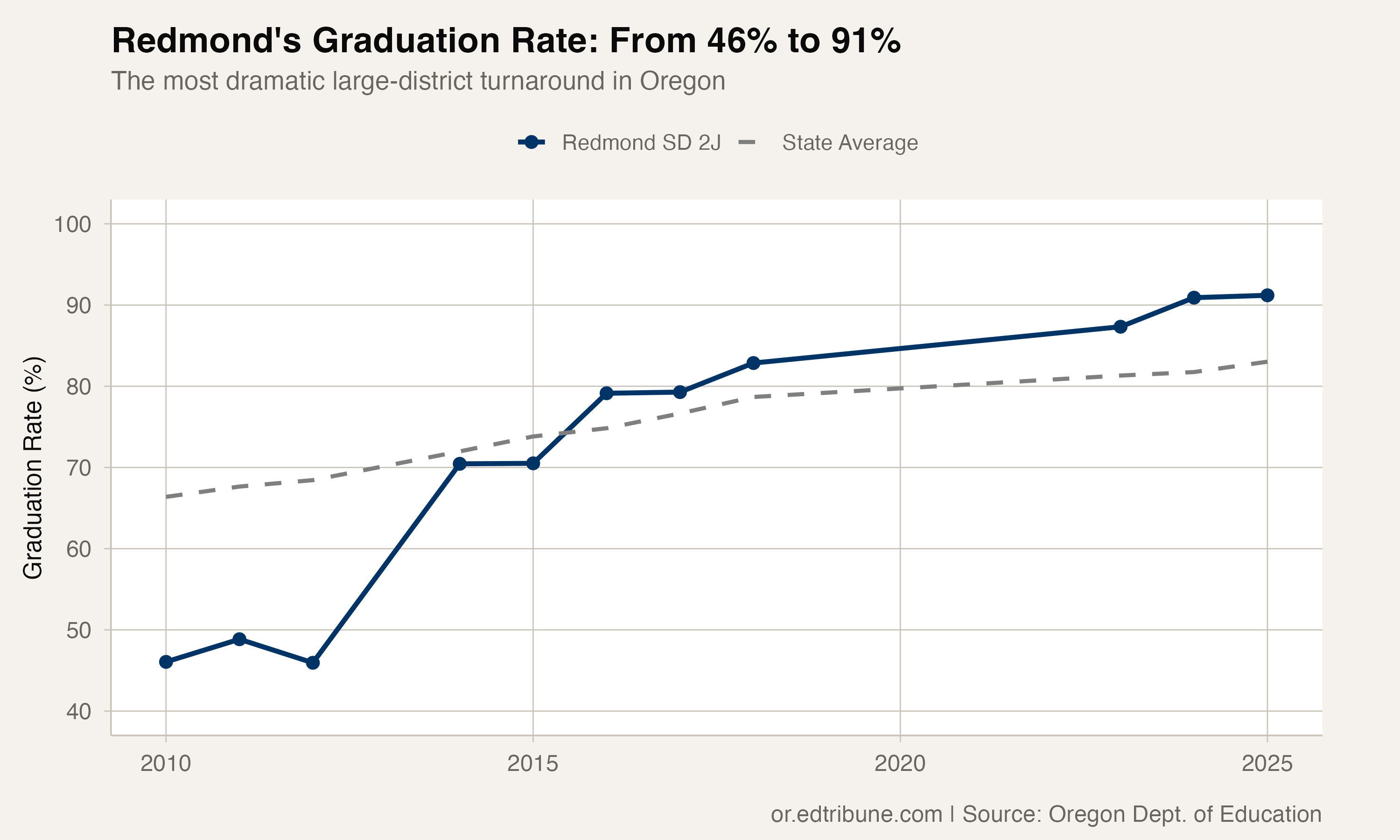
From 20 points below the state to eight points above
In 2010, Oregon's state row was 66.4%, putting Redmond 20.3 percentage points below it. In 2025, the state row was 83.0%, putting Redmond 8.2 points above it.
The crossover did not occur in 2015, as the earlier article stated. Redmond reported 70.5% in 2014 compared with 72.0% statewide, a 1.5-point deficit. In 2015, Redmond again reported 70.5% while the state row was 73.8%, a 3.3-point deficit.
The first published observation in the panel with Redmond above the state was 2016: 79.1% for the district and 74.8% statewide, a 4.3-point difference.
A panel with gaps
The early Redmond observations were 46.1% in 2010, 48.9% in 2011, and 46.0% in 2012. The panel then resumes at 70.5% in 2014.
Every one of the eight published transitions after the 2012 observation was an increase. The later reported rates were 79.3% in 2017, 82.9% in 2018, 87.3% in 2023, 90.9% in 2024, and 91.2% in 2025.
Those observations do not form an uninterrupted annual series. The package panel omits 2013 and the years from 2019 through 2022, so it can verify changes between published observations but not what happened in each missing year.
Redmond's advantage over the state also did not widen every year. The largest observed advantage was 9.2 points in 2024; it narrowed to 8.2 points in 2025.
Current subgroup rows
The 2025 all-students row reported 91.2% for a cohort of 683. White students reported 93.0% in a cohort of 486, while Hispanic students reported 84.6% in a cohort of 156. That 8.4-point difference was wider than the 4.6-point difference between Oregon's white and Hispanic state rows, which were 84.5% and 79.9%, respectively.
Redmond's economically disadvantaged row reported 85.6% in a cohort of 257. The special education row reported 79.3% in a cohort of 92, and the English learner row reported 70.3% in a cohort of 37.
Both Redmond's white and Hispanic rates were above their corresponding state rows. The package values establish those comparisons; they do not establish why the district's rate changed or which programs, funding decisions, or regional conditions contributed.
What the executed package supports
The defensible finding is substantial without a superlative: across the 11 observations available in the Oregon Department of Education graduation panel, Redmond rose 45.1 points from 46.1% to 91.2%. It first appeared above the state row in 2016, increased in every published transition after 2012, and ended 8.2 points above the state in 2025.
Detailed code that reproduces the analysis and figures in this article is available exclusively to EdTribune subscribers.
Discussion
Sign in to join the discussion.
Loading comments...